
Notice: I receive compensation if you buy something through affiliate links on this post. This does not change the price you would pay. As an Amazon Associate I earn from qualifying purchases.
You shaped it well.
It looked promising as it went into the oven.
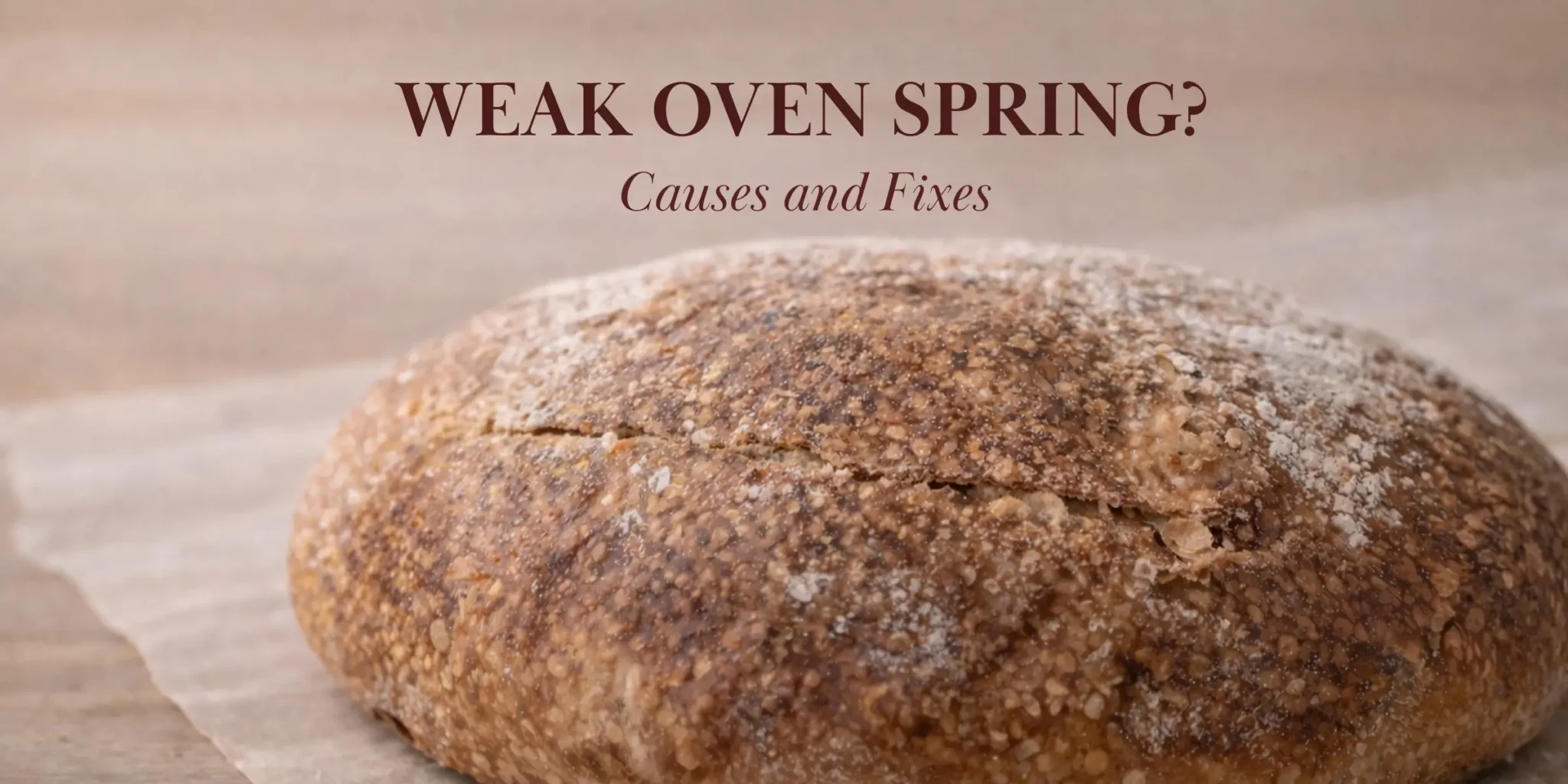
Then the score opened only a little.
The loaf baked lower than it should have.
Weak oven spring usually starts earlier than the bake itself.
Once you know what limited that early lift, the next adjustment is easier to make.
Fast Diagnosis
Signs of Weak Oven Spring
- Tight crumb and tearing → usually underproofed
- Low rise and weak bloom → usually overproofed
- Wide loaf and slack dough → usually weak dough strength
- Tight score with little opening → usually crust set too early
- Side burst and uneven lift → usually a scoring issue
Table of Contents
- 1 What Weak Oven Spring Looks Like
- 2 Weak Oven Spring vs Normal Oven Spring
- 3 What You See, What It Means, and What To Do Next
- 4 Cause 1 — The Problem Started Before Baking
- 5 Overcorrections That Make Weak Oven Spring Worse
- 6 Cause 2 — The Problem Happened In the Oven
- 7 What To Change On Your Next Bake
- 8 This Is How You Get the Spring Back
What Weak Oven Spring Looks Like
Weak oven spring has a visible pattern. The loaf does not gain much height in the oven, the score stays tight, or the expansion goes sideways instead of up.
Before you diagnose the cause, identify how the loaf baked.
The loaf baked low instead of lifting
This is the clearest sign of weak oven spring. The loaf went into the oven shaped well, but it did not rise much once the heat hit.
It bakes shorter through the center, with less height than you expected. Instead of looking fuller, it’s low and often looks broader than it should.
The score opened only a little
The loaf expanded, but not enough to create a strong bloom. The cut may separate a bit, but it’s narrow and tight instead of wider.
That signals that the loaf did not have enough upward push behind the score.
The problem is not just the cut itself. It is a limited expansion.
The loaf spread outward more than upward
Oven spring and dough structure are at play here. If the loaf widened more than it lifted, the dough did not hold expansion upward well.
Heat helps create oven spring, but structure helps direct it. When the loaf spreads instead of rising, the issue is often due to factors beyond oven temperature.
The loaf burst somewhere other than the score
Sometimes the loaf has pressure to expand, but it does not open where you planned. Instead, it tears at the side, near the base, or along another weak spot.
That tells you the score did not become the main release point. This is usually a scoring, crust setting, or dough strength issue.
Weak Oven Spring vs Normal Oven Spring
Not every loaf is supposed to spring dramatically. Some breads rise with a bold bloom and clear lift, while others bake with a quieter change.
The goal is to separate normal oven lift from a real problem so you do not overcorrect after one modest bread lift.
Not every loaf shows dramatic oven spring
Some loaves naturally rise less in the oven, even when the process was sound.
Pan loaves have side support, so the expansion looks more contained.
Enriched doughs usually bake with a softer, less dramatic lift because fat, sugar, eggs, or dairy change how they expand.
Some whole-grain loaves also rise less sharply because bran and germ can limit how far the dough stretches.
So a loaf does not need a dramatic ear or a big burst of height to be successful.
When a modest oven spring is normal
A modest oven spring is normal when the loaf holds its shape, the score opens enough to show controlled expansion, and the crumb feels light for that type of bread.
That is the key difference. A normal, quiet bake looks controlled.
A weak oven spring loaf stays low, opens poorly, or spreads, suggesting the dough did not hold and direct expansion well.
What You See, What It Means, and What To Do Next
Check how your loaf baked (shape, crumb, feel) and match the results to the most likely cause. Assess the entirety of the loaf, not just one factor, to avoid changing the wrong variable.
The score barely opened
This shows that the loaf had limited expansion or no clear path to open.
What you see
The score opened only a little. It remained narrow, shallow, or tight.
Likely causes:
- The dough is overproofed
- The score was too weak, too shallow, or poorly placed
- The crust set too early
Scoring gives the loaf a planned weak point. When that path is weak or missing, expansion is limited, and the loaf may split somewhere else.
What to check next
Check whether the dough felt very airy or fragile before baking, whether the cut was deep and well-placed, and whether the oven or vessel was fully preheated.
The loaf spread sideways instead of lifting
In this case, the dough expanded, but it did not hold and direct that expansion well.
What you see
The loaf baked wider and lower, rather than fuller through the center.
What it usually means
The dough lacked support before it went into the oven because of:
- Weak shaping,
- Not enough strength, or
- Overproofing
What to check next
Review how the dough behaved and felt before baking. Did it feel loose, flatten after turning out, or lose shape too quickly during proofing?
The loaf burst at the side or the bottom
This means the loaf had gas, but there was no clean path for its release.
What you see
The loaf tore at the side, near the base, or along another weak spot instead of opening at the score.
What it means
- The score was too shallow, misplaced, or missing
- The outer skin set too early
- The loaf still had pressure, but no clean opening path
What to check next
Check whether the score was well-placed for it to open cleanly, whether the surface firmed too fast early in the bake, and whether the loaf looked like it still has room to lift.
The loaf baked low, and the crumb was tight
This is the result of a loaf going into the oven lacking gas, strength, or gas retention.
What you see
The loaf is squat, feels heavy, and the slice shows small, closely packed holes.
It stems from:
- underfermentation
- weak gas retention
- not enough dough strength
What to check next
Did the dough stay dense and show limited bubbles during fermentation, or was it tight and prone to tearing during handling?
Why a Loaf Can Look Fine Before Baking but Still Have Weak Oven Spring
A loaf can look ready and still bake with weak oven spring. It needs enough gas, strength, and outer support when it goes into a hot oven.
If the dough is underfermented, overproofed, underdeveloped, or loosely shaped, it may not have enough support to open well and lift.
That is why a loaf can seem ready before baking, then still bake low, open poorly, or spread more than expected.
Cause 1 — The Problem Started Before Baking
Weak oven spring can stem from problems before baking. The dough went into the oven without enough gas, strength, or outer support to expand well.
The main pre-oven causes are underfermentation, not enough dough strength, and poor shaping tension.
Underfermented dough
Underfermented dough lacks gas. It feels dense or tight, and the loaf is compact instead of fuller.
Key signs
- The dough felt dense or tight
- The loaf is compact
- The crumb has small holes and is heavy
Overproofed dough
Overproofed dough may look airy, but it has less lift left once it hits the oven.
Key signs
- The dough felt fragile
- The score did not open cleanly
- The loaf spread or deflated instead of lifting
Inadequate dough strength
The dough lacked the strength to hold gas and keep its shape in the oven.
That can happen when it is not mixed or folded enough, when there is too much water for the type of flour, or when it’s overfermented
The result is usually the same. The loaf spreads easily and lifts less.
Key signs
- poor tension
- slack shaping
- The loaf widened instead of rising
Weak shaping and low surface tension
Sometimes the dough holds in the basket, then softens quickly after turning out.
That suggests that shaping did not build enough outer tension. The loaf had some gas, but not enough support to hold its shape and direct expansion once it was out of the basket.
Key signs
- The dough held in the basket, but softened too quickly after turning out
- Expansion went outward instead of upward
Overcorrections That Make Weak Oven Spring Worse
A weak oven spring problem can worsen with over-corrections.
One short loaf does not always mean the dough needed less water, less proof, a deeper cut, or more steam.
If you change the wrong thing, you can end up with a tighter loaf and less expansion, not more.
Here are common overcorrections you should be careful of:
Adding flour too quickly
This is probably the most common reaction. The dough felt soft, spread more than expected, or did not lift well, so you add more flour next time to make it easier to handle.
That can make the dough feel firmer, but it does not automatically fix the real problem.
If poor fermentation, weak shaping, or poor dough strength resulted in weak oven spring, extra flour can reduce expansion rather than help it. The loaf may feel easier to shape, then bake up tighter and heavier.
Change water carefully. Do not use extra flour as a fast fix for every low loaf.
Cutting proofing too short on the next bake
This is another common swing. A loaf spread or felt weak, so you shorten proofing next time to keep it tighter.
That can backfire fast. If the first loaf was not clearly overproofed, cutting proofing can leave the dough dense and under-aerated. Then the next loaf turns out even lower, the crumb is tighter, and heavier.
A shorter proof only helps when overproofing was the problem. If you are not sure, do not rush to cut proofing time.
Scoring deeper to force a bigger opening
A deeper score can help when the cut was too shallow. But it does not create strength that is not there.
If the dough is already weak, overproofed, or poorly supported, cutting deeper can make the loaf open rougher instead of better.
You may get a larger tear, not a better lift. The loaf needs enough strength to hold shape and expand cleanly.
Use scoring to guide expansion, not to force it.
Blaming steam when the dough itself was weak
Steam matters, but it is not the answer to every weak oven spring loaf. If the dough went into the oven dense, fragile, loose, or poorly shaped, more steam will not fix that.
A weak dough will not rise well in a well-preheated, well-steamed oven.
Steam helps protect the expansion that is already there. It cannot create dough strength, gas, or shaping support after the fact.
Check the dough first. Then check the oven. That order keeps the diagnosis cleaner.
Cause 2 — The Problem Happened In the Oven
Sometimes the dough was not the main issue. The oven setup held its rise back.
The usual problems are incomplete preheating, weak steam, poor scoring, or heat loss during loading.
Those first minutes decide how long the loaf will expand before the crust firms.
The oven or baking vessel was not fully preheated
A fully heated pot, stone, steel, or baking surface gives the loaf a strong start. If preheating is incomplete, early lift is weaker, and the loaf opens less.
The crust set too early because steam was weak
Steam keeps the surface extensible for a little longer. That gives the loaf more time to expand before the crust firms.
A covered vessel works well because it traps the loaf’s own moisture and helps slow early crust setting.
The scoring did not guide expansion well
Scoring is not decorative. It creates the opening path. When the score is too shallow, poorly placed, or missing, the bloom is smaller, and the loaf is more likely to blow out somewhere else.
Loading and heat loss
A slow transfer, too much open door time, or not enough retained heat can blunt the start of the bake.
If loading takes too long, or the oven loses too much heat, the early push is weaker.
Why Professional Bakeries Get Better Oven Spring Consistently
Professional bakeries get more consistent oven spring because they control early heat and steam precisely.
At home, the closest version is a fully preheated Dutch oven or other covered baker.
It traps moisture from the loaf and keeps the surface flexible for longer, which helps slow crust setting during the early part of the bake when expansion mostly occurs.
What To Change On Your Next Bake
Once the problem is clear, change that part of the process that most likely limited the loaf’s rise. Keep the adjustment narrow. That makes the next bake easier to judge.
If the crumb is tight and baked dense
Adjust fermentation time and dough strength.
A tight, dense loaf usually means the dough did not build enough gas, did not hold gas well, or both.
Give it ample time to ferment and proof, and make sure the dough develops adequate strength during mixing or folding.
If the dough softened too much before baking
If the dough is soft, fragile, or hard to handle before baking, it’s likely overproofed. Shorten the final proof before making any changes.
If the loaf spread more than it lifted
A loaf that spreads needs more support. Improve shaping, make sure the dough has enough strength, and check whether there was too much water for the flour and the process.
If the crust formed too fast
Adjust preheat, steam capture, and loading speed.
A crust that sets too soon cuts expansion short. Make sure the oven or vessel is fully preheated, steam is captured well early in the bake, and loading is quick to avoid heat loss.
Change one variable at a time
Change one thing that matches the clearest issue from your last loaf. Then bake again and compare. If you change too much at once, you will not know which adjustment worked.
This Is How You Get the Spring Back
You give the dough enough time to build gas.
You build strength with mixing and folds.
You shape it so it can hold itself.
You bake with enough heat and early steam to support expansion.
Then you watch how the loaf behaves and how it bakes.
It holds its shape better when you turn it out.
The score opens more cleanly.
The loaf rises through the center instead of spreading.
That is how you get the spring, the bloom, and the shape you were missing in your last loaf.
Mix It. Bake It.