
Notice: I receive compensation if you buy something through affiliate links on this post. This does not change the price you would pay. As an Amazon Associate I earn from qualifying purchases.
It looked promising.
It rose enough to keep going.
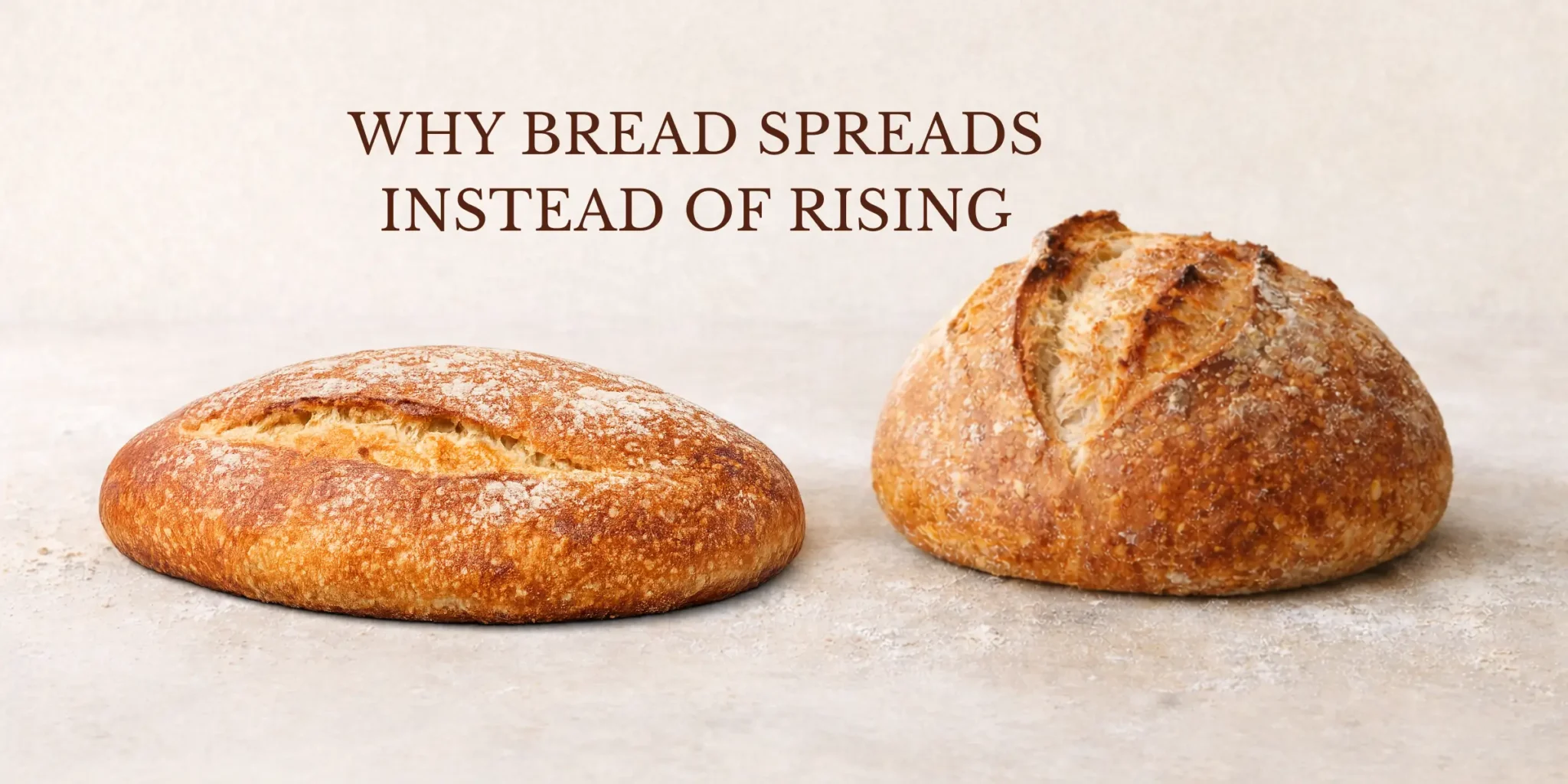
Then it widened instead of lifting.
A loaf that spreads gives clues at every stage.
Once you know where it started losing support, the next adjustment is clearer.
Your bread spreads instead of rising when the dough lacks strength, proofing went too long, shaping did not create enough surface tension, or the crust set too early in the oven.
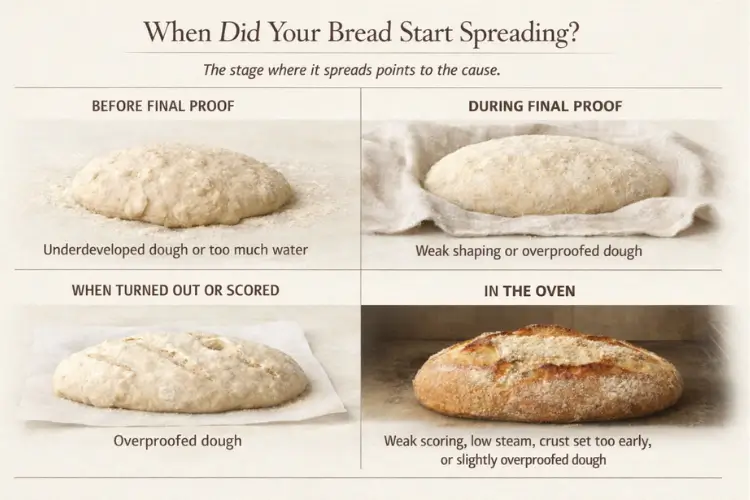
The stage at which the spread begins indicates the most likely cause.
When Did Your Bread Start Spreading?
- Spread on the bench before final proof: underdeveloped dough or too much water
- Spread after shaping during final proof: weak shaping or overproofed dough
- Flattened when turned out or scored: overproofed dough
- Held shape until baking, then widened in the oven: weak scoring, low steam, crust set too early, or slightly overproofed dough
Table of Contents
- 1 Why Your Bread Spreads Instead of Rising
- 2 Why Bread Spreads When the Dough Did Not Build Enough Strength
- 3 Why Bread Spreads When The Dough is Overproofed
- 4 Why Bread Spreads When Shaping Did Not Create Enough Outer Support
- 5 Why Bread Spreads When Hydration and Flour Strength Are Not Balanced
- 6 Why Bread Can Spread in the Oven Even if Proofing Looks Fine
- 7 What Your Finished Loaf Reveals
- 8 What to Change Next Time so the Loaf Rises Well
- 9 Related Fixes if This Is Not Really a Spread Problem
- 10 Spot the Stage, Make the Right Adjustment
- 11 FAQs
Why Your Bread Spreads Instead of Rising
The point when your dough first starts losing its shape will help you pinpoint the cause of bread spreading. It tells you where support was lost: during development, final proof, release, or oven spring.
Why does your dough spread before final proof
A dough that widens on the bench, relaxes after pre-shaping, or will not stay rounded after a rest has not built enough strength yet.
It cannot hold tension during shaping.
This suggests underdevelopment, excess water, or shaping that started before the dough could hold its shape.
If you tighten it and it spreads, the problem started before final proof.
Why does dough spread during final proof
Here, your dough shaped well at first, then sat lower and wider as proofing continued.
Some softening is part of proofing. Continued widening is not.
If the loaf keeps relaxing, losing edge definition, or settling outward as it rests, it may be overproofed or never had enough structure to hold the rise. In this case, look first at the final proof and shape retention.
Why does bread spread when turned out or scored
If your loaf holds shape in the basket but flattens once you turn it out or score it, it is overproofed. The basket was helping it hold form. Once that support is gone, the loaf has to hold itself.
Your loaf may have proofed too long, or the outer skin may have weakened, so that a release or a score is enough to let it spread.
If your loaf holds shape in the basket but flattens soon after turning out, it may be overproofed. Shorten the final proof a little next time and watch how fast it relaxes once released.
Why Bread Spreads in the Oven Instead of Rising
If your loaf goes into the oven looking decent but bakes wider rather than taller, the expansion has nowhere to go but out. Your dough still had gas. But it did not have enough support to lift it.
That points to late-stage weakness: the loaf is overproofed, shaping did not create enough tension, or the outer skin could no longer direct expansion upward.
When that happens, the loaf spreads and sets lower rather than opening up.
Why Bread Spreads When the Dough Did Not Build Enough Strength
In this case, the dough never developed enough strength to hold its shape and rise.
What weak dough looks like after mixing and resting
After mixing and resting, a weak dough feels soft but not gathered. When you lift it, it stretches a little, then tears before it stretches far.
When you fold it, the surface does not tighten into a smooth, held shape. It smears on the bench, clings to your fingers or scraper, and slumps back down instead of holding up.
This is not just soft dough. Soft dough can still feel organised. Weak dough feels loose under your hands. It may look smoother after resting, but it still does not feel like it can support itself.
What weak dough looks like during bulk fermentation
During bulk, weak dough often spreads in the bowl more than it lifts.
You may see bubbles at the sides or under the surface, but the dough still looks flat, loose, and wide.
When you move the bowl, it may wobble softly but not feel strong underneath.
Fermentation is happening, but support is not building fast enough to keep pace. The dough is getting softer without getting better at holding its shape.
King Arthur Baking has a good explanation of why folds during bulk help build dough strength.
What the baked loaf shows afterwards
Later, the loaf often bakes wider than you expected.
The score may open a little, then stop, or open weakly with little height.
In some loaves, the pressure escapes from the sides rather than lifting the top.
After slicing, the crumb often looks tighter and more crowded. The holes are smaller, closer together, and the slice feels heavier than it should for that type of bread.
The loaf fermented enough to make gas, but not enough strength was there to hold that lift well.
Why weak dough spreads outward instead of rising
Gas does not lift a loaf on its own. It needs sufficient internal support to sustain that expansion. When the dough is underdeveloped, the pressure takes the easier path: outward. That is why a loaf can ferment, soften, and develop bubbles, yet still bake wider rather than taller. The problem is not only a low rise. The dough did not have enough support to direct that rise.
If your dough keeps getting softer but never holds shape better, it may be fermenting faster than it is strengthening. Build support earlier with better development or folds, rather than trying to rescue the loaf only at shaping.
Why Bread Spreads When The Dough is Overproofed
Some loaves spread because they were weak from the start. Others had enough strength earlier, then lost it when it was time to bake.
Overproofed dough feels fuller, airier, and more fragile. Weak dough feels soft because it never built enough strength.
What overproofed dough feels like before baking
Before baking, overproofed dough feels extremely airy but deforms easily.
It may look full, but the outside no longer feels firm enough to hold its shape well. When you touch it, the dough dents easily. The dent may stay or rise back only a little.
King Arthur Baking’s proofing guide is useful here because it shows what the poke test is actually checking in a freeform loaf.
When you move the loaf, it spreads more than you expect.
Overproofed dough feels inflated, soft, and spent. It has gas, but it no longer holds that gas well
What happens when you score and load it in the oven
When you turn the loaf out, it starts to relax as soon as the basket support is removed. Score it, and the cut does not lift cleanly. Instead of opening with tension, the loaf may sink, widen, or spread after the blade goes in.
The loaf may wobble, flatten, or lose shape during the move to the oven. That suggests support that has already thinned out by the end of the proof.
What the crumb looks like afterwards
The baked loaf may still feel light. It does not always come out as dense as underdeveloped dough does.
Instead of a loaf that lifts with control, you get one that spreads and sets wider.
The crumb may look airy in places but uneven, with a shape that feels collapsed rather than held.
The loaf had gas. It just did not have enough support left to carry that gas upward.
If the dough feels very airy but also fragile, and it spreads more easily the moment you handle it, it may be overproofed. Shorten the proof next time instead of tightening the shape harder.
Why Bread Spreads When Shaping Did Not Create Enough Outer Support
Some loaves spread even when the dough was strong enough to shape well.
The problem is not weak dough from the start; shaping did not give the loaf enough outer support to hold its shape as it proofed and expanded.
Weak shaping and weak dough are not the same problem
Weak dough feels hard to manage from the start. It tears early, slumps after handling, and does not tighten much when you shape it.
With a shaping problem, the dough is manageable. It stretches without tearing right away. It gathers into shape.
But after shaping, it still sits wider than it should, relaxes faster than expected, or spreads because the outer layer was never tightened enough to hold it together.
Weak dough needs more strength before shaping. Weak shaping needs better support on the outside.
What a supported outer skin feels like on the bench
A supported outer skin is what bakers call surface tension: a slightly taut outside that helps the loaf stay rounded. It should feel held, not strained.
On the bench, the dough should have a smooth outer layer and some resistance to your hands.
When you round or roll it, the surface should tighten slightly, helping the dough keep its shape.
It should not feel loose and puddled. It also should not feel stretched so hard that the skin starts tearing or the dough turns stiff and thin on the outside.
You want enough outer hold to keep the loaf gathered while it expands.
If you want a visual of how surface tension helps dough keep its shape during proofing, The Perfect Loaf shows that bench drag clearly
What shaping mistakes lead to sideways spread
Sideways spread often starts with shaping that moves the dough around without building real support. The loaf may be formed, but not held.
That happens when final shaping stays too loose, when one side is tightened more than the other, when the seam is not sealed well, or when the dough is rolled and repositioned without creating a firm outer layer.
In each case, the loaf can look shaped for a moment, then relax and widen during proofing or after release because the outside was never doing enough holding.
When does more tightening stop helping
More tightening is not always more support.
If the dough is already weak or overproofed, shaping it harder does not rebuild its structure. It only forces the loaf into a tighter shape for a short time.
That is why some loaves look controlled right after shaping, then still spread during proofing or in the oven.
The outer layer was pulled tighter, but the dough underneath could not support that hold. Once the loaf softened again, the spread came back.
If you keep shaping harder, but the loaf still relaxes, more tightening won’t fix it.
Before you tighten the loaf more, check whether the dough already feels delicate or too relaxed. More shaping pressure can make a late-proofed loaf look tighter for a moment without giving it real support in the oven.
Why Bread Spreads When Hydration and Flour Strength Are Not Balanced
Hydration and flour strength can fall out of balance. When that happens, the dough is too loose for the flour and the process behind it.
Soft dough does not always mean the formula is wrong
Some doughs feel loose early, then change with rest and folds.
At first, the dough may cling more, spread more in the bowl, or feel too soft. After resting, it may smooth out, tighten slightly, and hold its shape better when you fold it. That is normal development.
Early softness does not always mean the formula is off.
When the dough stays looser than its structure can support
In this case, the dough keeps softening without holding its shape. You shape it, and it spreads. You round it, and it stays low. You fold it, and it still will not hold a shape.
This is the mismatch. The dough is not only soft. It is too loose for the strength it has built so far.
This can happen when the dough has too much water, the flour cannot support it well, or the handling does not build enough support.
Why does the same hydration behave differently with different flours
The same hydration can feel and behave differently in different doughs.
One flour may absorb it well and still let the dough hold shape. Another may leave the dough softer, stickier, and harder to support.
That is why one baker can handle dough cleanly at the same hydration level, while another baker gets spreading and poor shape retention.
Flour strength changes how much water the dough can carry. So does the process behind it: mixing, resting, folding, and shaping.
Hydration is only one part of the picture.
Why adding flour midstream often blurs the real diagnosis
Adding flour midway can make the dough easier to handle for a while. But it does not tell you what the original problem was.
The dough may have needed more rest. It may have needed more strength from mixing or folds. It may have been proofing on track, but still too loose for the flour.
Once extra flour goes in, those signals get harder to judge. You may end up correcting it feels in your hands while missing the real cause.
Fermentation and support are not the same thing. A dough can be on track in terms of timing and still be too soft for the flour, handling method, or shaping support. In that case, the loaf is not automatically underproofed or overproofed. It is simply looser than its strength can support. That is why some loaves feel lively and fermented, yet still widen rather than rise with control.
Sticky or soft does not always mean the dough is too wet. If it smooths out, gains support with folds, and starts holding shape better after rest, wait to judge it until later in the process.
Why Bread Can Spread in the Oven Even if Proofing Looks Fine
Some loaves go into the oven looking supported, but then bake wider rather than taller.
In this case, the oven result shows how expansion was managed once heat, steam, scoring, and crust setting took over.
When the score does not help the loaf rise
A score is there to give the loaf a clear place to open. If that cut is too shallow, too deep, too straight down, or made after the outer skin has already weakened, it may not guide the push well.
Then the loaf still expands, but not where you want it to. The score stays low, opens only a little, or seals over without lifting much.
Pressure looks for an easier exit and may push at the side, under the crust, or along a weaker part of the loaf instead.
King Arthur Baking’s scoring trials make this clear: even a good score will not open well if the loaf does not have enough steam early on.
When the crust sets too early
If the outside firms up before the loaf finishes expanding, the loaf loses time to rise upward. The top may stop opening, the score may bloom weakly, or the loaf may burst at the side where the crust is thinner or weaker.
This can leave you with a loaf that looked fine going into the oven, but still baked low and wide. The gas was there. The early oven window closed before that push could lift the loaf well.
What to Check for Better Oven Spring
Focus on the few baking conditions that most strongly control early expansion.
You want enough heat to drive oven spring, but not so fast that the crust sets before the loaf can open.
You also want enough early steam to keep the surface flexible during that first stage of lift. If steam is weak, delayed, or too short, the crust can dry and set before the loaf finishes expanding.
If the heat is too aggressive at the start, the same thing can happen.
Check these three things first: whether your oven was fully preheated, whether the loaf had enough steam at the start, and whether the crust started setting before the score had time to open well.
What weak bloom or side-bursting means
Weak bloom or side-bursting does not stand alone. It traces back either to the support that was already missing or to the expansion that was not guided well in the oven.
If the score stays low and the loaf spreads, look back at late proofing and shaping structure.
If your loaf looked supported going into the oven but burst on the side, check the score and how quickly the crust set.
In both cases, the loaf had pressure. The question is whether it still had enough support and enough oven opening time to send that pressure upward.
If the loaf looked supported going in but burst at the side or stayed low at the score, check whether the score opened well and whether the crust set too early for the loaf to expand upward.
What Your Finished Loaf Reveals
The crumb, score, and overall loaf shape can help you trace earlier failures. A flat loaf can happen for different reasons.
Flat loaf with a tight, crowded crumb
When your loaf is flat, and the crumb looks tight, small-holed, and crowded, the dough often did not develop enough strength to hold the gas well or lift with it.
This is often the result of underbuilt dough, weak development, or dough that never built enough support to lift well. The dough fermented, but it lacked sufficient strength to rise well.
Here’s a tighter rewrite with the filler cut out and the diagnosis stated faster.
Flat loaf with an airy but fragile crumb
If your loaf looks light inside but still bakes low and wide, support was there earlier and faded before baking.
This loaf can look more open than one made from weak dough, but it still lacks height and hold. The crumb may have larger air pockets, but the shape is low and spread. This fits dough that lost support late, often during the final proof.
Flat loaf with weak score opening or side burst
If the score opens only a little or the loaf bursts on the side, expansion did not go where it needed to.
This can happen when the score did not open well, the crust set too early, or earlier weakness showed up under heat. The loaf had pressure. It did not direct that pressure upward.
Flat loaf with a very soft dough from start to finish
If your dough stayed very soft the whole way through, spread easily at each stage, and never started holding shape better, the problem started before proofing time.
This fits dough that was too loose for the flour, too soft for the handling method, or never built enough strength to hold itself. In that case, the loaf was already off track before final proof.
What to Change Next Time so the Loaf Rises Well
Ascertain at what stage the loaf lost shape. Then use the fix that matches that stage.
You do not need to rebuild the whole formula. One clear adjustment will tell you more than five small guesses.
Build more strength earlier in the process
If the dough was already spreading before the final proof, do not wait until shaping to rescue it. Build support earlier.
That can mean mixing until the dough feels more gathered after resting, or using folds during bulk to help it hold itself better.
It’s not about hitting a set number of minutes, but about whether the dough feels more organized. It should stretch farther before tearing, sit up better after a fold, and hold shape better than it did at the start.
If none of that is happening, shaping later will not fix the real problem.
End final proof a little sooner if the dough is already relaxing fast
Watch what the dough does when you handle it near the end of proofing. If it feels very airy but also fragile, dents easily, and starts spreading as soon as support is removed, it’s overproofed
In that case, shorten the final proof slightly for the next bake.
Do not chase a fuller look if the dough is already getting softer faster than it is holding shape.
A loaf that still feels supported when you turn it out will rise better than one that looked fuller in the basket but had already started giving way.
Shape for support, not maximum tightness
Shaping is not about forcing the loaf as tight as possible. It is about giving it enough surface tension to stay rounded while it expands.
That means building a smooth, slightly taut outer skin without dragging, tearing, or overstretching it.
The loaf should feel gathered and held together. It should not feel loose and spread out right away, but it should not feel strained or thin on the outside either.
If you shape harder and harder just to make the loaf look tighter, you can hide the real problem for a moment without fixing it. Aim for controlled support.
Adjust hydration deliberately on the next bake, not reactively in the middle
If the dough remained softer than it could support, change the hydration on the next bake in a measured way. Do not keep throwing in flour midstream just to make handling easier.
Extra flour added during mixing, folding, or shaping can blur the diagnosis. It becomes harder to tell whether the real issue was too much water, weak development, weak shaping, or overproofing.
A better move is to finish the bake, note what the dough did at each stage, then lower the water slightly next time if the dough stayed too loose from start to finish.
Small changes are enough. You don’t have to force an instant correction.
Change one variable at a time
When a loaf spreads, it is tempting to fix everything at once. Resist that.
If you mix longer, shorten proofing, tighten shaping, and lower hydration all in the same bake, you will not know which change solved the problem.
Keep the next test clean. Change the one factor that best matches what you saw. I
f the dough was weak early, build strength earlier. If it felt airy and fragile late, shorten proofing.
If it was soft the whole way through, adjust hydration. If it shaped loosely despite decent dough, work on shaping support.
That is how you get a clearer diagnosis and a better loaf at the same time.
Do not change everything on the next bake. If you shorten proof, mix longer, tighten shaping, and lower hydration at the same time, you will not know which change helped the loaf hold shape.
Related Fixes if This Is Not Really a Spread Problem
Sometimes the loaf spreads, but spread is not the main diagnosis. The dough may be too sticky to judge clearly, too loose for the formula, or low and tight for a different reason. In that case, use the guide that best matches what you saw.
If the dough feels sticky more than weak
If the dough clings, smears, and grabs more than it collapses, start with Why Is My Dough Sticky. That guide helps you tell whether the dough is still developing, simply hydrated, or truly hard to handle.
If the formula may be too loose for the flour or the method
If the dough is soft from the start and never held shape well, go to Dough Hydration. That is the better next step when the problem is formula balance, flour strength, or too much water for the process.
If the real problem is a dense loaf more than a spreading loaf
If the loaf baked low, tight, and heavy rather than simply wide, read Dense Bread next. That guide is a better fit when the bigger problem is a lack of lift, tight crumb, or poor gas retention.
If the dough may never have developed enough support during mixing
If the dough never felt stronger after mixing and resting, go to How Long to Knead Dough With a Stand Mixer. That guide helps you judge development by how the dough behaves, not by the clock alone.
Spot the Stage, Make the Right Adjustment
Watch when the loaf starts spreading, not just how it looks at the end.
Most bread spreading problems start earlier than the bake itself:
A dough that never held shape well.
A loaf that relaxed too fast in proof.
A score that did not help the loaf open upward.
When you learn to spot when the failure happened, spread stops feeling random.You stop changing everything.
You start by changing the right thing first.
You know what to watch before the loaf goes into the oven.
Mix it.
Bake it.