
Notice: I receive compensation if you buy something through affiliate links on this post. This does not change the price you would pay. As an Amazon Associate I earn from qualifying purchases.
It looked puffy.
You pressed it and paused.
Bake now, or wait longer?
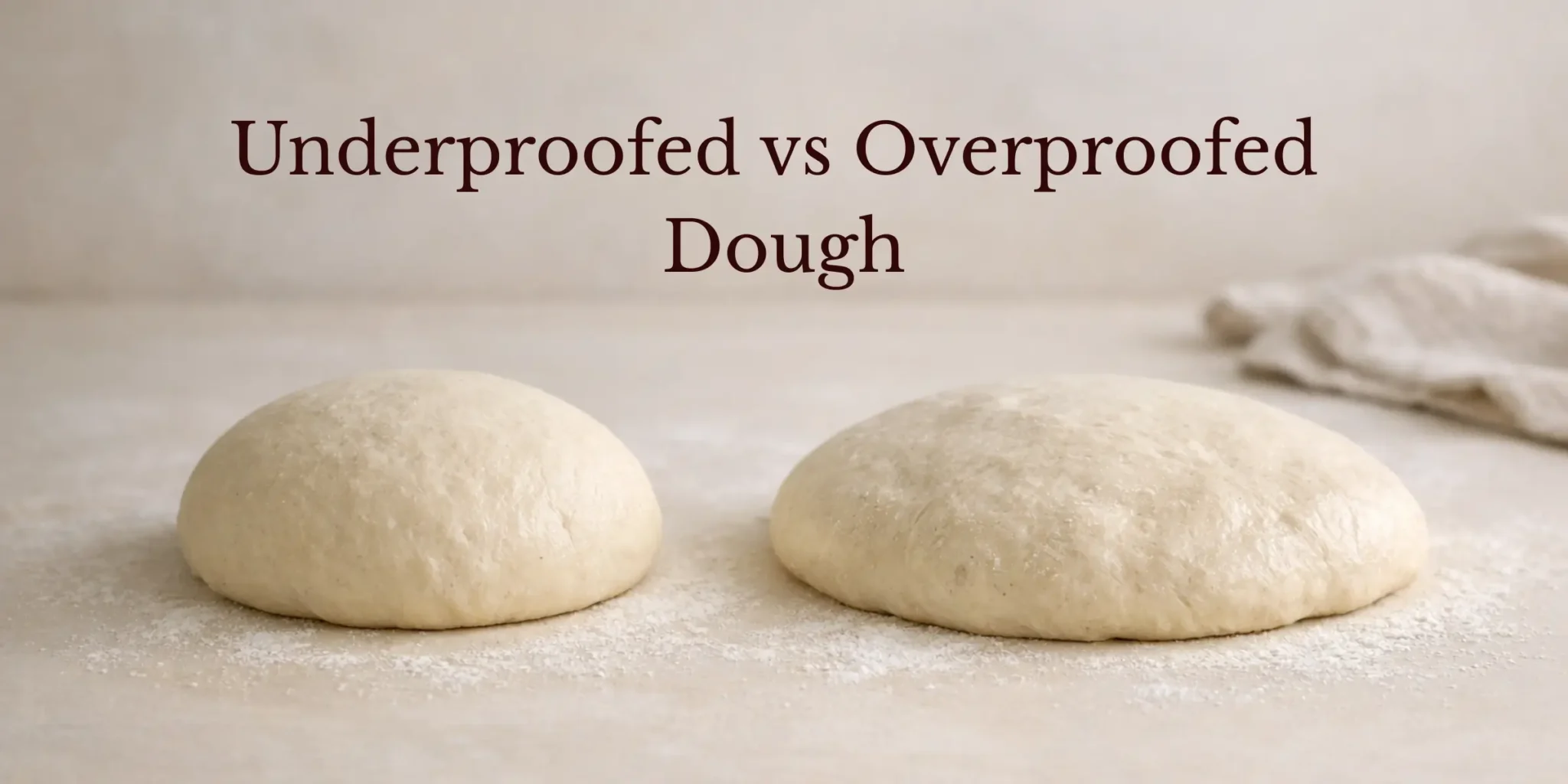
Underproofed and overproofed dough can both look close to ready. Once you know what to watch, the difference becomes much easier to see.
If dough is underproofed, it has not fermented long enough to build the gas and looseness needed for balanced expansion.
If dough is overproofed, it has gone past its strongest point, so the gluten network can no longer hold gas well.
Both situations can produce disappointing bread, but they do not fail in the same way.
In this guide, we’re talking about final proofing — the stage after shaping, when the dough rises before baking.
Bulk fermentation matters too, but the signs in this post are the ones you use to judge whether the loaf is ready to bake.
The fastest way to tell the difference is to watch three things:
- how the dough responds to touch
- how well the shape still holds
- what happens during oven spring
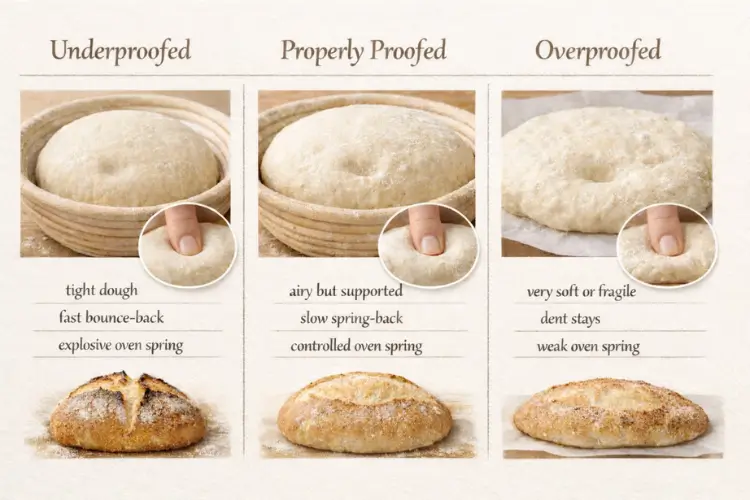
| Dough Stage | Before Baking | In the Oven | After Baking |
|---|---|---|---|
| Underproofed | Dough feels tight and springs back quickly. Surface still looks firm. | Strong or uneven oven spring. Loaf may tear or blow out. | Tight crumb. Dense areas. Sometimes slightly gummy. |
| Properly Proofed | Dough feels airy but supported. Slight slow spring-back after a poke. | Controlled oven spring with clean score opening. | Balanced volume and even crumb structure. |
| Overproofed | Dough feels very soft or fragile. Dent stays or recovers slowly. Shape may start to slacken. | Weak oven spring. Loaf spreads or barely lifts. | Flatter loaf with weaker structure and uneven crumb. |
A good final proof is not the moment when dough looks biggest. It is the moment when the dough has enough gas to expand well in the oven and still enough strength to hold that expansion.
That is why both underproofed and overproofed dough can look “risen” at a glance. The difference shows up in how supported that rise still is.
Underproofed Dough
Underproofed dough still has strength, but not enough internal expansion. It has started rising, but it has not relaxed enough to bake with a balanced structure.
What you see before baking
Underproofed dough often feels tighter and more resistant than ready dough. It may look neat and rounded, but that shape can be misleading because the inside has not expanded enough yet.
Common signs include:
- dough springs back quickly when poked
- surface still looks firm and held together
- loaf feels dense for its size
- dough shape still looks tight rather than airy
Sometimes underproofed dough even looks “beautiful” before baking because it still has strong tension and a clean shape. The problem is that the inside still has not expanded enough.
What it means
These signs point to dough that has not fermented long enough to build enough gas and looseness.
The gluten network is still strong, but the dough has not relaxed enough to support an even rise. In simple terms, it still has more pushing power than readiness.
That is why underproofed dough often enters the oven with a lot of expansion still left to do. Instead of rising in a controlled way, it may push hard and unevenly.
What happens in the oven
Underproofed dough often produces a strong, but uneven oven spring.
Typical results include:
- explosive expansion
- tearing or blowouts
- aggressive score opening
- dense interior despite tall rise
This is where bakers sometimes get confused. A loaf can spring dramatically and still be underproofed.
A big rise alone is not proof of correct proofing. If that rise comes with tearing, bursting, or a dense crumb, the dough was likely not fully proofed.
If the loaf rose hard but still baked heavy or tight inside, see Dense Bread to sort out the other reasons bread can still turn out heavy.
Overproofed Dough
Overproofed dough has already expanded past its strongest point. It may still look airy and full, but the structure holding that gas has weakened.
What you see before baking
Overproofed dough usually feels very soft or fragile. Instead of looking supported, it starts to look tired.
Common signs include:
- dent remains after poke
- dough feels slack or overly soft
- surface tension looks weak
- shaped loaf spreads wider instead of holding height
In some cases, the dough may look full enough to bake, but the shape begins to flatten, soften, or blur at the edges.
Overproofed dough also sticks more easily during proofing because the outer surface becomes softer and weaker.
If that sounds familiar, this guide on dough sticking to the banneton walks through the most common surface moisture and proofing causes.
What it means
These signs suggest the dough has passed peak proofing. Gas continued building, but the structure holding it weakened along the way.
That weakening can happen because the dough has stretched too far, fermented too long, or simply stayed warm and active longer than expected. The result is the same: the dough may still contain gas, but it cannot use that gas well anymore.
This is why overproofed dough can seem airy in the bowl and still bake into a loaf with poor lift.
What happens in the oven
Overproofed dough usually produces little oven spring.
Typical results include:
- flatter loaf
- weak score opening
- crumb that looks deflated or collapsed
- spreading during baking
Instead of lifting upward, the loaf may drift outward. There is no longer strong stored expansion. Rather, the dough had already used too much of its strength before it was baked.
Underproofed vs Overproofed Dough: The Fastest Ways to Tell the Difference
When the signs feel mixed, the clearest move is to compare several clues instead of trusting one test in isolation.
Proofing becomes easier to ascertain when touch, shape, and oven behavior all point in the same direction.
What the poke tells you
The poke test is useful, but it only becomes reliable when used together with other cues.
- Underproofed: springs back quickly
- Fully proofed: returns slowly and leaves a slight indentation
- Overproofed: the dent stays, or the dough feels too soft to recover well
A fast bounce-back usually means the dough is still tight and not expanded enough yet.
A slower return usually means it has built enough air while still keeping support.
A dent that stays can mean the dough has gone too far, especially when the loaf also looks slack or is starting to spread.
The poke test matters less when dough is very sticky, very wet, or not shaped tightly enough. In those cases, the outside feel and the loaf’s overall shape is usually more reliable.
If the dough is so sticky that touch becomes a hazy cue, start with Why Is My Dough Sticky? so you can separate dough feel from proofing cues.
If you already know the dough is too sticky, How to Fix Sticky Dough walks through what to adjust before you judge proofing by touch.
How the loaf holds itself
Height alone can mislead you. How well the dough is still holding its shape tells you more.
A loaf can look bigger and still be either early or late in the proofing process. These cues tell you whether it still has enough support:
- Underproofed: still looks tight
- Properly proofed: looks expanded but still supported
- Overproofed: starts to look slack, soft, or less defined
This is one of the most useful comparisons because it shifts your attention away from rise alone.
A dough can look full before it is ready, and it can look airy after it has already gone past its best point.
The better question is whether the loaf still looks like it can support one more stage of expansion in the oven.
What the oven confirms
Oven spring often shows whether the dough was ready when it was baked.
- Underproofed: strong, but uneven lift
- Properly proofed: controlled lift
- Overproofed: weak rise
Underproofed dough still has too much unfinished expansion, so it can jump hard and unevenly.
Properly proofed dough usually rises with more control because gas and structure are still working together.
Overproofed dough has less lift left to give, so the loaf may stay low or spread instead of rising well.
What the crumb tells you after baking
The crumb often gives you the final answer when the earlier signs are hard to determine.
- Underproofed: tighter crumb with dense patches
- Properly proofed: balanced crumb structure
- Overproofed: flatter loaf with weaker crumb structure
Why Proofing Has a Window, Not a Perfect Minute
Proofing works best within a window, not at one exact minute. Early on, the dough still has strength but not enough internal expansion. Later, it may hold plenty of gas but lose the support needed to use that gas well.
The best stage is when expansion and structure are still working together. That is why dough can look risen before the ideal point and still look risen after it.
The Window of Readiness
Final proof is not about waiting until the dough looks biggest. It is about catching the point where the loaf feels expanded yet still supported.
That is the stage that usually produces the cleanest oven spring and the most balanced loaf.
What properly proofed dough usually feels like
Properly proofed dough feels lighter and more open than underproofed dough, but it does not feel weak.
It feels airy but still supported, soft with a slow spring-back, and expanded without losing shape.
If the dough still feels tight, it probably needs more time. If it feels too soft to move or score cleanly, it may already be late.
A ready loaf does not feel stiff, but it does not feel collapsed either. It feels expanded and held together at the same time.
Why the clock is not enough
Proofing time shifts from bake to bake, even when the recipe stays the same. Dough temperature, room temperature, water level, dough strength, and yeast activity all change how quickly the dough proofs.
That is why one dough may be ready in 45 minutes while another needs 75. The clock can guide you, but it cannot judge readiness for you. The dough still has to confirm it.
For a baker-to-baker explanation of why proofing speed changes with temperature and why the poke test matters more than the clock, see What is proofing bread? And how do I get it right?
If dough strength keeps changing from bake to bake, How Long to Knead Dough with Stand Mixer helps you rule out underdevelopment before you blame proofing.
How Bulk Fermentation Affects Final Proof
Final proof does not restart fermentation. It continues what bulk fermentation has already set in motion.
During bulk fermentation, the dough builds gas, strengthens its internal structure, and becomes easier to stretch without tearing.
By the time the dough reaches final proof, those earlier conditions are already influencing how quickly it proofs and how much support it still has.
If bulk is slightly short, the dough often enters final proof tighter and less expanded. It may still catch up and bake well if the dough is otherwise strong.
If bulk fermentation went too long, the dough may enter final proof already close to its limit. In that case, overproofing can happen faster, and readiness becomes harder to judge.
That is why the final proof can feel inconsistent. Sometimes the confusion started earlier, during bulk fermentation, and only shows itself after shaping.
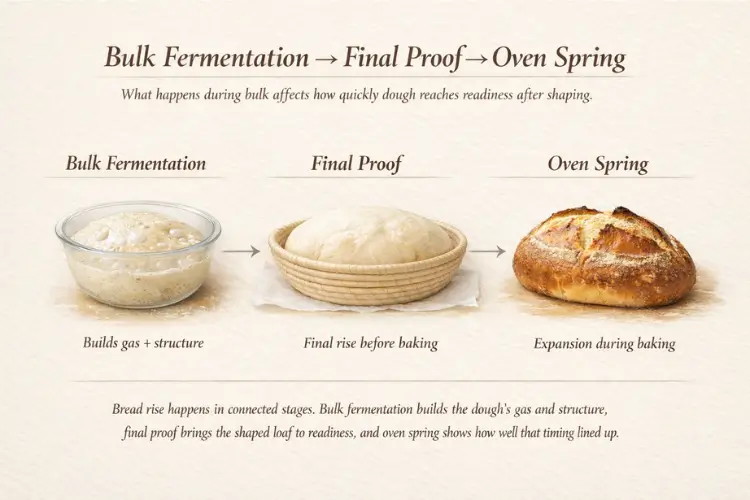
Timeline visual caption
Bread rise happens in connected stages. Bulk fermentation builds the dough’s gas and structure, final proof brings the shaped loaf to readiness, and oven spring shows how well that timing lined up.
Final proof does not restart fermentation. It continues what bulk fermentation has started.
What to do when you are unsure
When the signs do not line up cleanly, stop looking for one perfect signal. Assess the dough against the cues.
Check the poke response, the way the loaf is holding its shape, and how well it expanded in the oven.
A dough that still feels tight usually needs more time. A dough that feels very soft and less supported usually should bake soon.
For a deeper look at how bulk fermentation differs from final proof and why dough temperature changes fermentation speed, see The Ultimate Guide to Bread Dough Bulk Fermentation.
If you are also unsure whether the dough developed enough earlier in the process, see Why Didn’t My Dough Rise During Bulk Fermentation?
Why Dough Becomes Underproofed or Overproofed
Proofing usually goes off because of small shifts in temperature and timing, not because of one dramatic mistake.
A slightly cooler dough, a warmer kitchen, or a longer wait after shaping can be enough to move the loaf out of its best window.
Common reasons dough stays underproofed
Underproofing usually happens when fermentation moves more slowly than expected, or the loaf goes into the oven before it has expanded enough.
Common causes include:
- cool dough temperature
- cool room temperature
- shortened proofing time
- baking before the dough is fully ready
This often happens when the clock says the dough should be ready, but the dough itself has not caught up yet.
The loaf may look shaped and risen, but it still feels tight and under-expanded when you check it closely.
If the dough never seems to move the way the recipe says it should, your formula may also be affecting the timeline, see Dough Hydration.
What causes dough to overproof quickly
Overproofing is more likely when the dough is warmer, more active, or simply left longer than planned.
Common causes include:
- warm dough temperature
- warm kitchen temperature
- proofing continues too long
- the dough is left sitting after it has already reached readiness
Warm dough in a warm kitchen ferments faster than expected, especially during final proof. That is why a loaf that looked ready 20 minutes ago can start looking softer, looser, or less supported by the time you bake it.
If you want a target to check against, Desired dough temperature explains why dough temperature has such a direct effect on fermentation speed
What to Do Next Based on What You See
Diagnosis only helps if it leads to the next decision. Once you can read what the dough is telling you, you can respond sooner and with less guesswork.
Fast read
What the Dough Is Telling You
Springs back fast: still underproofed
Returns slowly: likely ready
Dent stays and loaf feels soft: likely overproofed
If your dough is underproofed
Give it more time, then check again using more than one sign. Look at the poke response, the way the loaf is holding its shape, and how much it has actually expanded.
Do not expect the oven to finish the job for you. The oven can expand dough that is ready to rise, but it cannot replace the fermentation the loaf still needed before baking.
If your dough is overproofed
Bake it as soon as possible if it still holds some shape. Waiting longer usually weakens the structure further.
You may not get ideal oven spring at that point, but baking sooner gives the loaf its best remaining chance to keep the support it still has.
If you keep misreading proofing
Sometimes proofing is not the only issue. A loaf can be hard to read because another dough variable is affecting how it looks and behaves.
Helpful next reads:
- Why Bread Spreads Instead of Rising
- Oven Spring Explained
- How to Tell If Dough Hydration Is Too High
Those posts help when the dough seems confusing because proofing is only part of the picture.
Proofing Gets Easier When You Know What to Watch
Watch the dough, not just the clock.
Proofing mistakes rarely feel dramatic in the moment. They usually show up quietly:
A warmer room.
A dough that looked ready too early.
A loaf that felt airy but not supported.
The more often you compare poke response, surface tension, and oven behavior, the easier proofing becomes to read.
And the more clearly you understand the stage before that, the easier it becomes to tell when the final proof is right
You stop guessing.
You start recognizing the signs.
You know what you’re looking at before the loaf ever goes into the oven.
Mix it.
Bake it.