
Notice: I receive compensation if you buy something through affiliate links on this post. This does not change the price you would pay. As an Amazon Associate I earn from qualifying purchases.
A few minutes ago, the dough was rough and tearing.
Now it stretches farther, sticks less to the bowl, and feels different when you touch it.
But is it ready?
Kneading is one of the easiest stages to overthink because dough doesn’t suddenly switch from “not ready” to “ready.”
It changes gradually, and the timer doesn’t always tell the full story.
So, how long should you knead dough with a stand mixer?
Key Takeaways
- Use Speed 1 to bring ingredients together and Speed 2 for kneading.
- Lean bread dough usually needs 4–6 minutes of kneading after the dough comes together.
- Enriched doughs often need 6–10 minutes because fat and sugar slow gluten development.
- High-hydration doughs often benefit more from short rests than extended kneading.
- Start checking dough before the maximum time range.
- Smoothness, elasticity, and stretchability are more reliable than the timer.
How Long Should You Knead Dough With a Stand Mixer?
Kneading times are best used as starting points, not guarantees. The same dough can reach full development sooner or later, depending on the flour, hydration, batch size, dough temperature, and even the mixer.
That’s why experienced bakers don’t stop kneading because the timer says so. They use time to get close, then watch how the dough changes.
Use the chart below as a guide, then let the dough make the final decision.
Stand Mixer Kneading Time by Dough Type
| Dough Type | Time | Notes |
|---|---|---|
| Lean Bread Dough basic white, sandwich bread | 4–6 min | Look for a smoother, more elastic dough. |
| Enriched Dough rolls, cinnamon rolls, brioche-style | 6–10 min | Usually develops more slowly because of fat and sugar. |
| High-Hydration Dough ciabatta, focaccia, some sourdoughs | 3–5 min | Often benefits from short rests instead of nonstop kneading. |
| Whole Wheat / Mixed-Grain | 4–7 min | Usually less stretchy than white dough. Do not chase a perfect windowpane. |
| Very Stiff Dough bagels, pretzels | 8–10 min | Can strain the mixer. Knead in short blocks with rests. |
What Changes As Dough Develops?
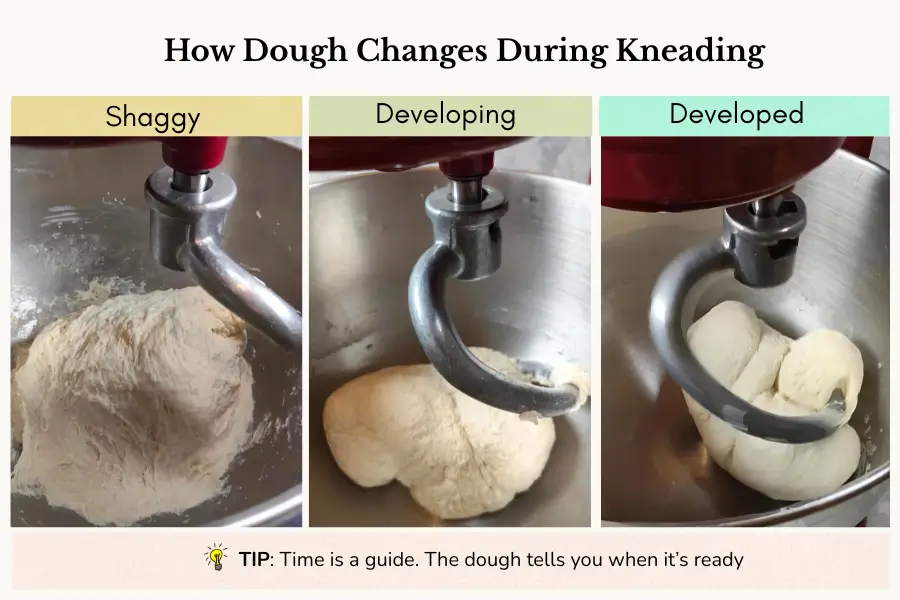
Dough does not become fully kneaded all at once. As mixing continues, the surface, texture, and stretchability gradually change.
Learning to recognize those changes is more useful than watching the timer.
Early Mixing: Shaggy and Rough
Early in the mixing process, the dough usually looks rough, uneven, and torn rather than smooth.
Dry spots, lumpy areas, and tearing are common at this stage.
If you stretch a small piece, it usually tears quickly. The ingredients have come together, but the dough has not yet developed enough structure to stretch well.
Developing Dough: Smoother but Still Sticky
As mixing continues, the dough becomes smoother, stretches farther before tearing, and starts being more cohesive.
Sticky dough can still be developing normally. Some doughs continue sticking to the bowl even as their structure improves.
Look for change. If the dough stretches farther, feels smoother, and holds together better than it did a few minutes ago, development is usually improving even if some stickiness remains.
Fully Developed Dough: Stronger and Easier to Stretch
A fully developed dough is noticeably different from the dough you started with.
The surface is smoother, the dough holds together, and it stretches farther before tearing.
Instead of tearing immediately, the dough stretches and resists gently as you pull it.
Not every dough forms a perfect ball or completely clears the bowl.
Focus on how the dough stretches and handles now compared to a few minutes earlier, rather than on a specific appearance.
Why Is My Dough Still Sticky After Several Minutes of Kneading?
Sticky dough does not always mean it needs more kneading. Sometimes it needs more development. Other times, temperature or hydration is the real cause.
When Sticky Means It Needs More Development
Early in mixing, dough often feels sticky because it lacks structure.
It may cling heavily to the bowl, tear easily when stretched, and feel messy during handling.
If the dough still feels weak after several minutes of kneading, it needs more development.
When Sticky Means the Dough Is Warm
Warm dough often feels softer and stickier than expected.
Instead of pulling together cleanly, it may smear along the sides of the bowl. It can also become harder to handle as mixing continues.
If the dough seems to be getting softer rather than stronger, check the dough temperature before kneading further.
Learn more about how warm dough affects mixing in Why Dough Temperature Matters.
When Sticky Means Hydration Is High
Some doughs stay sticky because they contain more water.
These doughs often cling to the bowl longer and spread more easily than lower-hydration doughs.
A short rest may make them easier to handle, even if they still feel sticky.
If the dough is gaining strength despite the stickiness, hydration may be the reason it continues sticking.
During one of my early bread experiments, the dough never formed a ball and continued smearing along the bowl.
I assumed it needed more kneading, so I kept mixing for about 8 minutes, and gradually added flour until it finally cleared the bowl.
The dough became easier to handle, but my bread turned out denser than expected.
On a later bake, I tried a different approach. Instead of continuing to knead, I stopped mixing earlier and gave the dough a short rest.
After a few rounds of stretching and folding, the dough became stronger and developed more structure without adding extra flour.
That experience taught me that sticky dough does not always need more kneading. Before changing the recipe or adding flour, it helps to understand why the dough feels sticky in the first place.
If you’re working with a wetter dough, see Why Is My Dough So Sticky? for a closer look at how hydration affects handling.
How Do You Know When Dough Is Kneaded Enough?
No single sign can tell you with certainty that your dough is ready. Instead of relying on one test, look for several signs pointing in the same direction.
The Dough Feels Tacky Rather Than Wet
Fully developed dough often feels tacky rather than wet.
Tacky dough lightly sticks to your fingers but releases cleanly. Wet dough leaves residue behind, smears across your skin, and is harder to handle.
A dough can be tacky and fully developed at the same time.
Not Every Dough Forms a Perfect Ball
Many bakers expect a fully developed dough to form a smooth ball and completely clear the bowl. Some doughs do. Others don’t.
Higher-hydration doughs often cling to the bowl even as they develop.
Small batches may wrap around the hook rather than staying low in the bowl.
Warmer doughs may soften and smear against the sides during mixing.
Bowl clearing can be a useful sign, but it should not be the only sign you rely on.
If your dough keeps wrapping around the hook instead of staying in the bowl, see Why Dough Climbs Up the Hook.
Using the Windowpane Test Correctly
The windowpane test is useful, but it works best alongside other observations.
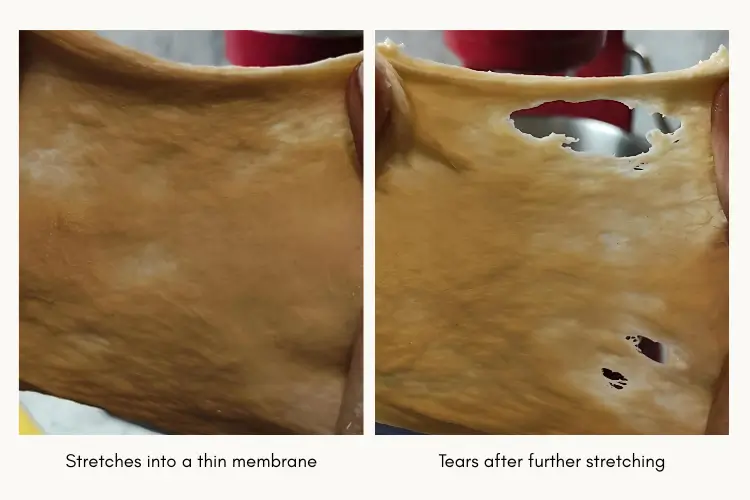
Stretch a small piece of dough between your fingers. A well-developed dough usually stretches into a thin membrane before tearing.
If the dough tears immediately, it may need more development. However, a failed windowpane does not always mean more kneading is the answer.
Recently mixed dough sometimes stretches better after a short rest.
Dough temperature, hydration, and flour type can also affect the result.
Whole-wheat and mixed-grain doughs often do not form the same paper-thin windowpane as white bread dough.
Instead of chasing a perfect translucent stretch, look for elasticity, cohesion, and stronger structure during handling.
Look for a Pattern, Not a Single Test
A dough that feels tacky, stretches well, and passes a reasonable windowpane is usually ready for bulk fermentation.
If one sign looks good but the others don’t, keep mixing or reassess what you’re seeing.
The goal is not to pass a single test. The goal is to see multiple signs of development pointing in the same direction.
Dough that lacks strength can contribute to problems later, including dense bread.
Can You Over-Knead Dough in a Stand Mixer?
Yes, but it is less common than many bakers think.
Most home bakers are more likely to stop kneading too early than to knead beyond what the dough needs.
Even so, prolonged mixing can affect dough structure, especially if the dough becomes too warm.
Signs the Dough May Be Over-Kneaded
One of the first signs is a rise in dough temperature. As the dough warms, it may become softer and more difficult to handle.
Instead of stretching smoothly, the dough may begin tearing more easily. Some doughs also become tighter and resist shaping despite continued kneading.
If the dough seems to be getting weaker rather than stronger, over-kneading may be contributing to the problem.
How To Fix Overkneaded Dough
Stop mixing and let the dough rest for a few minutes.
If excessive heat is the main issue, a short rest may improve handling.
If the dough still tears easily and feels unusually tight, continue with fermentation and evaluate how it behaves during shaping rather than kneading more.
What Speed Should You Use for Kneading?
For most stand mixers, Speed 1 and Speed 2 are all you need for bread dough.
Speed 1: Bringing the Ingredients Together
Use Speed 1 to combine the ingredients and hydrate the flour.
At this stage, the goal is to bring everything together into a rough dough before kneading begins.
Speed 2: Developing Gluten
Once the ingredients are combined, switch to Speed 2 for kneading.
This speed provides enough movement to develop gluten without putting unnecessary strain on the dough or the mixer.
Higher speeds may seem faster, but they can generate more friction and heat. For most bread doughs, Speed 2 is the recommended kneading speed.
Most manufacturers recommend kneading yeast dough on Speed 2 when using a stand mixer dough hook.
Most bread doughs can be mixed successfully in many stand mixers. However, if you bake bread regularly, bowl size and mixer design can affect how the dough mixes and handles.
Recommended Mixers
Looking for a mixer that handles bread dough well?
If you bake bread regularly, mixer capacity, bowl size, and motor strength can affect kneading performance.
The Dough Will Tell You When It’s Ready
The next time you knead dough in a stand mixer, try paying less attention to the timer and more attention to the dough itself.
Notice how the surface changes.
How the dough stretches.
How it feels when you touch it.
Once your dough is ready for fermentation, it should feel stronger, stretch farther, and handle differently than it did at the start.
The more dough you mix, the more familiar those signals become.
Kneading times can get you close. Learning to read the dough is what tells you when it’s ready.
Related Reading
Still troubleshooting your dough?
Explore the Bread Troubleshooting Hub for guides on sticky dough, dense bread, weak oven spring, proofing problems, and other common bread-baking issues.