
Notice: I receive compensation if you buy something through affiliate links on this post. This does not change the price you would pay. As an Amazon Associate I earn from qualifying purchases.
The hook keeps spinning.
The dough keeps riding up.
You push it down, and it happens again.
You wonder if it’s too sticky, too dry, or if your mixer is doing something wrong.
Why does the dough climb up the dough hook?
Here’s what it means, and how to get your dough kneading smoothly again.
Key Takeaways
- A little dough climbing at the start of mixing is normal. Constant climbing usually signals a dough or mixing issue.
- Dough that forms a smooth ball is usually developing well. Dough that stays wrapped around the hook needs closer attention.
- Common causes include sticky or stiff dough, warm dough, overmixing, and small batch sizes.
- Before changing the recipe, slow the mixer, give the dough a short rest, and watch how it develops.
- The dough’s overall behavior—not just the climbing—offers the best clues to what’s happening.
Not sure what the issue is? Start with the Bread Troubleshooting Hub to match what you saw to the right stage.
Why Does Dough Climb Up the Dough Hook?
A dough hook is designed to stretch, fold, and turn the dough repeatedly. As it kneads, the dough should be briefly pulled upward, released, and then it folds back on itself.
That continuous stretching and folding develops gluten and gradually transforms a shaggy mixture into a smooth, elastic dough.
When the dough slithers up the hook, that cycle breaks down.
Instead of releasing and folding back into the bowl, the dough grips the hook and keeps winding upward. The hook keeps spinning, but the dough isn’t being kneaded as effectively.
A little climbing at the beginning of kneading is normal.
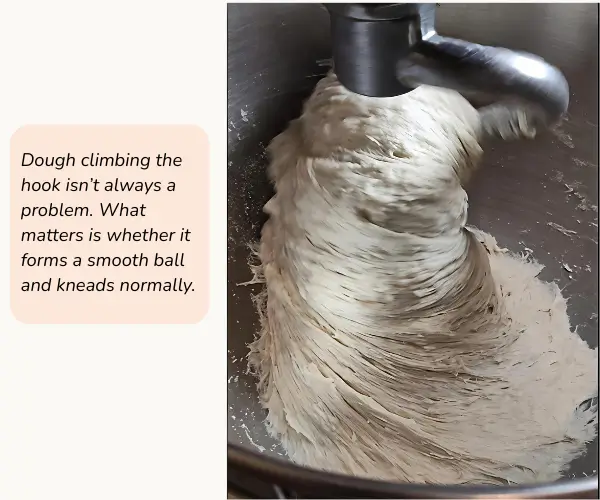
Before the dough has developed enough strength to hold together, it may briefly wrap around the hook as the ingredients come together.
In many cases, it will settle down and form a cohesive ball after a minute or two.
If the dough keeps climbing the hook, it’s time to assess the process.
What Does Dough Climbing Up the Hook Tell You?
Dough climbing the hook is a sign that something in the dough or process conditions is off.
The Dough Climbs, Then Forms a Ball
This usually means everything is working as it should.
The dough is developing gluten, starting to organize, and gradually strengthening as it mixes. A brief ride up at the beginning is normal while the dough is still loose and uneven.
If it settles into a smooth ball, the dough is developing properly, and there’s nothing to fix.
The Dough Rides Up and Never Organizes
This is where most problems show up.
If the dough stays tangled around the hook and never gathers into a ball, one or more of these may be causing the problem:
- The dough is too sticky. It clings to the hook instead of releasing and folding back into the bowl. Sticky dough often behaves this way during kneading.
- The dough is too warm. As it softens, it loses strength and is more likely to wrap around the hook.
- The hydration is too high. The flour may not develop enough structure to support the dough.
- The gluten isn’t developed enough. Without sufficient strength, the dough struggles to organize into a cohesive ball.
During kneading, friction can gradually raise dough temperature and change how the dough behaves.
Some dough becomes harder to read when hydration affects how quickly it develops structure.
The Dough Starts Climbing After Kneading Normally
If the dough kneads normally at first but begins winding up the hook after a few minutes, something is changing during the process.
As kneading continues, friction builds, the dough warms, and its texture becomes softer or more elastic.
Instead of stretching and folding, it starts wrapping and climbing the hook.
If this continues, it can lead to weaker structure and a denser crumb.
Don’t judge the dough by the climbing alone. A dough that briefly wraps the hook but soon forms a smooth ball is usually developing normally. A dough that keeps climbing and never organizes is a sign something needs attention.
How to Stop Dough From Climbing the Hook
If your dough keeps climbing the hook, resist the urge to change everything at once. Work through these steps in order.
1. Lower the Mixer Speed
Start by reducing the speed to the manufacturer’s recommended kneading speed (Speed 2 on most KitchenAid mixers). Higher speeds can pull the dough up the hook before it has a chance to stretch and fold properly.
2. Pause and Let the Dough Rest
If the dough has been mixing for a minute or two without improving, stop the mixer and let it rest for 5–10 minutes. This gives the flour more time to absorb water and allows the gluten to relax before kneading resumes.
3. Watch for Ball Formation
Turn the mixer back on and watch how the dough responds. If it gradually gathers into a ball, the dough is developing normally, and you can continue kneading.
4. Scrape the Dough Down if Needed
If the dough remains wrapped around the hook, stop the mixer and gently scrape it back into the bowl. Then restart and see whether it begins kneading better instead of climbing again.
5. Check the Batch Size
Very small batches can wrap around the hook because there isn’t enough dough for the hook to stretch and fold effectively.
If you’re making a small recipe, check whether it falls within your mixer’s recommended capacity.
Small-batch dough behaves differently in compact mixers like the KitchenAid Artisan and KitchenAid Mini Artisan.
6. Adjust Hydration Only if Necessary
If the dough still won’t organize after the previous steps, evaluate its consistency.
Dough that’s clearly too dry or excessively sticky may need a small hydration adjustment. Otherwise, avoid adding flour or water too quickly, as many doughs improve as gluten develops.
If you notice persistent dough climbing or uneven kneading, it may help to choose a stand mixer that is designed to handle heavier bread doughs more efficiently.
Should You Stop the Mixer?
It depends on how the dough behaves after it starts climbing.
If it wraps around the hook early but eventually gathers into a smooth ball, keep the mixer running.
But if it stays wrapped around the hook, keeps winding up even after being scraped down, or never begins to organize, pause the mixer and reassess.
Lower the dough, check its consistency, and decide whether it needs more kneading, a short rest, or another adjustment.
Not sure when to stop kneading? Learn how long to knead dough with a stand mixer and the signs your dough is ready.
What I Learned From My Bread Experiments
When I first started tracking my bread dough, I assumed the dough climbing up the dough hook meant my mixer wasn’t kneading efficiently.
But after several test bakes, I realized it wasn’t the most useful clue.
In earlier bakes, the dough would wind up the hook, smear across the bowl, and struggle to come together.
It stayed disorganized for much of the kneading process, making it hard to judge whether the gluten was actually developing.
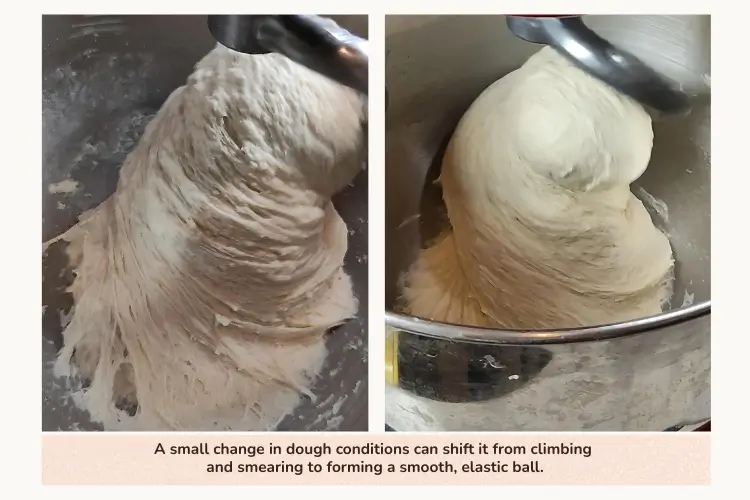
As I began using cooler water and paying closer attention to dough temperature, the behavior changed.
The dough formed a smooth ball sooner, wrapped around the hook less often, and became much easier to handle.
In other batches, it still wrapped briefly, but once it organized into a cohesive ball, it kneaded normally.
That changed how I troubleshoot bread dough. Instead of focusing on the mixer or the hook, I watch the dough.
Is it forming a ball? Is it stretching instead of smearing? Those observations tell me far more than the climbing.
Your Dough Is Giving You Clues
Watch the dough instead of the hook.
Does it gather into a smooth ball, or stay loose and tangled around the hook?
Does it drag and smear across the bowl, or slowly begin to tighten and organize as kneading continues?
And after a short rest, does it loosen and become more workable?
These shifts are small, but they tell you what’s wrong.
Mix it. Knead it. Bake It.