
Notice: I receive compensation if you buy something through affiliate links on this post. This does not change the price you would pay. As an Amazon Associate I earn from qualifying purchases.
You start mixing.
The dough gathers, then smears.
It clings to your fingers.
It feels wetter than you expected.
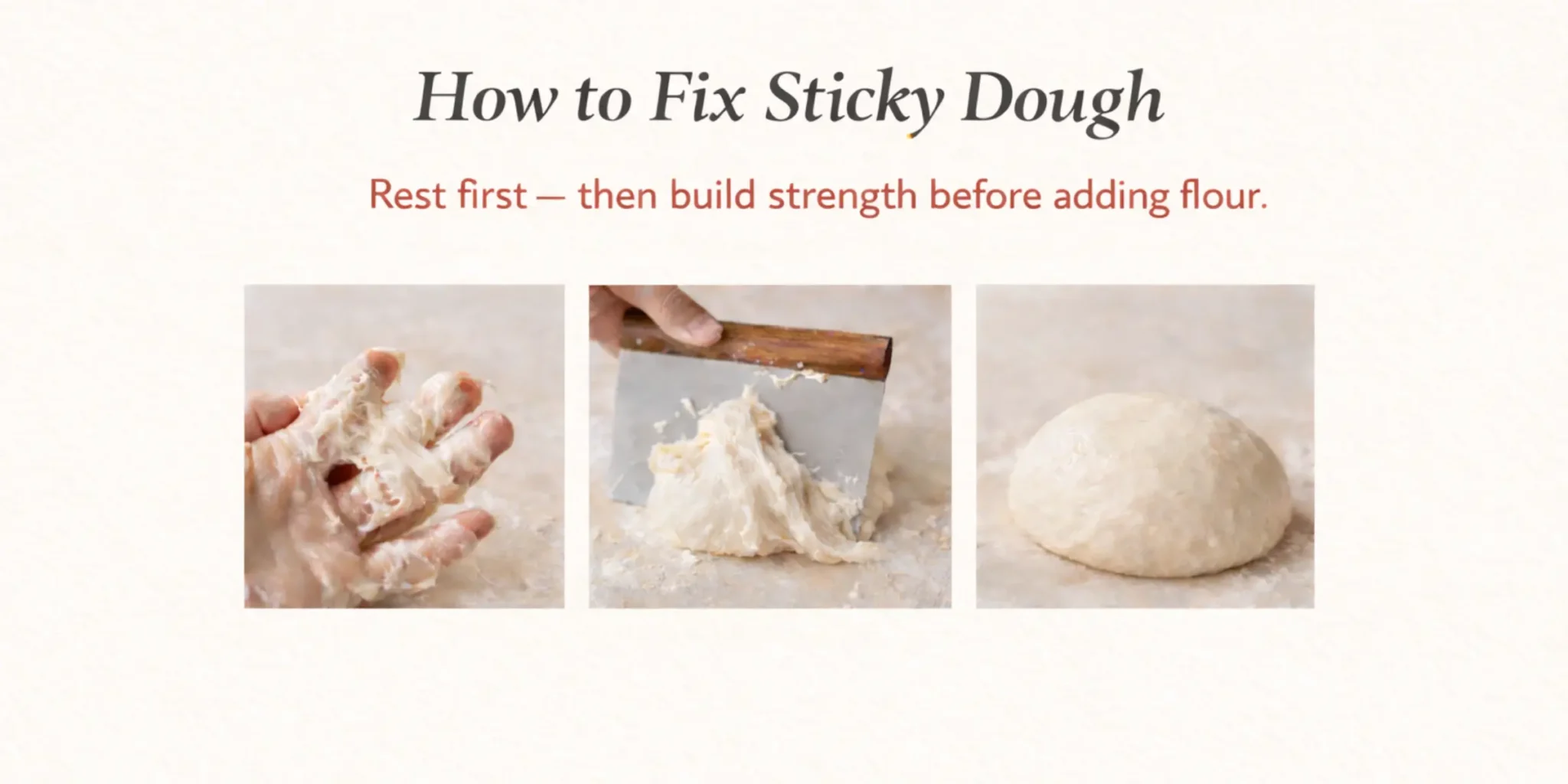
Sticky dough isn’t automatically wrong. Once you understand what stage you’re in, the fix becomes controlled, not reactive.
Quick Action Summary
Before adding flour, consider the stage. Early stickiness usually reflects incomplete gluten development, not excess hydration.
Work through these adjustments in order before altering the ratio and observe what improves.
- Stop mixing and let the dough rest 5–10 minutes.
- Strengthen it with extra mixing, or a stretch and fold before adding flour.
- Judge by stretch and shape retention, not by how much it clings to your fingers.
- Add flour only in very small increments if the dough cannot hold its shape after strengthening.
If the dough holds shape for 20–30 seconds after rounding, hydration is likely appropriate.
Correcting Sticky Dough Without Changing the Ratio
Sticky dough is a symptom, not a verdict. It usually reflects incomplete structure (the gluten network that allows dough to stretch, trap gas, and hold shape) rather than excess water.
Run these steps in sequence. Each one helps you determine whether the issue is gluten development, fermentation timing, or the dough is too wet to hold shape even after strengthening.
1. Stop Mixing and Let It Rest (5–10 Minutes)
If the dough clings heavily and forms strands when lifted, that is sticky — clings and strings when pulled. Early in mixing, this usually signals underdevelopment.
Water absorbs gradually. Alignment inside the gluten network takes time. During a short rest, absorption improves, and elasticity (stretches thin with slight spring-back) begins forming.
After resting, lift and stretch the dough again. If it stretches farther before tearing and releases more cleanly, development was the issue.
When rest improves behavior, continue mixing or folding. Do not add flour.
2. Strengthen Before Adjusting Hydration
If the dough still spreads after resting, build strength (the dough’s ability to hold tension and maintain shape instead of slumping).
The correction depends on the stage because dough structure behaves differently over time. Early mixing can tolerate additional mixing to build strength. Later stages require gentler strengthening.
Early mix: Mix slightly longer on low speed to build elasticity.
- Post-mix: Perform one stretch and fold to increase strength.
- During bulk fermentation: Add one additional fold, then reassess stretch and shape retention.
If the dough becomes elastic and holds shape briefly, hydration is not the problem.
For a step-by-step look at how kneading and folding align gluten and reduce stickiness without extra flour, see this guide from King Arthur Baking.
3. Evaluate Structure, Not Surface Feel
Surface stickiness alone does not indicate failure.
Many well-hydrated doughs are tacky (lightly sticks but releases cleanly).
To judge structure accurately, look for observable behavior:
- Does it stretch thin before tearing?
- Does it hold shape for 20–30 seconds after rounding?
- Does it release from the bench with a scraper instead of smearing?
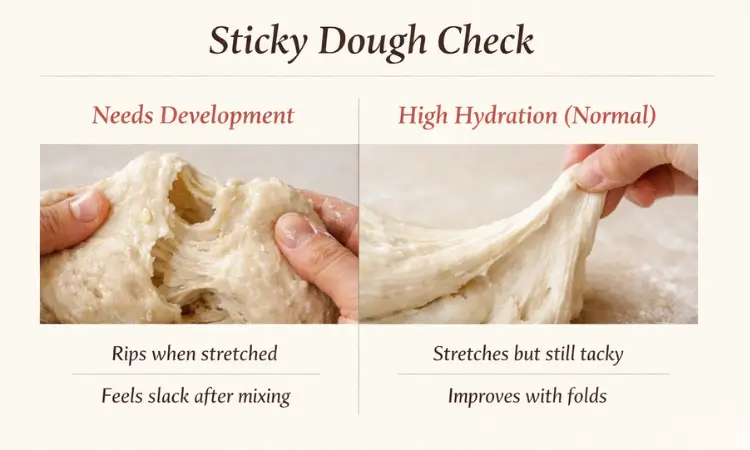
If yes, the dough is supported. If it tears easily and slumps flat immediately, it is weak (underdeveloped or over-fermented). Sticky and weak can feel similar, but structurally, they are different conditions.
Here’s what that difference looks like side by side.
4. Add Flour Only If Structure Fails
Flour is a structural correction, not a handling shortcut. Add it only if the dough remains weak after rest and strengthening.
Structural failure appears clearly in observable signs:
- Tears during a stretch test.
- Spreads quickly and cannot hold its shape.
- Does not respond to additional folds.
If you adjust, add flour gradually — 5–10 grams at a time — and mix fully before reassessing.
Large additions tighten the outer skin, reduce extensibility (how far it stretches before resisting), and often reduce oven spring (expansion during the first 10–15 minutes of baking). The result is frequently a dense crumb (small, packed air cells with low lift).
Why Sticky Dough Often Fixes Itself
Sticky dough early in mixing is often a hydration timing issue rather than a hydration mistake.
Water distribution is uneven at first. The gluten network has not fully aligned. As mixing or folding continues, elasticity increases, and adhesion becomes proportional to strength. What initially smears begins to gather. What clings heavily begins to release.
When a short rest or one fold noticeably changes behavior, that shift confirms proper development, not excess water evaporating.
What Happens If You Add Flour Too Early
Adding flour during early mixing can make sticky dough feel easier fast — but it often creates a new problem. The dough tightens before it has built real structure, so you end up mixing longer to get back the stretch you need. That extra time can raise dough temperature and push fermentation along faster than you intended. In the oven, early flour correction often shows up as less oven spring and a tighter, more dense crumb. If a 5–10 minute rest or one fold improves handling, flour wasn’t the fix. Time and strength were.
Early flour addition is a common reason loaves bake up with a tight crumb and low lift.
If your finished loaf feels tight with small, packed air cells, see the full breakdown in Dense Bread Troubleshooting to trace where structure was lost.
The steps above solve most sticky dough early in mixing. When stickiness appears later — after rising, during shaping, or in specific dough styles — the correction shifts slightly.
Special Cases: When Stage or Dough Type Changes the Fix
Sticky behavior is not the same at every stage. The dough you’re mixing behaves differently from the dough you’re shaping after proofing. Type matters too: pizza dough should feel different from sandwich bread.
The correction must match the stage.
How to Fix Sticky Dough Without Adding Flour
Sometimes the dough is correctly hydrated and simply needs better handling. In these cases, flour changes the ratio unnecessarily.
Instead of adjusting the formula, reduce surface sticking while preserving structure. You can do that with small handling shifts:
- Allow a brief rest so the dough relaxes and gathers.
- Add one or two stretch and folds to build strength.
- Lightly oil your hands during shaping.
- Use a bench scraper for clean release instead of pulling with your fingers.
These methods reduce adhesion (how much it clings) without tightening the crumb.
If the dough becomes more elastic and holds shape briefly after one fold, the ratio was not the problem.
For additional tips on handling sticky dough and when flour adjustments make sense versus when they don’t, this guide walks through the common causes and gentle handling strategies.
Sticky Dough After Proofing
Dough that becomes very sticky after rising changes the diagnosis.
Observe the behavior first. If it feels softer than expected and deflates easily when handled, fermentation may have been too long. Warm conditions can also increase surface stickiness.
Common causes at this stage include:
- Warm fermentation.
- Slight over-proofing (little or no spring-back when gently pressed).
- High hydration combined with full gas expansion.
At this point, dough structure is more fragile. Adding flour can degas the dough and tighten the outer layer, reducing oven spring.
Instead, adjust handling without changing hydration:
- Chill the dough briefly (15–20 minutes) before shaping.
- Use minimal flour only on the surface.
- Shape with deliberate, controlled tension.
If the dough collapses and cannot hold its shape even briefly, it may be past its ideal shaping window.
How to Fix Sticky Pizza Dough
Pizza dough is intentionally extensible. It stretches long with minimal snap-back. Surface tackiness is normal.
The goal is controlled stretch, not stiffness.
To manage stickiness without altering hydration, adjust how you handle it:
- Use light flour only for surface handling.
- Rest it cold if it feels overly relaxed.
- Dust the peel with semolina for transfer, not inside the dough.
You are aiming for a clean release and smooth stretch. Tightening the dough with added flour works against that goal.
If sticky dough happens occasionally, it’s usually a stage issue. If it happens repeatedly with the same recipe, the cause is likely measurement or environment.
If Sticky Dough Keeps Happening
Repeated stickiness usually traces back to measurement or environment, not the recipe itself.
If the same recipe keeps turning sticky, check these three variables first.
- Volume measurement instead of weight.
- Flour variation.
- Kitchen temperature shifts.
If sticky dough keeps showing up in the same recipe, stop treating it as a one-off handling problem. Repeated stickiness usually comes from how flour is measured, how warm the kitchen is, or how the dough is being developed.
Weighing flour avoids the compression differences that happen when you scoop. If you want a clear way to control the ratio every time, see the Dough Hydration Guide.
If you’re mixing by machine and the dough smears around the bowl or the motor slows under load, the issue is often mixing time or capacity. Use How Long to Knead Dough in a Stand Mixer to recalibrate timing, and Best Stand Mixer for Bread Dough to check whether your mixer is sized for the dough you’re making.
Most sticky dough problems are visible before they become baked outcomes. The control comes from recognizing what you’re seeing.
From Guessing to Recognizing
Pause before correcting.
Let gluten development finish.
Strengthen before adjusting.
Most sticky dough resolves when its structure catches up.
Weigh your ingredients.
Watch the dough, not the clock.
Small errors compound quietly:
A little flour too early.
One extra minute of mixing.
A dough that held shape — but you adjusted it anyway.
When you recognize the difference between sticky and weak, control becomes visible.
Stretch.
Hold.
Lift.
Mix it. Bake it.