
Notice: I receive compensation if you buy something through affiliate links on this post. This does not change the price you would pay. As an Amazon Associate I earn from qualifying purchases.
The dough sticks to everything.
It spreads instead of holding shape.
Every fold feels weaker instead of stronger.
You wonder if this is normal high-hydration dough, or too much water.
Is your dough too wet?
Here’s how to tell the difference before the loaf bakes flat.
This guide helps you tell whether your dough is simply sticky, properly high hydration, or holding more water than its structure can support. You’ll learn the signs to watch for during mixing, folding, proofing, and shaping.
If your loaf baked low, flat, or dense, this bread troubleshooting hub helps you trace the problem back to the stage where it started.
- High hydration dough is not automatically a problem.
- Dough becomes too wet when it loses the strength to hold its shape and trap gas well.
- Sticky dough can come from excess water, weak gluten development, overproofing, or flour that cannot absorb enough water.
- The best clues come from how the dough behaves during folds, shaping, and proofing — not just how sticky it feels.
- Small adjustments in water, flour strength, mixing, and fermentation usually fix the problem faster than adding large amounts of flour late.
What Dough Looks Like When Hydration Is Too High
The problem is not that the dough feels sticky.
The problem starts when the dough holds more water than its structure can support.
At that point, the dough stops gaining strength the way it should. Instead of becoming smoother, tighter, and easier to handle as mixing and folding continue, it stays weak and unstable from one stage to the next.
One of the first signs is the surface itself.
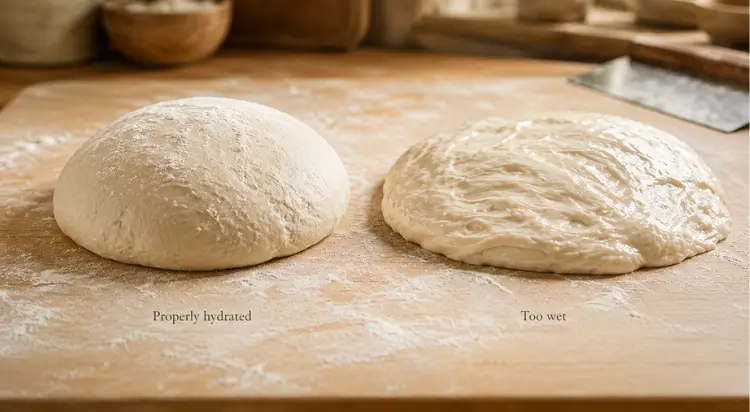
The dough may stay wet-looking long after mixing. Not just tacky, but slick, messy, and difficult to handle cleanly. It clings heavily to your hands, the bowl, the scraper, and the counter. Every movement feels like a cleanup.
Folds also stop helping like they normally should.
Rather than gradually tightening and organizing the dough, each fold feels temporary. You lift the dough, but it stretches downward heavily and spreads back into itself almost immediately.
The dough may still stretch easily, but it does not build enough strength to support itself.
As handling continues, shaping becomes harder.
You create surface tension, but it disappears quickly. The dough relaxes outward before you even finish shaping it. Instead of a supported round or oval shape, it flattens under its own weight.
The dough may also smear or tear during handling. Rather than stretching with clean elasticity, it feels slippery, fragile, or difficult to control.
By the time the dough reaches proofing and baking, the lack of structure is even more visible.
Instead of rising upward steadily during proofing, the dough spreads outward more aggressively. The loaf looks flatter and wider during final proof, especially after turning out from a banneton or proofing basket.
If your dough keeps spreading outward instead of holding height, this guide to why bread spreads instead of rising walks through the most common structural causes.
Scoring becomes difficult, too.
The blade can drag through the surface instead of cutting cleanly. The dough may stick to the blade, smear sideways, or partially collapse around the score line rather than opening with tension.
The same pattern continues in the oven.
The loaf may spread wider instead of rising taller. Oven spring stays weak because the dough cannot expand upward effectively. The score line may stay tight with little bloom, and the finished loaf often looks flatter than expected.
What matters most is the overall pattern: the dough keeps losing structure instead of gaining it.
How Properly Hydrated Dough Behaves Differently
Properly hydrated dough can still feel sticky, soft, and highly extensible. That alone does not mean the hydration is too high.
The difference is that the dough gradually becomes more organized as mixing, resting, and folding continue.
The surface starts smoothing out. Folds begin building visible strength. The dough holds its shape longer after each round of handling.
High hydration dough should still be manageable.
It may cling lightly to your hands, but it should not feel like it is melting across the counter. You should still be able to guide the dough, build tension during shaping, and maintain some structure between folds.
A well-balanced, high-hydration dough stretches easily while still holding itself together.
Is Sticky Dough Always High Hydration?
No. Sticky dough and overhydrated dough are not always the same thing.
A dough can feel sticky and still be properly balanced. Many breads, especially artisan-style doughs, naturally feel softer and tackier than beginner recipes.
What matters is not just stickiness. It is whether the dough can still build and hold structure.
That is where many bakers get confused.
Sometimes the dough feels wet because the hydration is genuinely too high for the flour or the dough strength. But other times, the real problem is gluten development, fermentation, or temperature.
Sticky dough is not the problem by itself. The problem is sticky dough that never gains strength, keeps spreading, and cannot hold tension after folds or shaping.
Weak gluten development is one of the biggest causes of “fake wet dough.”
When gluten is underdeveloped, the dough struggles to organize itself. It stays shaggy, loose, and sticky because the structure has not formed sufficiently to contain the water.
The dough may improve significantly with more mixing, folds, or resting time, even without adding flour.
Warm dough can also feel much softer and stickier than cooler dough.
Sticky dough is not always caused by excess water.
As dough temperature rises during mixing or fermentation, the structure relaxes more easily. The surface may feel wetter and harder to handle even when the hydration itself is reasonable.
This is especially common in warm kitchens or long mixing sessions.
Learn why dough temperature matters before adding more flour.
Overproofing creates another kind of sticky, slack dough.
Overproofed dough weakens and loses tension. A dough that previously held shape can suddenly start spreading, sticking, and collapsing easily. In that case, the hydration did not change; the structure did.
That is why sticky dough alone is not enough to diagnose high hydration.
You have to watch how the dough behaves over time:
- Does it gain strength after folds?
- Does it hold tension after shaping?
- Does it keep structure between rests?
- Does it improve as gluten develops?
Those clues tell you much more than stickiness by itself.
If wet dough keeps sticking to the proofing basket, this guide on banneton sticking explains how hydration, flouring, and basket airflow affect release.
When Sticky Dough Is Completely Normal
Some properly hydrated doughs feel sticky almost the entire time.
Ciabatta, focaccia, and many artisan sourdoughs are designed to stay soft, extensible, and lightly tacky. They are not supposed to feel dry or easy like low-hydration sandwich dough.
A balanced, high-hydration dough may still cling lightly to your fingers or the counter. That is normal.
High hydration dough naturally feels softer and stickier than lower hydration dough, especially in artisan-style breads.
The key difference is that the dough still behaves predictably.
It strengthens after folds. It becomes smoother over time. You can still build tension during shaping. The dough stretches without turning into a puddle.
Sticky does not automatically mean wrong.
What you are looking for is control and structure, not dryness.
What Happens If Dough Hydration Is Too High?
The biggest issue is structural weakness.
Bread dough depends on gluten to trap gas and support expansion during fermentation and baking. When hydration pushes beyond what the flour and gluten network can handle, that structure becomes too weak to hold tension effectively.
Bread hydration affects how well the gluten structure can trap gas and support expansion during baking.
The dough may still stretch easily, but stretching alone is not enough. The dough also needs enough strength to contain that movement.
Once the structure weakens, gas retention suffers as well.
Instead of efficiently trapping fermentation gases, the dough allows more of that expansion to spread outward. The loaf may rise somewhat during proofing, but it often lacks upward support once it reaches the oven.
That is why excessively wet dough often bakes flatter and wider instead of taller.
Oven spring weakens, scoring opens poorly, and the loaf may appear broader with less height than expected.
- The dough spreads quickly after folds or shaping.
- The surface stays slick, wet-looking, and hard to handle.
- Folds do not build lasting strength or tension.
- The dough relaxes outward during proofing instead of holding height.
- Scoring drags, smears, or collapses the surface.
- The loaf bakes flatter with weaker oven spring.
If the loaf bakes flatter with little upward rise, this weak oven spring guide helps connect those signs back to dough strength and structure.
The crumb can also change noticeably.
Some high-hydration breads naturally produce an open, glossy crumb. But when hydration moves beyond what the dough can support, the interior may become gummy, overly dense in some areas, or unevenly compressed. The loaf can feel damp or heavy even after baking fully.
Handling usually becomes harder at every stage, too.
Mixing gets messier. Folds feel less effective. Shaping loses tension quickly. Scoring becomes harder to control.
If the dough keeps spreading wider instead of building strength through folds, shaping, proofing, and baking, the hydration may be exceeding what the dough structure can support.
Overhydrated vs Overproofed Dough
Overhydrated dough and overproofed dough can look very similar.
Both may spread outward, lose tension, feel sticky, and bake flatter than expected. The difference is when the weakness appears.
Overhydrated Dough Starts Weak
Overhydrated dough struggles from the beginning.
Even at the early stages of mixing or folding, the dough feels overly loose, messy, and difficult to work with. Folds do not build much strength. Surface tension disappears quickly, and the dough spreads back into itself rather than tightening gradually over time.
The structure feels weak throughout the process.
By proofing and baking, that weakness becomes more obvious. The dough spreads outward more aggressively, scoring becomes harder to control, and oven spring usually stays limited because the dough cannot support upward expansion well.
Overproofed Dough Often Weakens Later
Overproofed dough usually starts stronger.
Folds work normally at first. The dough gains tension, holds shape better, and may even feel smooth and well-developed during shaping.
Later, the structure starts to fade.
Overproofed dough weakens and loses gas retention. A dough that once held its shape may suddenly relax outward, stick more, or collapse during handling.
Overproofed dough often loses oven spring because the gluten structure can no longer contain the expanding gas well.
The key difference is progression.
Overhydrated dough usually feels weak throughout the process. Overproofed dough often becomes weak after initially developing strength well.
Overhydrated dough usually starts weak. Overproofed dough often starts strong, then weakens later as it over-ferments.
If you are unsure whether it’s excessive hydration or a fermentation problem, this underproofed vs overproofed dough guide helps separate the signs.
What Your Baked Loaf Looks Like
The finished loaf often gives the clearest clues about whether the problem was overhydration or overproofing.
Overhydrated dough bakes into a loaf that spreads wider with less upward lift. The score may stay tight or open unevenly, and the crumb can look gummy, compressed, or uneven despite a long bake.
The loaf feels heavy for its size.
Overproofed dough shows more collapse-related signs. The loaf may deflate slightly during scoring or baking, spread outward suddenly in the oven, or bake with a flatter top and weaker oven spring than expected.
The crumb often looks overly airy in some areas and compressed in others because the dough lost strength after overexpanding.
There is overlap between the two, which is why the earlier dough behavior matters so much.
The final loaf confirms the pattern that started earlier in mixing, folding, shaping, or proofing.
How to Fix Dough That Feels Too Wet
If the dough feels too wet, avoid dumping in a large amount of flour immediately.
That often creates a different problem: dense, tight bread with uneven texture.
Instead, slow down and work through the dough step by step.
- Stop adding more water
If the dough already feels overly loose or unstable, stop increasing hydration. Small water changes make a big difference. - Let the dough rest first
Freshly mixed dough often feels wetter than it will later. A short rest gives the flour time to absorb water and allows gluten to organize itself. - Use folds before adding flour
Stretch and folds can build structure without changing the hydration balance. If the dough gains strength after folds, the hydration may still be workable. - Check whether the dough is underdeveloped
Weak gluten can mimic overhydration. If the dough improves with more mixing or folds, the problem may be development rather than too much water. - Reduce hydration slightly next time
If the dough remains weak during shaping and proofing, lower the water slightly on the next batch. Even a small reduction can noticeably improve handling. - Chill the dough if handling becomes difficult
Cold dough firms up and becomes easier to shape and score.
If your dough feels sticky but still has some structure, these sticky dough fixes can help improve handling without overcorrecting the hydration.
The goal is not dry dough.
The goal is dough that can stretch, hold tension, and support expansion.
Can You Save Overhydrated Dough?
Usually, yes. At least, if the dough is only moderately overhydrated.
Many wet doughs improve after resting, folding, chilling, or better gluten development. A dough that feels messy early on is not automatically ruined.
The key is whether the dough can still build strength.
If folds help the dough hold shape longer over time, the hydration may still be workable. Chilling can also improve handling and make shaping easier.
But if the dough stays weak throughout the process, spreading aggressively and losing tension quickly, recovery becomes harder.
In that case, changing the loaf style may work better than forcing a free-standing loaf. Very wet doughs often perform better as:
- focaccia
- ciabatta
- pan loaves
The goal is not perfect handling.
The goal is getting the best result from the dough you already have.
What a Balanced Dough Looks Like
You’ll usually notice the difference before the loaf reaches the oven.
The dough starts holding shape longer after folds. Shaping feels more controlled. Instead of spreading immediately across the counter, the dough holds tension and height.
Then the same balance shows up in the bake.
The score opens more cleanly. The loaf rises with more direction instead of flattening outward. The crumb feels lighter, not gummy or compressed.
That is what you are aiming for: a dough that stretches easily without losing structure.