
Notice: I receive compensation if you buy something through affiliate links on this post. This does not change the price you would pay. As an Amazon Associate I earn from qualifying purchases.
You mixed the dough. It came together.
But it clings to your hands. It spreads when you try to shape it.
You hesitate. More flour — or more time?
In most cases, sticky dough means one of two things: it still needs more development, or the formula is meant to feel wetter than you expect. The key is to judge the dough correctly before you add more flour.
Why Is My Dough Sticky? Quick Check
Tears and a rough surface: usually underdeveloped. Give it more mixing or a short rest.
Stretches well and smooths with folds: usually sticky by design.
Was manageable, then turned loose and fragile: check fermentation before adding flour.
Save this Pin for later
How to Interpret What You’re Seeing
Table of Contents
- 1 How Sticky Bread Dough Should Feel
- 2 When Sticky Dough Needs More Development
- 3 When Sticky Dough Is Normal for High-Hydration Bread
- 4 Why Is My Dough Stickier After Bulk Fermentation?
- 5 What Sticky Dough Looks Like During Shaping and Proofing
- 6 Tacky vs Truly Sticky Dough
- 7 When You Should Add Flour to Sticky Dough
- 8 When Sticky Dough Starts Overloading the Mixer
- 9 Why Is My Dough Sticky? What to Check First
- 10 Sticky Dough FAQs
How Sticky Bread Dough Should Feel
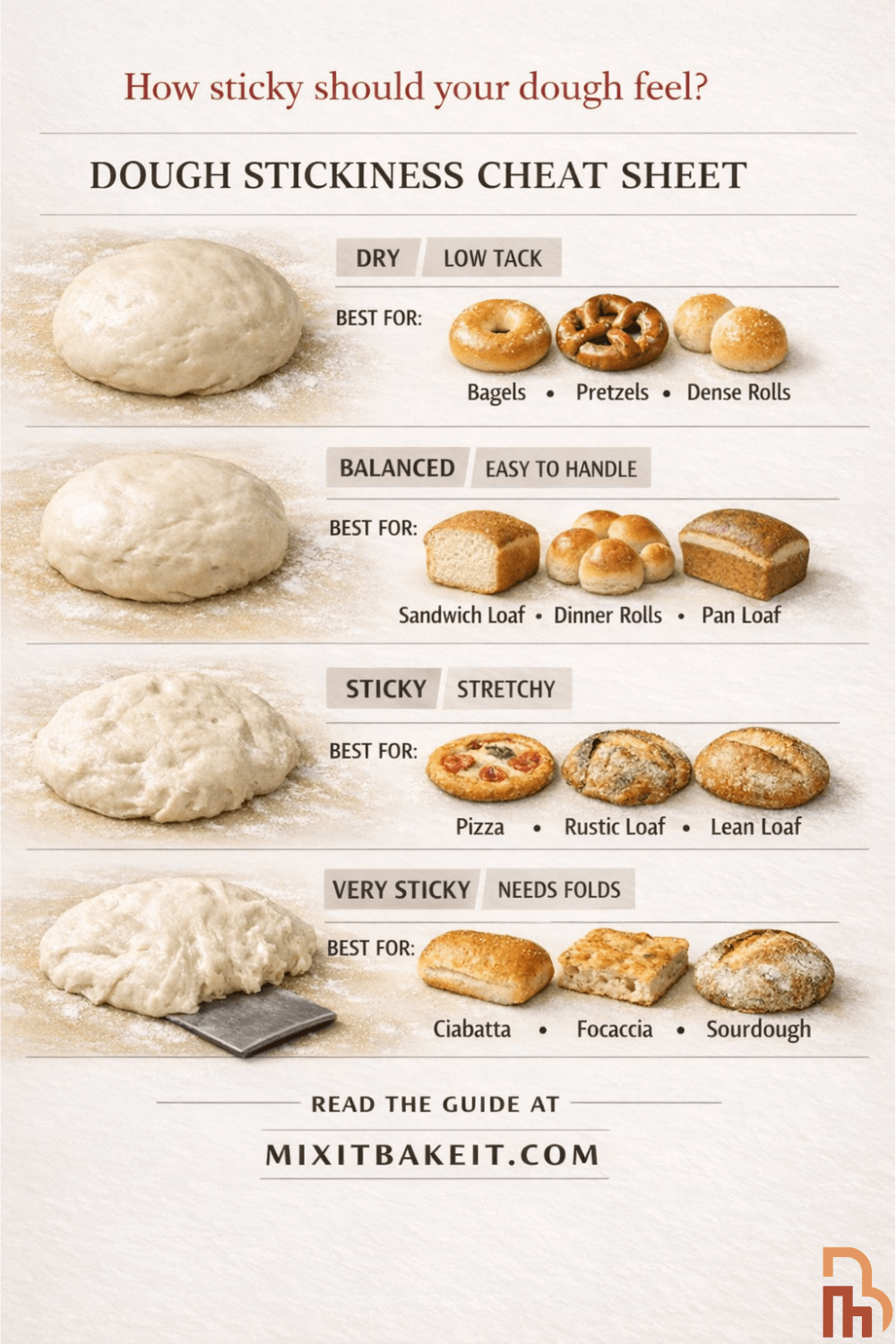
Dough doesn’t flip from dry to wrong. It moves along a range. Some breads are meant to feel firm and barely tacky. Others are intentionally soft and cling slightly during shaping.
Before deciding whether something is off, it helps to see what different levels of stickiness are designed for.
Sticky alone isn’t the problem. Misreading it is.
If you’re unsure whether you’re feeling hydration or underdevelopment, start with Sticky Dough Feel for a stage-by-stage breakdown.
When Sticky Dough Needs More Development
Sometimes sticky dough has nothing to do with too much water. It is simply too early.
The dough has not built enough internal structure yet, so it feels wetter and messier than it will a little later.
It may stretch a little, then rip. It may cling to your fingers and smear more than it lifts. The surface often looks rough instead of smooth, and the dough can feel pasty instead of lightly springy.
That points to a development issue, not a hydration issue.
Early in mixing, the flour and water are combined, but the dough is still loose and poorly organized.
As mixing continues, or as the dough rests, that internal structure gets stronger.
The dough starts holding itself together better. It traps water more effectively, feels smoother, and stretches cleanly instead of tearing.
Before you add flour, check whether the dough gets smoother after 5 to 10 minutes of rest.
If it does, the problem was early development, not too much water.
If you’re unsure how long development should take, see How Long to Knead Dough in a Stand Mixer.
When Sticky Dough Is Normal for High-Hydration Bread
Sometimes sticky dough is not underdeveloped. It is just a wetter dough.
This kind usually looks smoother, stretches farther before resisting, and strengthens when folded. It still clings more than you expect, but it does not act weak in the same way.
Above roughly 72 to 75% hydration, dough often stays softer and slightly adhesive even when developed properly. That is normal.
Sticky but normal often looks like this:
- clings lightly but does not smear everywhere
- stretches farther before resisting
- smooths out after folds
- still holds some shape between handling steps
The fix is usually not more flour. It is better handling.
If the dough feels wetter than expected but still strengthens with folds, the next question is whether it is just sticky at this stage or truly overhydrated. The sticky dough fixes guide is the next step.
If you want to understand what different hydration percentages actually produce, use this Dough Hydration guide as your reference.
Why Is My Dough Stickier After Bulk Fermentation?
Dough can feel manageable during mixing, then looser and tackier later. That often happens during bulk fermentation.
As gas builds inside and the dough relaxes between folds, the dough starts to feel softer, stretch more, and sometimes feel stickier than before.
That is not automatically a problem. It is often just a stage change.
If the dough still keeps gentle tension and holds some shape, it may be right where it should be.
If it spreads fast, feels fragile, or tears easily during handling, it may have gone too far.
Bulk fermentation changes dough feel. The question is not whether it got stickier, but whether it still has enough strength to hold together.
This guide to bulk fermentation explains why dough often becomes smoother, more aerated, and alive in the bowl as fermentation progresses
What Sticky Dough Looks Like During Shaping and Proofing
Sticky dough tells you more once it leaves the bowl.
During shaping, the question is not whether the dough sticks a little. It is whether it still holds tension and shape. Some sticky dough is still workable. Some has fermented too far. Some is not ready yet.
If the dough is still workable, it has tension when you shape it. The seam can close.
The surface may soften as it rests, but it does not collapse into a puddle. It may feel soft and clingy, but it still responds to your hands.
If the dough is too far gone, it spreads quickly after shaping, the skin tears easily, and it loses strength.
The seam may refuse to stay closed. When you handle it, it can deflate more.
That kind of sticky dough does not just feel wet. It feels fragile.
A dough that’s not ready yet feels tight, springs back hard when you try to shape it, resists stretching, and does not feel lightly puffy.
In that case, it has not relaxed or fermented enough yet.
A little stickiness during shaping and proofing is normal. What matters is whether the dough still holds together, keeps its shape, and does not spread too easily when handled.
If you are wondering whether sticky dough can still be shaped well, this tutorial on how to shape a boule shows how slight bench grip helps the dough build surface tension instead of sliding around.
Tacky vs Truly Sticky Dough
There’s a distinction most bakers feel but don’t name.
Tacky dough:
- Clings lightly
- Releases cleanly
- Holds shape once tensioned
Truly sticky dough:
- Leaves residue
- Smears under pressure
- Spreads without resistance
This is a feel difference, not just a visual one. If the dough strengthens with folds and starts holding shape, it was just early, not wrong.
If you’ve identified the stage but need practical handling adjustments, see Sticky Dough Fixes.
When You Should Add Flour to Sticky Dough
Adding flour should be rare and deliberate.
Use it only when the dough never improves, rest does not help, and you can confirm a measuring mistake.
If the dough gets smoother with time, folds, or rest, flour is probably not the answer.
Extra flour lowers the water ratio and can turn a manageable dough into a tighter, heavier loaf. That is how a sticky dough fix can end in dense bread.
Adding flour too quickly can turn a manageable dough into a tighter, heavier loaf later, which is why overcorrection often shows up as dense bread.
See the Dense Bread Troubleshooting Guide for the full breakdown.
When Sticky Dough Starts Overloading the Mixer
Sticky dough can change how the mixer behaves.
You may notice the speed slowing, the head bouncing, or the machine shifting on the counter. Those are load signals.
That does not automatically mean the recipe is wrong. It means the mixer is working harder.
Wetter dough and longer mixing both raise the load. Some sticky dough stretches far before resisting, so the hook keeps pulling and wrapping it instead of kneading it cleanly.
If the dough keeps riding up the hook instead of staying centered, see why dough climbs up the hook and what it means.
If this happens often, the real limit may be mixer capacity, not flour.
If bread is something you bake regularly, this is where choosing a stand mixer built for bread dough makes a difference.
Why Is My Dough Sticky? What to Check First
Check what changes.
Does the dough get smoother after rest?
Does it stretch more cleanly after folds?
Does it hold shape better instead of spreading outward?
When you learn to recognize those signs, you stop reacting.
You pause. You observe. You adjust.
And the next time your dough clings to your hands, you won’t rush for flour.
You’ll feel it. You’ll know whether it’s still developing — or simply hydrated.