
Notice: I receive compensation if you buy something through affiliate links on this post. This does not change the price you would pay. As an Amazon Associate I earn from qualifying purchases.
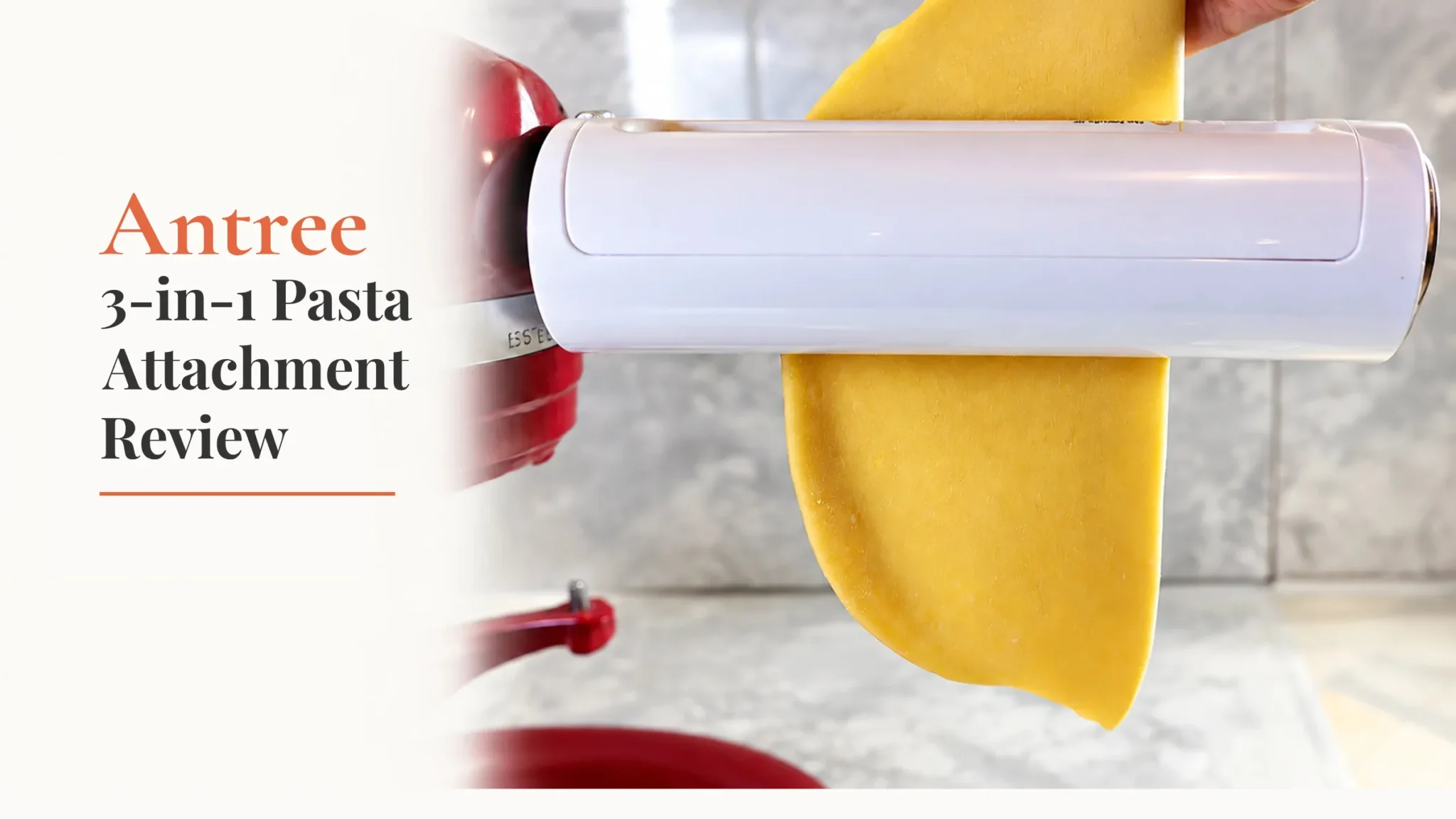
The Antree 3-in-1 Pasta Maker Attachment combines an eight-setting roller, spaghetti cutter, and fettuccine cutter in one unit for compatible KitchenAid stand mixers. It costs less than KitchenAid's three-piece set.
In repeated tests with all-purpose flour and semola rimacinata egg pasta, it produced smooth, even sheets and cleanly cut noodles.
Its main limitation is cleaning: dough can become lodged deep inside the cutters, where it's difficult to remove. Trapped residue can interfere with cutting and cause noodles to crumple.
The Antree delivers reliable rolling and cutting performance at a reasonable price, making it a practical choice for home cooks who regularly make fresh pasta.
The Antree 3-in-1 Pasta Maker attachment delivers what I want: a way to roll fresh pasta and cut spaghetti and fettuccine with my KitchenAid Pro stand mixer, without paying for three separate attachments.
Since I got it, I’ve made multiple batches with different flours and dough consistencies. I’ve watched firm, slightly rough dough turn into smooth, thin sheets and long strands of pasta that cook up tender with a satisfying bite and chew.
Not every batch went smoothly. I’ve had dough stick to the rollers, noodles crumple in the cutters, and dried bits of dough that took patience to remove.
Along the way, I’ve learned which problems came from the dough and which were the Antree’s quirks.
So, has the Antree lived up to my expectations? Here’s what I’ve learned about its rolling and cutting performance, ease of use, cleaning, and whether it’s worth buying.
Quick Verdict: Antree 3-in-1 Attachment
| Evaluation Criteria | Rating |
|---|---|
| Pasta rolling performance | 4.5/5 |
| Cutting performance | 4.5/5 |
| Ease of use | 4.2/5 |
| Cleaning and maintenance | 4.0/5 |
| Value for money | 4.5/5 |
| Overall Rating | 4.3/5 |
Quick Verdict: The Antree 3-in-1 produces smooth pasta sheets and clean spaghetti and fettuccine at a much lower price than separate KitchenAid attachments. Its downside is cleaning trapped dough from the cutters.
What Is the Antree 3-in-1 Pasta Maker Attachment?
The Antree 3-in-1 Pasta Maker Attachment combines a pasta roller, spaghetti cutter, and fettuccine cutter in a single unit.
It connects to the power hub of a compatible KitchenAid stand mixer and uses its motor to roll and cut fresh pasta dough.
Because it’s a 3-in-1 unit, you don’t have to swap attachments when switching from rolling to cutting.
The attachment has a plastic body with stainless steel rollers and cutters.
With an 8-thickness roller setting, you can gradually thin sheets to your desired thickness.
The package includes the 3-in-1 pasta attachment, a cleaning brush, and a thumb screw for securing it to the mixer power hub.
Antree Pasta Attachment Specifications
| Feature | Antree 3-in-1 Pasta Attachment |
|---|---|
| Functions | Pasta roller, spaghetti cutter, fettuccine cutter |
| Roller settings | 8 thickness settings |
| Attachment type | KitchenAid stand mixer power hub |
| Material | Plastic body; stainless steel rollers and cutters |
| Included accessories | Cleaning brush and thumb screw |
| Compatibility | Compatible KitchenAid stand mixers with a suitable power hub; verify your mixer model before purchasing |
| Cleaning | Follow the manufacturer’s cleaning and maintenance instructions |
| Current price | Check price on Amazon |
How I Tested the Antree Pasta Attachment
I’ve used the Antree 3-in-1 attachment to roll and cut multiple batches of fresh egg pasta made with all-purpose (AP) flour and semola rimacinata.
I tested different dough consistencies, rolled sheets on various settings, and used the spaghetti and fettuccine cutters.
I also tested softer, stickier dough to see how the attachment handled it. Along the way, I encountered dough grabbing the rollers, noodles sticking together, and pasta crumpling in a cutter that had trapped dried dough.
These tests helped me distinguish between attachment issues and problems caused by dough consistency, feeding technique, or cleaning.
The Pasta Doughs I Used
I tested two flour types, using both mixer-kneaded and hand-kneaded dough.
Semola rimacinata egg pasta: For my mixer-kneaded batch, I used 300 g flour, 150 g eggs, and 20 g water. The dough was initially stiff and rough but became smoother and more pliable as I kneaded it and then rested it. It was easy to handle, passed through the rollers without sticking, and produced cleanly cut noodles.
I rolled this dough to less than 1 mm at setting 6 and continued through setting 8 without it tearing.
I discussed this test in my guide to How Long to Knead Pasta Dough, where I compared how dough texture and elasticity developed during kneading.
All-purpose flour egg pasta: I used a smaller batch of 102 g flour and 51 g egg, adding different amounts of water to test how softness affected rolling and cutting.
- 8 g additional water: Soft and workable with some resistance.
- 10–13 g additional water: Easier to knead and roll while remaining manageable.
- 15–16 g additional water: Too soft and sticky. The dough grabbed the rollers on the first pass, although thinner passes worked better. The sheet became extremely extensible, sagged, and had almost no springback. Cut noodles also stuck together.
I explain how dough consistency and feeding technique contribute to these problems in Why Pasta Dough Sticks to Rollers.
I also hand-kneaded a small egg pasta batch and observed how the dough became smoother, more elastic, and easier to handle as I kneaded.
What these tests showed: The Antree pasta attachment handled properly prepared dough well, including rolling very thin sheets without tearing. But when the dough became excessively soft, cut noodles stuck together.
I also learned that dough thicker than the widest roller setting could grab and stick to the roller, while dried dough trapped inside a cutter could crumple fresh noodles.
These observations are important when evaluating the attachment. Not every rolling or cutting problem indicates a machine defect.
Dough consistency, preparation, feeding technique, and cleaning all affect the results.

Antree 3-in-1 KitchenAid Pasta Attachment
- 3-in-1 convenience: Roll pasta sheets and cut spaghetti or fettuccine without switching attachments.
- Proven performance: Produces smooth, thin sheets and cleanly separated noodles with properly prepared dough.
- Better value: Get all three functions at a lower cost than the KitchenAid 3-piece attachment set.
How Well Does the Antree Pasta Roller Work?
The Antree pasta roller has performed well across my tests with both all-purpose flour and semola rimacinata dough.
Dough consistency or feeding technique caused most of the issues I encountered.
Feeding the Dough Through the Roller
Properly prepared dough fed smoothly through the roller, but its thickness before the first pass is important.
When I fed a piece of bulky dough, it grabbed the rollers. Flattening it so it’s thinner than the widest opening solved the problem.
I always feed the dough through setting 1 on the first pass. Then, I run it through all settings in order rather than skipping settings.
Catching the leading edge of the sheet as it emerges on the first pass prevents it from curling up and grabbing the roller. Once it has enough length, I let it hang without pulling so it does not get distorted or stretched.
Watch the sheet width. A pasta sheet wider than the roller opening is difficult to feed and can fold or wrinkle at the edges. Trim, fold, or reshape the dough as needed to keep the sheet slightly narrower than the roller opening.
Adjusting the Thickness
The Antree has eight thickness settings for progressively thinning the sheet.
I start at the widest setting and work toward my desired thickness, passing the dough through each setting. This gradual reduction helps maintain an even sheet and avoids forcing thick dough through a narrow gap.
| Roller Setting | Suggested Use |
|---|---|
| 1–2 | Initial kneading and thinning |
| 3 | Thick noodles |
| 4 | Egg noodles |
| 4–5 | Lasagna, fettuccine, spaghetti, ravioli |
| 6–7 | Tortellini, thin fettuccine, fine linguine |
| 7–8 | Very thin pasta, such as capellini |
Source: Antree pasta attachment manual. These are the manufacturer’s suggested settings; actual preferences may vary depending on dough consistency and desired texture.
The thickness range has been more than sufficient for the pasta I’ve made. At setting 6, I could roll semola rimacinata dough to less than 1 mm.
Rolling the dough on setting 8 without tearing confirmed that the roller can produce very thin sheets when the dough has sufficient strength.
For spaghetti and fettuccine, the ideal thickness depends on the texture and bite I want in the finished pasta.
The eight settings offer flexibility, though the thinnest sheet isn’t automatically the best choice for every pasta shape.
Quality of the Rolled Pasta Sheets
Pasta sheet quality is one of Antree’s strongest points in my testing.
My properly kneaded and rested semola rimacinata dough passed through the rollers smoothly. The dough remained intact even through the thinnest setting.
The results matched what I observed during kneading: dough with enough elasticity and pliability rolls easily into a uniform sheet.
The softer AP flour dough behaved differently. With excessive added water, it became extremely extensible, sagged under its own weight, and had almost no springback.
Although it could still pass through thinner settings, it was harder to control and handle cleanly.
This distinction matters because a sheet that wrinkles, stretches excessively, or sticks isn’t necessarily evidence of poor roller performance.
Overall, the Antree roller has delivered the smoothness, thickness control, and sheet quality I need for homemade spaghetti and fettuccine.
How Well Do the Antree Pasta Cutters Work?
Both the spaghetti and fettuccine cutters performed well in my tests, producing cleanly separated noodles when pasta sheets are well-prepared.
I’ve used them with semola rimacinata and all-purpose flour egg dough, including batches with different moisture levels.
Dough consistency and trapped dough on the cutters affected cutting performance.
Fettuccine Cutter
The Antree fettuccine cutter produces evenly sized, flat noodles.
With my properly kneaded and rested semola rimacinata dough, the strands came through without sticking together.
The cutter worked best when the pasta sheet was smooth, manageable, and not excessively soft.
I cooked my fresh fettuccine for approximately 5 minutes and liked the resulting texture and chew. This was my preferred cooking time for that batch, rather than a fixed recommendation for all fresh fettuccine.
Spaghetti Cutter
The spaghetti cutter also produced well-formed, separate strands with good dough. The noodles emerged cleanly, without the crumpling or sticking.
With my softer AP flour dough, however, the strands tended to stick together after cutting. This was particularly noticeable in the batch with 15–16 g of additional water per 102 g of flour and 51 g of egg. The sheet was extremely extensible and sticky even before cutting.
This suggested that the problem was primarily the dough’s excessive softness rather than a cutter deficiency.
My fresh spaghetti cooked in approximately 3 minutes, producing the texture I preferred.
What Happened When My Pasta Crumpled in the Cutter
One of the more frustrating problems I encountered was pasta coming out of the cutter crumpled instead of separating into clean strands.
At first, it seemed like poor cutting performance. However, I discovered dried dough trapped inside the cutter. The residue interfered with fresh pasta passing through, causing the noodles to bunch up and crumple.
After removing the trapped dough, the cutter worked properly again.
It reinforced something I observed throughout my testing: poor cutting results don’t always mean the cutter itself is defective.
Excessively soft dough, improperly prepared sheets, and dried residue can all interfere with clean noodle separation.
I cover these problems and their solutions in more detail in Pasta Dough Sticking to Rollers or Cutters? Causes and Fixes.
Overall, I’m satisfied with both cutters. With properly prepared dough, they produce clean spaghetti and fettuccine with the texture and chew I want.
The main drawback isn’t the cut quality, but the need to keep the cutters free of trapped dough.
Is the Antree Pasta Attachment Easy to Use?
The Antree 3-in-1 is easy to use once you understand how to prepare and feed the dough. Its biggest convenience is that it combines the roller, spaghetti cutter, and fettuccine cutter in one unit, so you don’t have to remove and replace attachments when switching between rolling and cutting.
To install it, fit the attachment into the KitchenAid power hub and secure it with the thumb screw. Once attached, the mixer’s motor powers all three functions.
To roll pasta, I start by flattening a portion of rested dough so it can enter the widest roller setting without getting caught. I then feed it through progressively thinner settings until I reach the thickness I want.
Once the sheet reaches the desired thickness, I simply feed it into the spaghetti or fettuccine cutter without changing attachments.
One Awkward Detail: Reaching the Speed Control
When I attach the Antree to my KitchenAid Pro 600, the fettuccine cutter is on the opposite side of the mixer’s speed control. This makes it a little awkward to reach over and adjust the speed.
My KitchenAid Pro 600 is one of the larger stand mixers, and I’m not tall. Someone taller or using a smaller KitchenAid model may find it less awkward to reach the speed control.
TIP
A simple workaround is to turn on the mixer first, then guide the pasta sheet into the cutter and catch the strands. Once the sheet has passed through, I lay down the cut pasta, then reach over to switch off the mixer. This way, I don’t have to operate the speed control while handling the dough.
Cleaning the Antree Pasta Attachment
Cleaning the Antree is generally straightforward, but dough trapped deep inside the cutters can be difficult to remove. I’ve experienced this firsthand when leftover dough caused freshly cut noodles to crumple instead of separating cleanly.
How to Clean the Antree
The Antree requires dry cleaning rather than rinsing or soaking. Here’s the approach I use:
- Turn off and unplug the mixer, then remove the attachment.
- Remove the top cover to fully expose the rollers and cutters.
- Let any stuck dough dry completely. Dried pieces are easier to remove without smearing dough into the mechanism.
- Brush away dried residue using the supplied cleaning brush.
- Carefully dislodge trapped pieces with a wooden toothpick or skewer where accessible, without forcing it against the cutters.
- Turn the attachment over. Repeat Steps 4 & 5.
- Inspect the openings for remaining dough before storing the attachment.
The Main Cleaning Challenge
The exposed surfaces are easy enough to clean. The difficulty comes when dough becomes lodged inside the cutters, beyond the brush’s reach.
Unlike some pasta machines, I can’t simply rotate every cutting component manually to expose trapped residue. This makes removing stubborn pieces more tedious.
If your model has a removable access cover, follow the manufacturer’s instructions before opening it. Don’t force or dismantle any components.
Should You Use Water?
Avoid rinsing, soaking, or putting the attachment in the dishwasher unless the manufacturer explicitly permits it. Water can carry softened dough deeper into the mechanism and potentially cause corrosion or damage.
Always follow the manufacturer’s cleaning and maintenance instructions for your specific attachment.
For me, removing trapped dough remains the Antree’s biggest inconvenience. However, once I cleared the residue that caused my noodles to crumple, the cutters worked properly again.
Antree 3-in-1 Pasta Attachment: Pros and Cons
Antree vs KitchenAid Pasta Attachments
The Antree 3-in-1 and KitchenAid 3-Piece Pasta Roller & Cutter Set have the same basic functions: rolling fresh pasta sheets and cutting them into spaghetti or fettuccine. The main differences are their design, construction, and price.
Antree vs KitchenAid: What’s the Difference?
The Antree combines all three functions in one attachment, while the KitchenAid set includes three separate metal attachments that you swap as needed.
Both have eight roller thickness settings. The Antree has a plastic housing with stainless steel rollers and cutters, while the KitchenAid set features stainless steel rollers and cutters in separate metal-bodied units.
| Feature | Antree 3-in-1 | KitchenAid 3-Piece Set (KSMPRA) |
|---|---|---|
| Brand | Antree, third-party manufacturer | KitchenAid |
| Configuration | One integrated attachment | Three separate attachments |
| Functions | Roller, spaghetti, fettuccine | Roller, spaghetti, fettuccine |
| Thickness settings | 8 | 8 |
| Roller width | Approximately 5.5 inches | 6 inches |
| Construction | Plastic body, stainless steel rollers and cutters | Metal-bodied attachments with stainless steel rollers and cutters |
| Switching functions | Feed dough into a different opening | Change attachments |
| Included accessories | Cleaning brush, thumb screw | Cleaning brush |
| Cleaning | Dry cleaning according to manufacturer’s instructions | Dry cleaning according to manufacturer’s instructions |
| Warranty | One year | One-year limited warranty; regional terms vary |
| Price | Lower-cost alternative | Premium-priced branded set |
Note: KitchenAid specifications are based on manufacturer information. I haven’t personally tested the KitchenAid set, so I can’t directly compare rolling smoothness, cutting quality, durability, or ease of cleaning.
Check the Antree 3-in-1 price on Amazon
View the KitchenAid 3-Piece Pasta Roller & Cutter Set
Who Should Buy the Antree Pasta Attachment?
The Antree 3-in-1 is a good choice for KitchenAid owners who want an affordable, convenient way to make fresh pasta.
I’d recommend it if you:
- Make fresh pasta regularly. Powered rolling saves time and effort, especially with multiple batches.
- Want spaghetti and fettuccine. Both cutters produce clean, well-separated noodles with dough that’s the right consistency.
- Prefer an all-in-one design. Roll and cut without swapping attachments.
- Want better value. Get three functions at a lower price than KitchenAid’s separate attachments.
Who Should Skip It?
- Occasional pasta makers. A rolling pin may be enough if you rarely make fresh pasta.
- Hand-rolling enthusiasts. You can produce thin, even sheets without a machine. See my [How to Roll Pasta Dough by Hand] guide.
- Anyone who dislikes fiddly cleaning. Trapped dough inside the cutters can be difficult to remove.
- Those wanting more pasta shapes. The built-in cutters are limited to spaghetti and fettuccine.
Ready to Make Fresh Pasta with the Antree?
There’s something satisfying about watching a sheet of fresh pasta turn into long, separate strands, then cooking them until they’re tender but still have that pleasant bite and chew.
That’s what keeps me making fresh pasta, and the Antree has made the process easier without taking away the hands-on pleasure of working with dough.
If you already have a compatible KitchenAid mixer and want to make fresh pasta more often, I think the Antree is worth considering.
You don’t need to master everything on your first try. Start with a small batch, get a feel for the dough, and learn how it behaves as you roll and cut it.
If fresh spaghetti or fettuccine is something you’d enjoy making in your own kitchen, the Antree is an affordable place to start.
Give it a try, and you may find yourself reaching for homemade pasta more often than you expected.