
Notice: I receive compensation if you buy something through affiliate links on this post. This does not change the price you would pay. As an Amazon Associate I earn from qualifying purchases.
The dough still feels rough.
A few minutes later, it’s smoother.
You knead a little longer, wondering if it needs more, or if you’re wasting effort.
How long should you knead pasta dough?
I compared hand kneading and stand mixer kneading minute by minute to see when the dough actually stopped changing, and what happened after it rested and rolled.
Quick Answer
If you’re wondering how long to knead pasta dough, my tests showed about 7 minutes in a stand mixer and about 10 minutes by hand
More important than the timer, I stopped kneading when the dough became cohesive, noticeably smoother, sprang back slightly when pressed, and showed little improvement with additional kneading.
These times come from my experiments using fine Durum wheat (semolina rimancinata), eggs, and a small amount of water.
Different flours, dough formulas, mixers, and kneading techniques can change how long your dough takes to develop.
Experiment at a Glance
- In the stand mixer test, the dough reached its practical kneading endpoint at about 7 minutes.
- In the hand-kneading test, the dough continued improving until about 10 minutes.
- A 30-minute rest improved the dough’s workability.
- After resting, both doughs rolled to about less than 1 mm thick without tearing.
What Does Properly Kneaded Pasta Dough Feel Like?
Unlike bread dough, pasta dough is naturally low in hydration, so it won’t become soft or stretchy as you knead it.
Instead of chasing a specific kneading time, pay attention to how the dough feels. A properly kneaded pasta dough should be firm, cohesive, smoother than when you started, and spring back slightly when pressed.
It should feel firm, not soft
If you’re used to making bread, pasta dough may seem under-kneaded because it stays firm throughout the process. That’s completely normal.
It is dense and resistant rather than soft or pillowy.
As you knead, the dough should gradually become easier to handle while remaining firmer than bread dough.
It should be cohesive and smooth
A well-kneaded pasta dough forms a cohesive ball with a noticeably smoother surface.
During early kneading, the dough may look rough or slightly shaggy. Over time, those rough spots begin to even out as the gluten develops.
Don’t expect a perfectly silky or polished surface, though. A few small rough patches or faint creases are normal, especially before the dough has rested.
It should spring back slightly
When you gently press the dough with a fingertip, it should spring back a little. That slight elasticity is a good sign that the gluten has developed enough to support rolling.
The spring back is subtler than bread dough. Rather than bouncing back quickly, it should resist gentle pressure and recover slightly when released.
Stand Mixer Test: How Long Did It Take?
To see how quickly pasta dough developed in a stand mixer, I recorded its changes every few minutes rather than relying on a timer alone.
Experiment Setup
- Flour: 300 g semola rimacinata
- Eggs: 150 g
- Water: 20 g
- Mixer: KitchenAid Pro 600
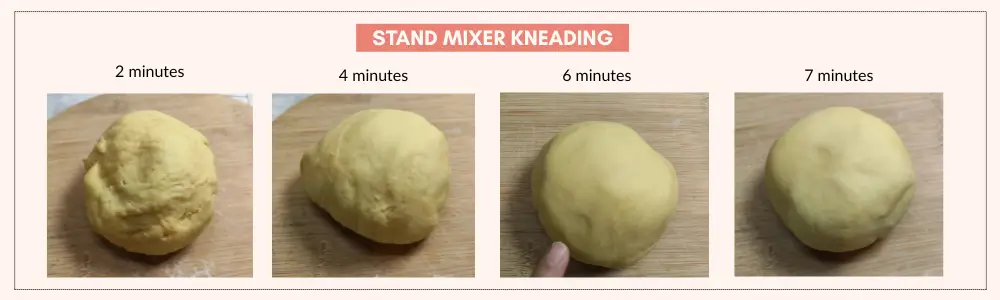
Minute 2
During the first 2 minutes, the dough was rough and very tight. Instead of grabbing the hook, it was pushed around the bowl, bumping against the sides and causing the mixer to strain slightly.
Minute 4
By 4 minutes, the dough had become less tight and noticeably smoother. It formed a more cohesive mass, although it briefly split apart during kneading before coming back together. The mixer also sounded less strained than it did earlier.
Minute 5
At 5 minutes, I noticed the first major change. The dough began grabbing the hook instead of resisting every rotation.
The surface looked smoother, and the dough developed a slight spring back when pressed.
Observation: This was the first major sign that the dough was becoming properly kneaded.
Minute 6
After 6 minutes, the dough felt noticeably softer while remaining firm. The surface became smoother, the springback was more pronounced, and the dough grabbed the hook more consistently throughout the kneading process.
Minute 7
By 7 minutes, the dough felt slightly softer again and showed a little more spring back than it did at 6 minutes. Although the improvements were smaller than those seen earlier in the test, they were still noticeable.
Experiment Finding
In this test, the dough continued improving through 7 minutes of kneading. The most noticeable changes occurred during the first 6 minutes, while the final minute produced smaller improvements in softness and spring back.
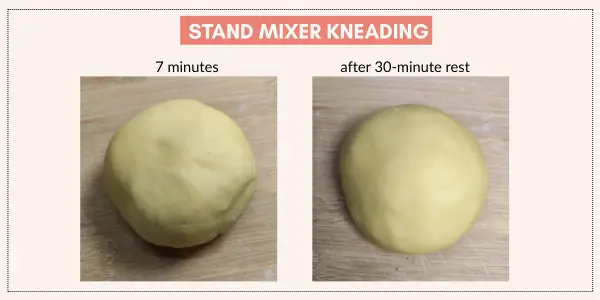
After a 30-Minute Rest
Resting the dough for 30 minutes made it slightly softer while improving its surface smoothness and sheen. It also held its shape better, forming a more defined ball.
Hand Kneading Test: How Long Did It Take?
To compare hand kneading with a stand mixer, I repeated the experiment using a smaller batch of dough and recorded how it changed every few minutes.
Experiment Setup
- Flour: 100 g semola rimacinata
- Eggs: 50 g
- Water: 8 g
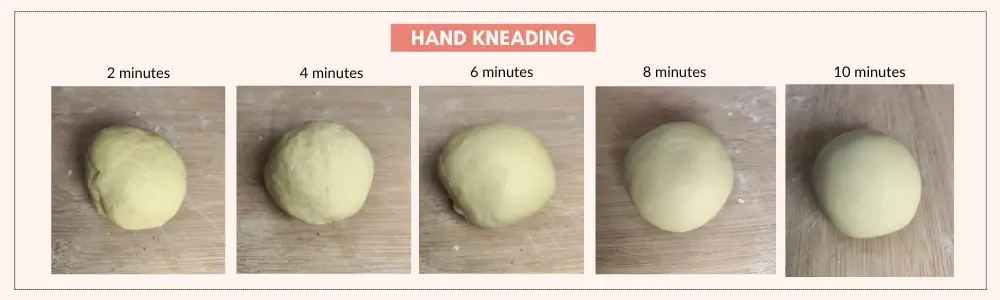
Minute 2
After 2 minutes, the ingredients had come together into a rough, cohesive ball. The surface was uneven, and the dough still felt quite firm.
Minute 4
By 4 minutes, the dough was still rough and felt tight, although it had become more cohesive than before.
Minute 6
At 6 minutes, the dough had become noticeably smoother and more cohesive. It also showed a slight springback when gently pressed, showing the dough was beginning to develop strength.
Minute 8
After 8 minutes, the dough felt softer while remaining firm. The surface continued to smooth out, and the springback became more noticeable.
Minute 10
By 10 minutes, the dough was smoother and slightly shinier than before. It also felt softer, more pliable, and it had the best springback of all the hand-kneading stages.
Experiment Finding
In this test, the dough continued improving through 10 minutes of hand kneading. The largest changes occurred during the first 8 minutes, while the final 2 minutes produced smaller but still noticeable improvements in smoothness, softness, and spring back.
After a 30-Minute Rest
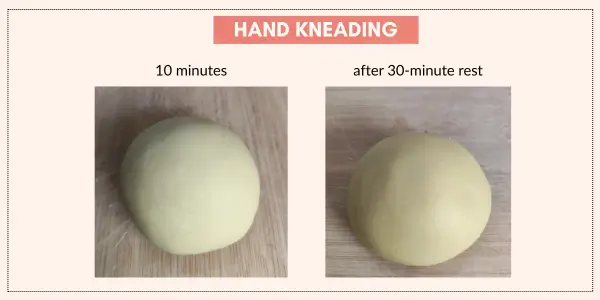
After resting for 30 minutes, the dough felt slightly softer and more pliable. It also formed a more defined ball and developed a smoother, shinier surface, making it even easier to roll.
If you already own a KitchenAid stand mixer, you can also use it to roll and cut fresh pasta with the KitchenAid Pasta Attachment.
How Do You Know When to Stop Kneading?
A timer provides a helpful starting point, but it shouldn’t be the only thing you rely on.
Instead, watch how the dough changes as you knead. Once the dough stops improving in meaningful ways, it’s usually ready to rest.
Look for these signs:
- It forms one cohesive dough ball. The dough should no longer look shaggy or crumbly.
- The surface becomes smoother. It doesn’t have to be perfectly polished, but the rough patches should be much less pronounced.
- It springs back slightly when pressed. When you gently press the dough with a fingertip, it should offer slight resistance and spring back a little when you release it.
- Additional kneading no longer changes the dough. If another minute of kneading produces little visible or tactile improvement, you’ve likely reached the practical kneading endpoint.
No single sign tells the whole story. When several of these happen together, the dough is usually ready to rest before rolling.
Rolling, Cutting, and Cooking Test: Was the Dough Actually Ready?
The real test of properly kneaded pasta dough isn’t when you stop kneading; it’s how well it rolls, cuts, and cooks.
A well-kneaded dough should pass smoothly through the pasta roller, produce cleanly cut noodles, and cook with a pleasant bite.
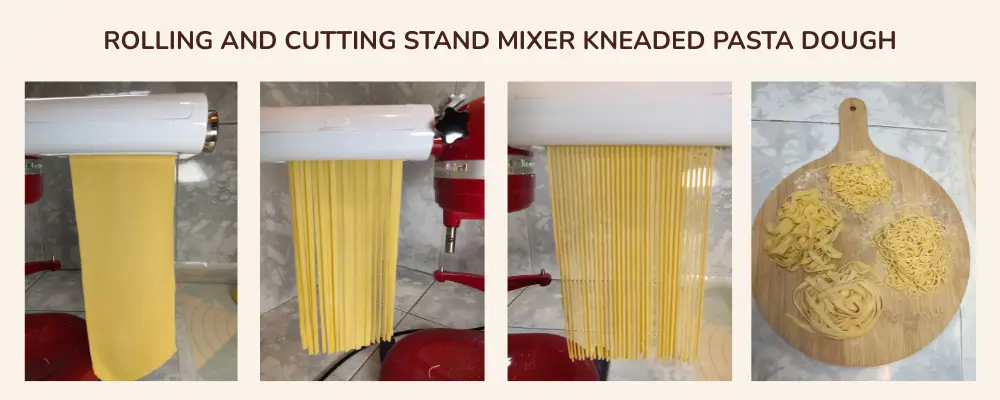
Stand Mixer Dough
After resting, the stand mixer dough passed smoothly through my Antree pasta roller to setting 8 (less than 1 mm thick) without tearing or sticking. It also passed cleanly through the cutter, producing well-defined noodles that separated easily.
I cooked the spaghetti for 3 minutes and the fettuccine for 5 minutes, which produced the level of chewiness and bite I prefer.
Hand-Kneaded Dough
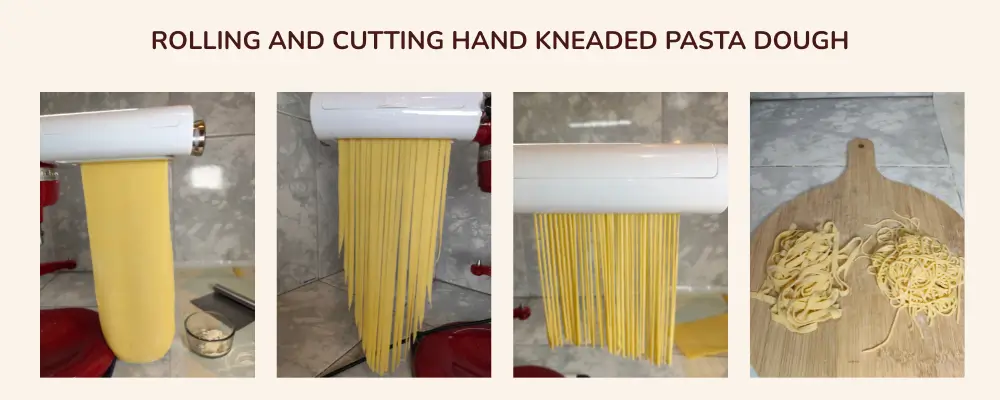
The hand-kneaded dough performed just as well. After resting, it rolled smoothly through the Antree pasta roller to setting 8, cut into uniform noodles, and cooked successfully.
Like the stand mixer dough, the spaghetti reached my preferred texture after 3 minutes, while the fettuccine took 5 minutes.
Does Pasta Dough Need to Pass the Windowpane Test?
The windowpane test is commonly used to check gluten development in bread dough, but it isn’t a reliable indicator for pasta dough.
In my test, the dough stretched well and resisted tearing, showing that the gluten had developed sufficiently. However, it never formed the thin, translucent windowpane you’d expect from a well-kneaded bread dough.

That’s because pasta dough is much lower in hydration than bread dough. Even when it’s properly kneaded, it remains firmer and doesn’t stretch into a paper-thin membrane as easily.
The better test is how the dough performs after resting. If it rolls into a thin sheet without tearing, excessive spring back, or cracking, it has developed enough gluten for pasta dough.
Key Takeaway
A bread-style translucent windowpane isn’t necessary. For pasta dough, successful rolling is a more reliable sign that it’s properly kneaded.
Common Mistakes When Kneading Pasta Dough
A few common mistakes can make pasta dough harder to work with or leave you wondering whether it’s ready. Here’s what to avoid.
Stopping While the Dough Is Still Rough
Early in the kneading process, pasta dough often looks rough and uneven. Give it time to develop. As the gluten forms, the dough should become more cohesive and noticeably smoother before you stop kneading.
Adding Too Much Flour
It’s tempting to add more flour when the dough feels firm or slightly tacky, but too much can make it unnecessarily dry and difficult to roll. Unless the dough is truly sticky, let kneading and resting do the work before adjusting the dough.
Skipping the Rest
Even a properly kneaded dough benefits from resting. In my test, a 30-minute rest softened the dough, improved its surface smoothness, and made it more pliable for rolling. Kneading develops the dough, while resting makes it easier to work with.
Professional pasta makers also emphasize that resting is an essential step for improving dough workability before rolling.
Expecting Bread Dough Softness
Pasta dough should remain firm throughout kneading. If you’re waiting for it to become soft and pillowy like bread dough, you’ll likely keep kneading longer than necessary.
Let the Dough Be Your Guide
Pasta dough starts rough, tight, and stubborn.
As you knead, it becomes smoother, more cohesive, and springs back slightly when pressed.
Then, after a good rest, it becomes more pliable and ready to roll.
In my tests, the timer was only a guide.
The real clues came from the dough itself.
When it stopped changing with additional kneading and rolled into a thin sheet without tearing, I knew it was ready.
The next time you make fresh pasta, watch the dough, not just the clock.
Once your dough is properly kneaded, a pasta roller can make rolling and cutting much faster. Read my KitchenAid 3-Piece Pasta Roller and Cutter Set Review.