
Notice: I receive compensation if you buy something through affiliate links on this post. This does not change the price you would pay. As an Amazon Associate I earn from qualifying purchases.
Some days the dough rises fast.
Other days it moves slowly.
You follow the same recipe.
Use the same flour.
Measure the same ingredients.
But the dough behaves differently anyway.
One hidden variable changes more than most home bakers realize: dough temperature.
Key Takeaways
- Dough temperature affects fermentation speed.
- Warmer dough ferments faster and weakens sooner if left too long.
- Cooler dough ferments more slowly and develops flavor differently.
- Final dough temperature changes how the dough behaves, the proofing time, and oven spring.
- Most home bakers do not need perfect precision, but understanding temperature helps make results consistent.
- An instant-read thermometer is one of the easiest ways to reduce the guesswork during fermentation.
What Is Dough Temperature
Dough temperature is the internal temperature of the dough after mixing.
That number changes more than most home bakers realize.
The flour affects it.
The room affects it.
The water temperature affects it.
Even your mixer adds heat during kneading.
That is why the same recipe can yield different results from one day to the next.
You might follow the same dough recipe in winter and summer and end up with:
- different fermentation speed
- different dough texture
- different proofing time
- different oven spring
The dough is reacting to temperature.
Warm dough moves faster.
Cool dough moves slower.
And once you start paying attention to that, a lot of confusing fermentation problems begin to make sense.
A Lesson Learned the Hard Way
For a long time, I followed recipes that called for warm water around 105–115°F (40–46°C).
I usually aimed for about 110°F, then placed the dough in a warm spot to bulk ferment.
The dough always looked active. It became bubbly, wobbly, and doubled quickly.
I assumed that meant everything was going well.
But the finished bread often told a different story.
The loaves sometimes tasted overly yeasty, the crumb was tighter than I expected, and fermentation seemed to move much faster than the recipe suggested.
Eventually, I realized I was stacking heat sources throughout the process.
Warm water, a warm kitchen, heat from the mixer, and a warm proofing environment were all pushing fermentation faster than I realized.
That made me wonder how much dough temperature was affecting the way my dough behaved.
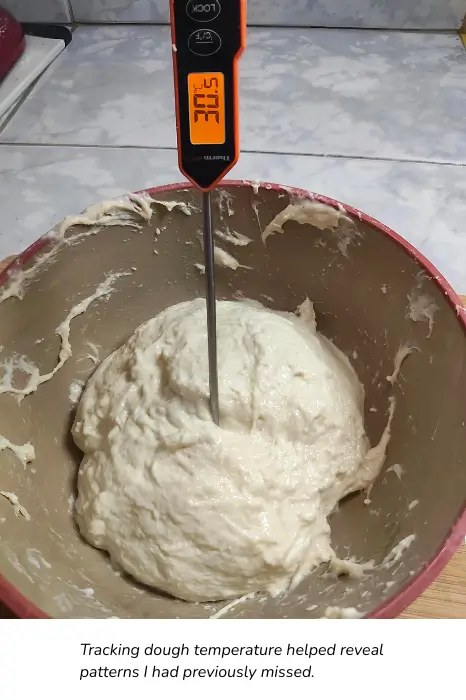
So I started measuring it.
What I Observed When I Started Tracking Dough Temperature
I originally thought sticky dough meant I had a hydration problem.
Then I started measuring dough temperature and recording what happened during mixing, bulk fermentation, shaping, and baking.
Over several loaf-pan bakes, I noticed patterns that changed how I think about dough behavior.
Bake 1: Warm Dough Changed Fast
This bake became what I now call my nightmare bake.
The dough repeatedly reached 30–32°C (86–90°F) during mixing and fermentation. It pooled at the bottom of the mixer bowl, smeared along the sides, and felt sticky throughout handling.
To manage the stickiness, I used multiple rests and folds. However, because the dough remained warm throughout those pauses, fermentation continued moving quickly.
By the final rest, the dough was already noticeably puffy. It showed visible strings of gluten, felt even stickier, and stretched unusually long.
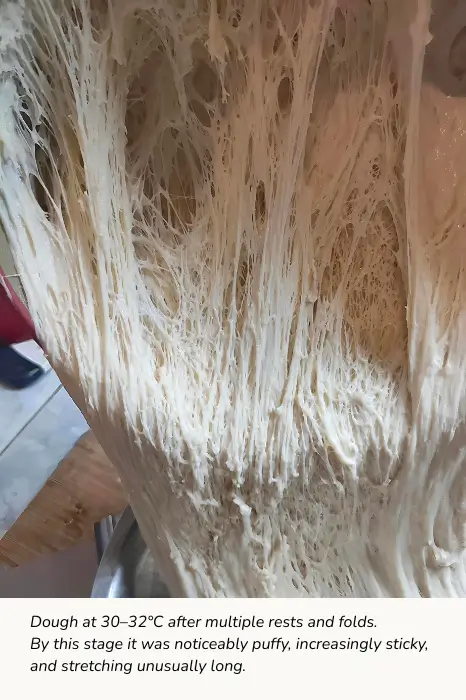
It spread across the bench, welded to the surface, and slid back down whenever I tried to tighten it.
Looking back, the dough behaved as if it had already fermented further than its structure could support.
Despite spreading and shaping poorly, it still produced a good oven spring once baked in a loaf pan, where the sides helped support the dough as it rose.
That bake was the first time I realized that dough temperature affects more than fermentation speed. While I was trying to improve the dough through rests and folds, the warm dough continued to ferment and change.
Bake 2: Cold Water Was Not Enough
For another bake, I used 10°C (50°F) water to reduce the dough temperature.
I expected the dough to remain cool throughout the process.
Instead, the final dough temperature still reached 31.1°C (88°F).
Despite some puddling still, the dough developed strong gluten, passed the windowpane test, and produced good oven spring.
But shaping remained difficult.
Bulk fermentation reached 100% rise in only 28 minutes.
The dough felt airy and full of gas much sooner than I expected.
That bake showed me that cold water alone does not guarantee cool dough.
Mixer friction, room temperature, and fermentation all continue adding heat throughout the process.
Bake 3: Lower Temperatures Changed the Dough
For my next experiment, I deliberately focused on controlling dough temperature throughout the process.
I used 9°C (48°F) water, chilled the flour overnight, shortened mixer time, finished kneading by hand, and moved bulk fermentation and proofing into an air-conditioned room.
The difference was noticeable.
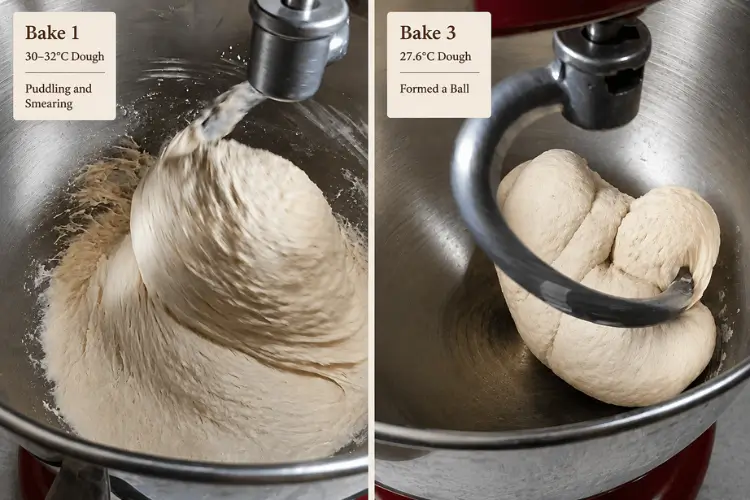
The dough formed a ball during kneading rather than puddling and smearing.
It spread less after being turned onto the bench.
Handling felt easier, and the dough held itself together better.
The final loaf produced a stronger oven spring and a taller profile than previous bakes.
Interestingly, shaping was still challenging.
Even though the dough felt stronger, it remained airy and filled with visible gas pockets after reaching a full 100% bulk rise.
That suggests dough temperature was only part of the story.
What These Bakes Taught Me
Lower dough temperatures improved dough behavior significantly.
I observed:
- less puddling during mixing
- stronger dough structure
- less spreading on the bench
- easier handling
- better oven spring
However, lower temperatures did not completely solve the shaping difficulty.
Because the dough still doubled during bulk fermentation, the amount of gas formed may also have influenced handling.
My takeaway:
Temperature affects not just fermentation speed.
It influences dough strength, stickiness, spreading, shaping, and oven spring.
How Dough Temperature Changes How Dough Behaves
Dough temperature changes both fermentation speed and dough handling.
That is why the same recipe can behave differently from bake to bake.
Warm Dough Moves Faster
Warm dough speeds up yeast activity and gas production.
The dough expands sooner, proofs faster, and moves through fermentation stages more quickly.
Bulk fermentation may finish earlier than expected, especially in warm kitchens or after long mixer kneading.
That faster pace creates a smaller margin for error because the dough continues to proof while you work with it.
Bread recipes can only give estimated fermentation times because dough responds to temperature, not the clock.
A dough that normally takes an hour to bulk ferment may race quickly in a warm kitchen or after long kneading in a stand mixer.
Cool Dough Moves More Gradually
A cool dough slows fermentation down.
The dough expands more gradually and is usually more stable during shaping and proofing. That slower pace gives you more time to observe changes before the dough moves to the next stage.
But when fermentation slows too much, the dough may struggle to build enough gas and structure.
For sourdough bakers who want a deeper dive, Maurizio Leo’s article on dough temperature and fermentation explores how temperature influences fermentation throughout the baking process.
Temperature Changes How Dough Behaves
Temperature changes how the dough behaves during handling, not just how quickly it rises.
Because fermentation progresses faster in warm dough, the dough becomes more gas-filled, more extensible, and less resistant to stretching sooner.
I found that the dough may seem stickier, lose shaping tension sooner, or spread more easily during proofing.
If the dough spreads instead of holding shape, start with this guide on why bread spreads instead of rising.
After the same amount of fermentation time, cool dough is usually less expanded and contains less gas than warm dough, which helps it hold its shape longer during handling.
This is one reason hydration can feel confusing to home bakers.
A dough that feels manageable in a cool kitchen may suddenly feel much wetter in a warm kitchen, even with the same amount of water.
A dough that seems too wet may not require more flour; it may be warmer and fermenting too long. For a deeper look at water balance, see my guide to dough hydration.
That is also why some sticky dough problems are actually temperature-related rather than true hydration problems.
If stickiness is the main issue, this guide on why dough gets sticky breaks down the other common causes.
What Temperature Is Best for Bread Dough?
There is no single perfect dough temperature for every bread type.
Some doughs benefit from warmer fermentation. Others develop better flavor and structure at cooler temperatures.
The goal is not chasing an exact number.
It is keeping fermentation predictable that the dough develops steadily without racing ahead or slowing too much.
Typical Dough Temperature Ranges
| Dough Temperature | Approximate Range | What Usually Happens |
|---|---|---|
| Cool | Below 72°F / 22°C | Slower fermentation, firmer dough, wider timing window |
| Moderate | 72–78°F / 22–26°C | Balanced fermentation speed and easier dough handling |
| Warm | Above 78°F / 26°C | Faster fermentation, softer dough, smaller margin for error |
Professional bakers often work toward a desired dough temperature because it helps keep fermentation and dough development consistent. King Arthur Baking has a helpful introduction to the concept of Desired Dough Temperature (DDT).
Most yeast doughs ferment in a moderate temperature range. Once the dough moves noticeably warmer or cooler than that, fermentation speed and how the dough behaves become more evident.
Most home bakers do not need bakery-level precision.
But understanding whether your dough is running cool, moderate, or warm makes fermentation more predictable.
Sourdough and Enriched Doughs Behave Differently
Different dough types respond to temperature differently.
Small temperature changes can noticeably affect sourdough fermentation speed, timing, and flavor development.
Enriched doughs containing butter, eggs, milk, or sugar usually ferment more slowly because those ingredients slow yeast activity.
That is why two doughs at the same temperature ferment at different speeds.
The dough type affects fermentation, too.
Do Home Bakers Need to Measure Dough Temperature?
Not every loaf requires a thermometer.
Many home bakers make excellent bread simply by watching the dough closely.
But checking dough temperature helps remove a lot of guesswork when fermentation is inconsistent.
This becomes especially helpful when:
- dough rises unpredictably
- bulk fermentation changes from season to season
- stand mixers warm the dough during kneading
- sourdough timing feels difficult to judge
When a Thermometer Helps
A thermometer helps explain why dough does not behave as expected.
You start noticing patterns between dough temperature, fermentation speed, proofing time, and dough behavior.
This is especially useful for:
- troubleshooting inconsistent fermentation
- understanding how warm and cool dough behaves
- checking how much heat a mixer adds during kneading
- managing sourdough timing
A fast instant-read thermometer is the best option for bread dough because it measures internal temperature quickly with minimal disturbance.
Infrared vs Probe Thermometers for Dough
Infrared thermometers only measure surface temperature. That works well for oven surfaces, baking steels, and Dutch ovens, but not for tracking dough temperature.
Probe thermometers measure the dough’s internal temperature, which is what matters during fermentation.
If you want to measure dough temperature, use an instant-read probe thermometer.
Bread bakers typically prefer thin-probe instant-read models because they stabilize quickly and leave only a small puncture in the dough.
What to Look for in an Instant-Read Thermometer
You do not need a commercial bakery thermometer.
For home baking, the most useful features are:
- fast readings
- a thin probe tip
- easy cleaning
- a readable display
- reasonable accuracy
- durable construction
The goal is not laboratory precision. You simply want a quick, reliable way to compare dough temperature between bakes.
Recommended Thermometers for Bread Dough

Best overall: Thermapen ONE — Extremely fast readings for checking dough temperature during mixing, bulk fermentation, and proofing.

Best value: ThermoPop — Simple, reliable, and useful for checking final dough temperature after kneading.

Budget option: Lavatools Javelin — A practical option for comparing dough temperatures and tracking fermentation trends between bakes.
How to Control Dough Temperature Consistently
You do not need perfect precision to control dough temperature. A few small adjustments can make fermentation consistent even when kitchen conditions change.
Adjust Water Temperature
Water temperature is one of the easiest ways to influence dough temperature.
Cooler water slows fermentation. Warmer water speeds it up.
This is especially useful during summer baking or in warm kitchens where fermentation moves quickly.
I eventually stopped thinking of warm water as an automatic good thing and started paying attention to dough temperature.
That small shift helped me judge fermentation by how the dough behaved instead of relying on the clock.
Watch Mixer Friction
Stand mixers warm the dough during kneading.
The longer and faster the mixer runs, the more heat it adds to the dough.
That extra warmth means the dough may enter bulk fermentation warmer and already fermenting faster than expected.
Checking dough temperature after mixing shows how much heat your mixer contributes. This is one reason many bread bakers keep an instant-read thermometer near the mixer.
If you use a stand mixer regularly, this guide on how long to knead dough with a stand mixer explains how mixing time affects dough development and dough temperature.
Control the Proofing Environment
Room temperature affects fermentation throughout bulk fermentation and proofing.
Covered containers trap warmth, and ovens with the light on create a warm proofing environment.
Small changes to the proofing environment help keep fermentation consistent.
Helpful Tools for More Consistent Fermentation
You do not need special equipment to make good bread.
But a few simple tools make fermentation easier to track and understand.
Helpful Tools for More Consistent Fermentation

Straight-sided fermentation containers like the Cambro CamSquare containers make dough expansion easier to track during bulk fermentation.

Proofing boxes such as the Brod & Taylor Folding Proofer help maintain a consistent fermentation environment during cold weather or in heavily air-conditioned kitchens.
Change One Variable at a Time
When fermentation goes wrong, avoid changing everything at once.
If you adjust hydration, yeast, proofing time, and dough temperature in the same bake, it becomes difficult to identify what changed the result.
Keep the rest of the process consistent so you can see the effect of temperature clearly.
Why the Same Dough Behaves Differently
Dough temperature explains many of the moments that confuse home bakers.
The dough that suddenly feels stickier.
The fermentation that moves faster than expected.
The loaf that spreads despite using the same recipe.
Once you start paying attention to dough temperature, those changes become easier to understand.
You rely less on the clock, trust the dough more, and make adjustments sooner.
The result is more consistent bread.