
Notice: I receive compensation if you buy something through affiliate links on this post. This does not change the price you would pay. As an Amazon Associate I earn from qualifying purchases.
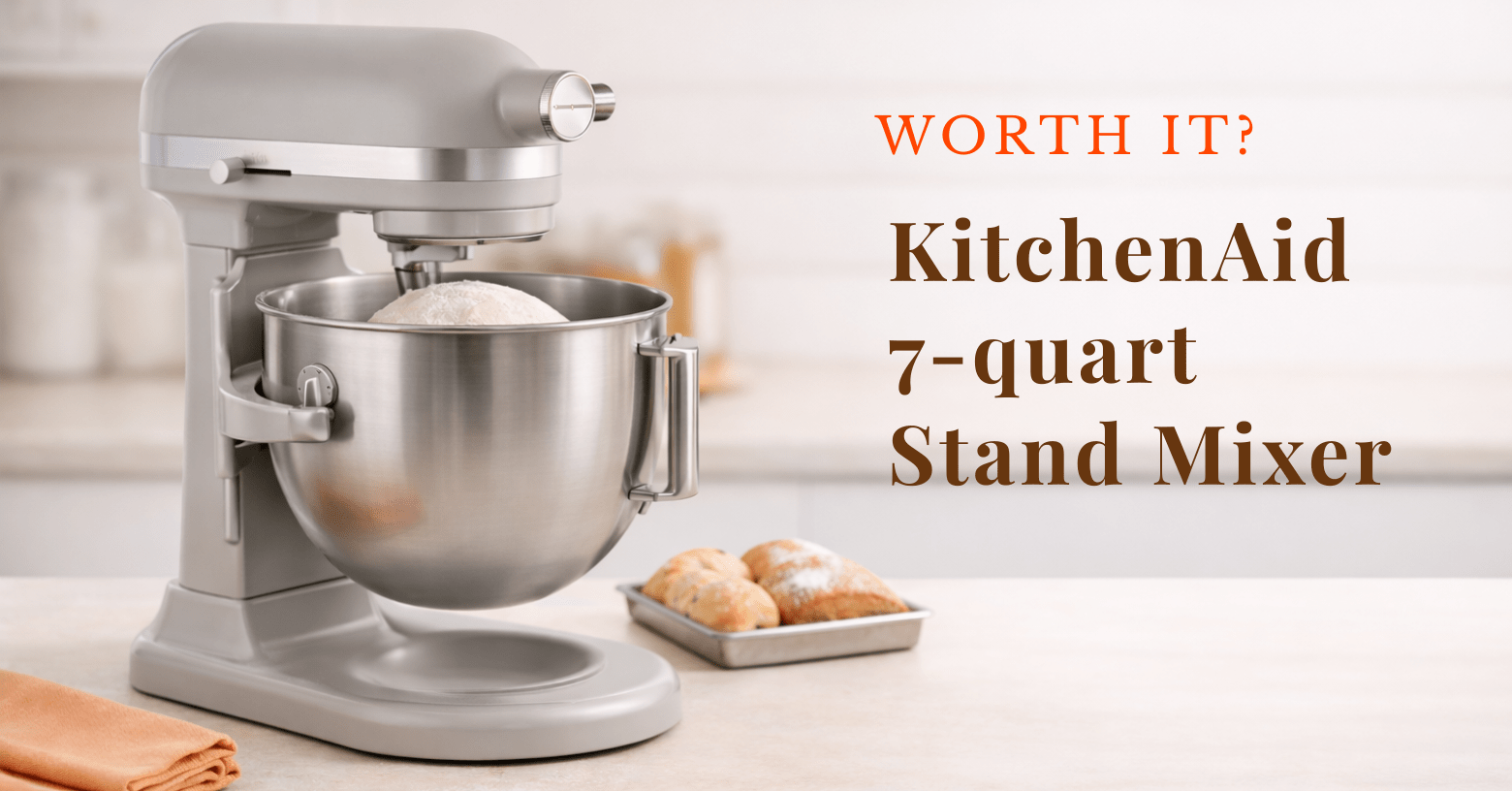
• KitchenAid 7-Qt Bowl-Lift Stand Mixer (KSM70SKXXMH) with a 3-point locking bowl for steadier mixing
• 500W with 11 speeds, including a gentle ½ speed for folding delicate ingredients
• Includes: 7-qt stainless bowl, double flex edge beater, coated flat beater, coated dough hook, 11-wire whip, pouring shield
• Listing claims: up to 13 dozen cookies, 8.5 lb bread dough, or 7.5 lb mashed potatoes per batch
• Reviews: praised for smooth creaming and big-batch performance; recurring negatives include early shut-offs/won’t turn on and beater-to-bowl clearance quirks; it’s also heavy
Quick Verdict (Based on User Reviews & Feedback)
| Feature | Rating | What Users Say |
|---|---|---|
| Mixing Performance | ★★★★☆ | Smooth mixing and great results, though some report early shut-offs. |
| Motor Power | ★★★★⯨ | Strong motor; handles dense mixes well. |
| Ease of Use | ★★★★☆ | Easy overall; bowl-lift locking and weight take practice. |
| Versatility | ★★★★⯨ | Attachment-ready and useful beyond baking; good included tools |
| Noise Level | ★★★★☆ | Reasonably quiet for its power; heavy dough can cause vibration. |
| Price Value | ★★★⯨☆ | Worth it on sale—value drops if you hit reliability/return issues. |
| Design & Aesthetics | ★★★★☆ | Sturdy and attractive; some mention bowl fit and clearance quirks. |
Does your dough make your mixer groan, your mixer bowl too small for double batches, or are you tired of scraping the bottom while the beater misses spots?
That’s where this KitchenAid 7-quart stand mixer review can help.
But, is it actually worth the counter space and the price tag… or is it just a bigger version of the same frustrations?
In this post, I’ll walk you through what matters in baking: power and capacity for bread dough, noise by speed, cleaning and maintenance, parts and repair options, and the most common praises and complaints from owners.
And just so you know, this is a research-based review: it’s built from specs, manuals, brand documentation, and real customer feedback, so you can make a confident decision even if you can’t test the mixer yourself.
Now, let’s get into it, starting with the specs that affect what happens in your bowl.
KitchenAid 7-Quart Stand Mixer Review (KSM70): Quick Specs
The KitchenAid 7-quart bowl-lift stand mixer (KSM70) is for big batches and heavy mixes, with a bowl-lift design that stays steady when dough gets dense.

At-a-Glance Specs
Here are the important specs that affect baking:
- 500 watts: At 500 watts, this KitchenAid 7-quart model is rated for thicker doughs and heavier batters. Wattage alone doesn’t determine results, but it signals what the mixer can handle.
- 11 speeds (including ½ speed): An 11-speed KitchenAid mixer gives you more precise control. The ½ speed is designed for folding in delicate ingredients with less risk of deflating the mixture.
- 7-quart capacity: The 7-quart capacity is the headline feature. It suits bakers who regularly max out smaller bowls with large cookie batches, big cake batters, and holiday baking.
- What’s included: The bundle includes a pouring shield and a double flex edge beater, which cuts down mess and reduces scraping frequency.
Who This Mixer Is Best For
This is a strong fit if you bake big batches and want a mixer built for capacity and stability.
You’ll appreciate this model if:
- You prepare big batches often (cookies for parties, multiple loaves, holiday baking marathons) and want a roomy bowl.
- You make thicker doughs or dense mixes and prefer the steadier bowl-lift design.
- You care about control for “finicky” steps, like gently folding in berries, chocolate chips, or whipped egg whites, where the extra-low speed can be useful.
Who Should Skip It
Is a 7-quart stand mixer too big?
Honestly, it takes up space, is heavier, and changes your workflow. You may want to skip this model if:
- Your baking is mostly small-batch mixing (single cakes, small frosting batches, occasional cookies), and you don’t want a large bowl. A bigger bowl can be frustrating for tiny amounts.
- You have a tight countertop or cabinet space, or you want a mixer you can easily move in and out of storage.
- You prefer something lightweight; bowl-lift models are heavier and can have a small learning curve with attaching and locking the bowl.
- You have physical limitations, and the mixer’s heft will be a struggle.
If you’re still undecided after going through the specs, the next sections: motor and performance, mixing efficiency, and user review patterns, will make the choice clearer, especially if you know whether you bake big batches or mostly small batches.
KitchenAid 7-quart Bowl-Lift Stand Mixer
- Steady as thick dough pulls cleanly off the sides.
- Smooth hum instead of a struggling whine.
- See fewer dry pockets (and less flour “poof” when you start).
- Enjoy faster cleanup with less splatter and overflow.
Bowl-Lift Design on the KitchenAid 7-Quart
This KitchenAid 7-quart uses a bowl-lift design. The head stays fixed. You lock the bowl in and raise it into position. This design keeps the mixer steady when you mix dense doughs and heavy batches.
Here’s what you’ll notice when you use it:
- More stability: The bowl locks in place, and the mixer’s weight helps it stay put.
- Different access: You add ingredients under a fixed head instead of tilting the head back.
- New routine: Attaching the bowl takes a few tries, then it becomes automatic.
- Space matters: Bowl-lift models are heavier and take up more vertical room.
Why A Bowl-Lift Mixer Is More Stable
This model uses a 3-point locking bowl. That lock keeps the bowl from shifting out of alignment. The mixer’s weight adds stability. It resists movement when thick dough pulls against the beater.
What does that mean for stability for heavy dough?
- Less shifting: Thick dough can twist the bowl out of place. The 3-point lock holds it.
- Less bounce: The mixer’s weight helps it stay planted instead of hopping or vibrating across the counter.
- More control at low speeds: Mix dense dough on low speed. A stable base keeps the mixer under control.
Ergonomics
Bowl-lift gives you stability, but the workflow is different.
Attaching the bowl:
You don’t drop the bowl in and go. You align it, seat it on the supports, then lock it. If it doesn’t click into place, re-seat it; forcing it wastes time.
Adding ingredients:
With a fixed head, you add ingredients while the bowl is lowered down.
- Add dry ingredients in smaller additions.
- Start at the lowest speed before adding more ingredients.
- Use the pouring shield if you want less flour and sugar mess.
Scraping:
You scrape with the head fixed and the bowl lowered down. Expect to pause, scrape down the sides and bottom, raise the bowl, then restart low. A flex-edge beater can reduce scraping, but thick batters still benefit from one quick scrape.
To learn more about a bowl-lift mechanism, head over to this detailed discussion: “Tilt-head vs. Bowl-Lift Stand Mixers”.
Motor & Power (Is the KitchenAid 7-Quart Powerful Enough for Bread Dough?)
Does the KitchenAid 7-quart mixer knead bread dough without bogging down?
The listing rates it at 500 watts and highlights a “power in the bowl” claim, often phrased as “2× power in the bowl vs tilt-head” (compared to the KSM150, above speed 2).
500 Watts: What It’s Good For
A 500-watt stand mixer gives you a higher power ceiling for everyday baking tasks and thicker mixtures. Here’s what that translates to:
- Cookie dough performance: creaming butter and sugar, then powering through thicker dough without stalling early.
- Frosting and buttercream: steady mixing for longer blends and higher-volume batches.
- Bread dough and heavy dough performance: better support for kneading and mixing denser doughs, especially when you keep speeds conservative.
Many owners praise smooth creaming and strong mixing, while a smaller set reports early shut-offs or “won’t turn on.” That doesn’t define the product, but it’s relevant if you’re planning long mixing sessions.
AC vs DC Motor
People ask about an AC vs DC stand mixer motor because the motor type affects how the mixer performs under load, even when wattage is similar. This model is listed as 120V AC, which means it’s an AC KitchenAid motor type.
In plain terms:
- AC motors often deliver more punch as speed increases. They can be strong, but under heavy load, they may respond differently than a motor designed to hold steady torque at low speeds.
- DC motors often deliver stronger control at low speeds and maintain speed better when dough builds resistance.
The takeaway: don’t judge power only by watts. How the motor delivers force under load matters. That’s where torque comes in.
Torque Explained (Why Dough Bakers Care)
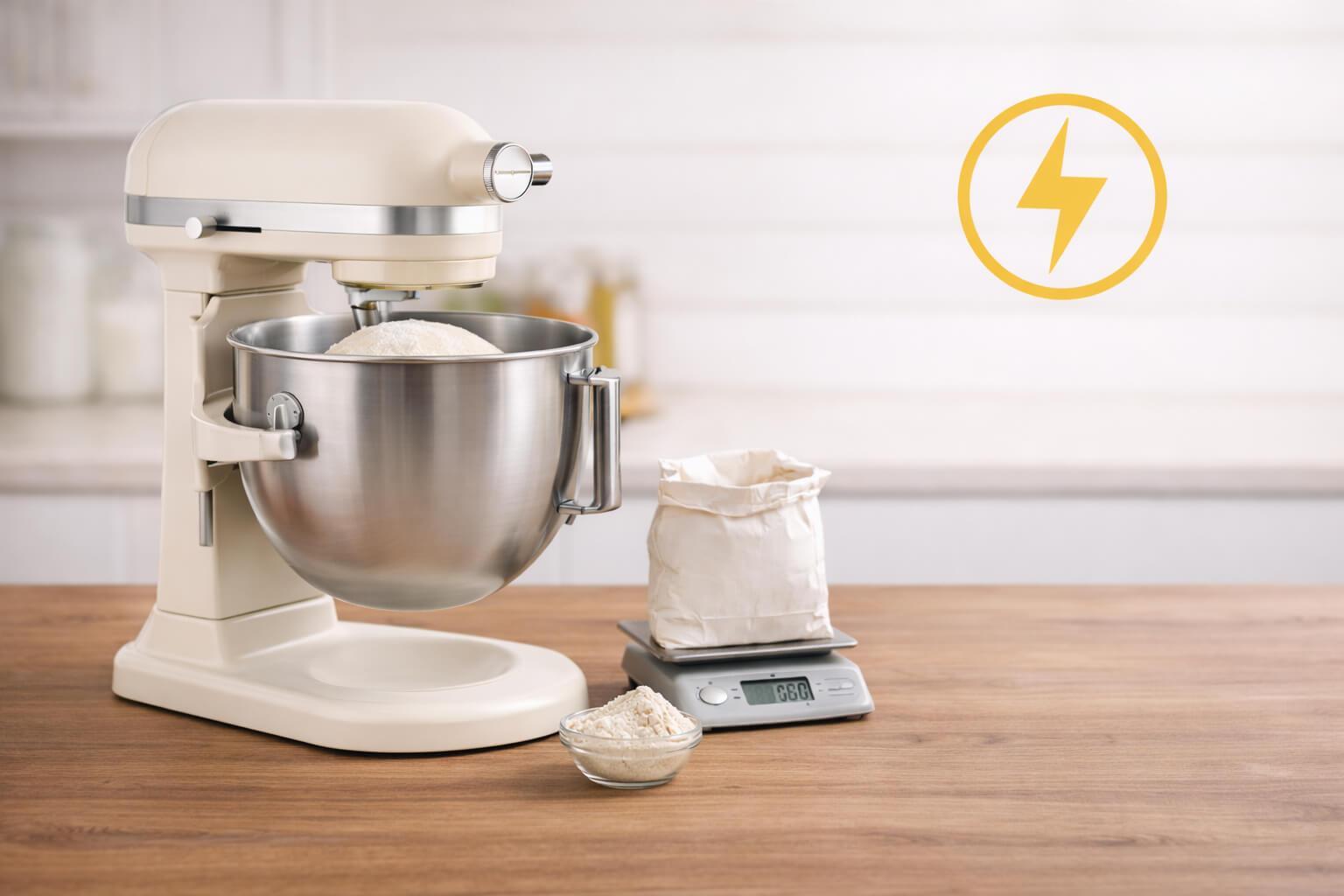
Torque is the twisting force that keeps the hook turning when the dough stiffens. For bread bakers, torque is important because dough resists the mixer as gluten develops.
Think of it like this: wattage tells you the size of the engine; stand mixer torque for bread dough tells you whether it keeps pulling when the dough turns heavy.
What torque helps with:
- Kneading bread dough without the mixer bogging down.
- Keeping the hook moving through stiffer dough as it tightens.
- Handling add-ins (nuts, dried fruit) without the mixer losing momentum.
Here’s a comprehensive breakdown of torque and AC and DC motors — AC vs DC Stand Mixers.
Heat Management + Long Kneads (What to Watch For)
If you’re doing long kneading sessions, pay attention to heat and behavior, especially given the “shut off /won’t turn on” stories that show up in some reviews.
What to watch for:
- Hot housing or a warm smell: That’s a signal to stop and rest the machine.
- Sudden shut-off: Unplug, let it cool, then retry (and document if it repeats for warranty).
- Speed choice: Keep dough kneading on low speeds; high speed increases strain and heat.
- Batch size: Don’t overload the bowl with dense dough, even if the bowl is large.
For long kneading sessions, build in breaks. It protects the motor and can improve dough texture.
Performance Checklist: What to Make First
Here are recipes that demonstrate how a mixer handles various mixing loads quickly.
- Cookie dough performance: thick chocolate chip cookie dough (watch for bogging, climbing, and bowl coverage).
- Whipped cream: small and medium batches (watch how quickly it aerates and whether it stays stable).
- Cake batter: creaming + adding eggs (watch for smoothness and whether you still need to scrape frequently).
- Pizza dough: a classic knead test for elastic dough that pushes back (watch motor strain and heat during the knead).
This guide compares powerful stand mixers for tough dough and large batches.
If you mainly bake bread, the big question isn’t “Can it knead once?” It’s “Can it knead well, repeatedly, without running hot or cutting out?” That’s where user review patterns, warranty, and good mixing habits come into play.
Mixing Action & Mixing Efficiency (Does It Mix Evenly ?)
Mixing efficiency affects two key aspects: coverage (does the beater reach the entire bowl?) and pickup (does it effectively pull ingredients off the sides and bottom?).
This KitchenAid uses planetary mixing action, wherein the attachment spins and travels around the bowl to cover a larger area.
When clearance is set correctly, ingredient incorporation is better. When it’s off, you scrape more.
Planetary Mixing
Planetary mixing action helps because the beater doesn’t stay in one spot. It sweeps around the bowl as it spins.
Where it performs well:
- Creaming butter and sugar for cookies and cakes
- Batters and frosting where you want even blending
- General mixing where dry ingredients need repeated contact with the beater
Where it can miss:
- Bottom-of-bowl pickup if the beater sits too high
- Thick mixtures that ride up the sides and need a scrape-down
- Small batches in a large bowl, where a small amount can sit below the beater path
Double Flex Edge Beater (Does It Really Scrape the Bowl Better
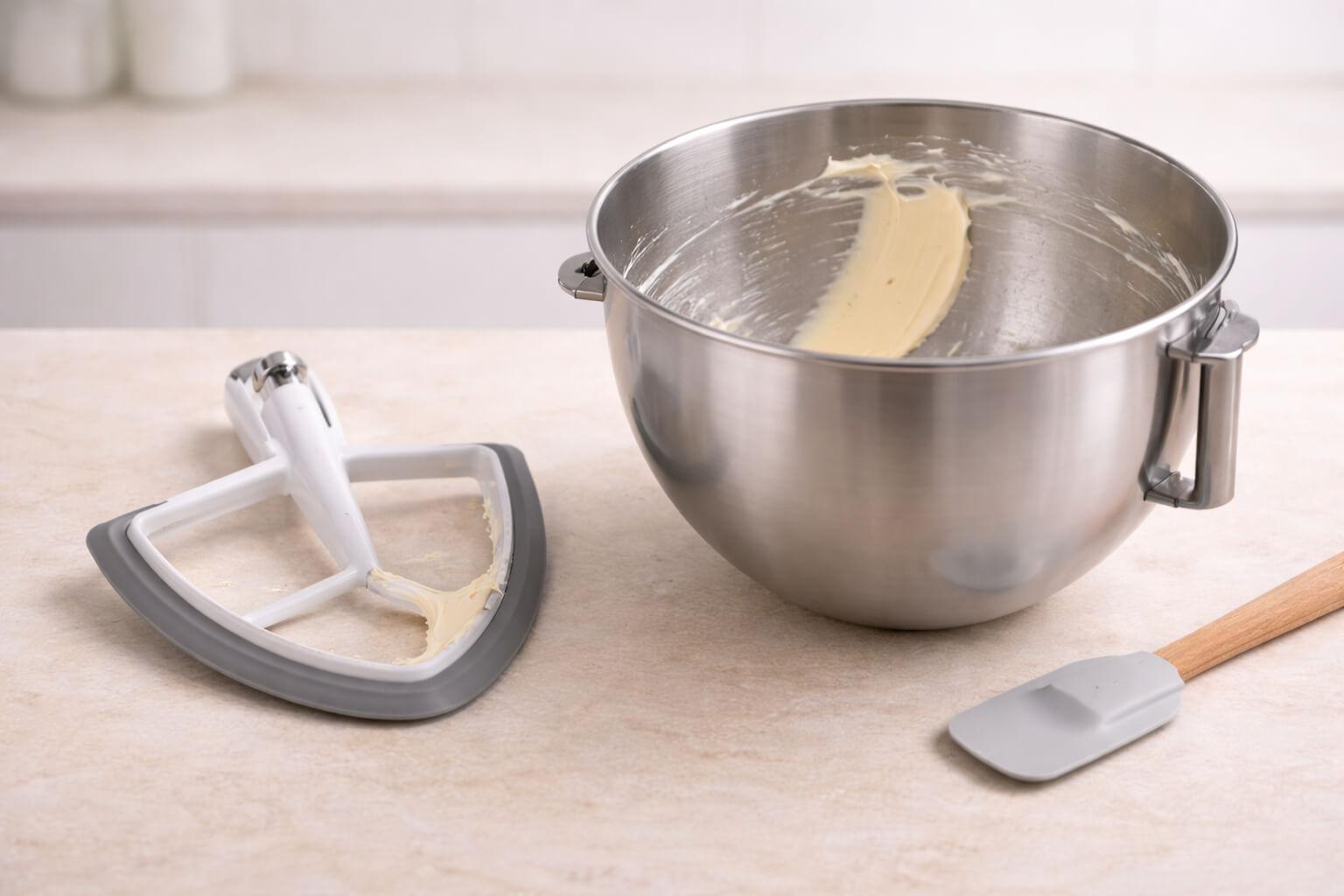
The double flex edge beater is designed to scrape while it mixes. The flexible edges drag along the bowl wall to pull ingredients back into the center, which can reduce stop-and-scrape pauses.
You know how frustrating it can be when you’re sure the batter is done, lift the beater and find a ring of dry flour pasted to the side or a butter-and-sugar layer sticking to the bottom of the bowl.
It’s not dramatic, but it’s annoying: you scrape, restart, scrape again, and your “quick” batch of cookies turns into a stop-and-go job.
Where flex edge beater scraping helps most:
- Cookie dough and thick batters that cling to the bowl
- Frosting and buttercream where streaks show up fast
- Quick mixes where you want smoother incorporation with fewer pauses
Where it still won’t replace scraping:
- Very stiff mixes that stick low and heavy
- Small amounts that don’t reach the beater path
- Dry pockets at the bottom when clearance isn’t set correctly
Beater-to-Bowl Clearance (The “Dime Test”)
If the beater sits too high, mixing suffers. That’s why people use the KitchenAid dime test. It checks whether the beater is close enough to move ingredients at the bottom of the bowl.
Clearance problems look like this:
- Ingredients not mixing at bottom (flour stays dry, butter sits untouched)
- Batter rides up the sides while the bottom stays thin and unmixed
- You scrape, restart, and still find pockets
How to fix it:
- Run the dime test (the beater should nudge the dime; it shouldn’t grind).
- Use the beater height adjustment screw if the beater doesn’t reach low enough.
Some owners report they can’t lower the beater enough to pass the dime test, and the result is predictable: more scraping and more hand-mixing to pull ingredients off the bottom, especially with smaller batches in a 7-quart bowl.
This is how to adjust your KitchenAid stand mixer (dime test explained).
Next up: speed settings.
11 Speeds + ½ Speed (What Speeds Should You Use?)
This KitchenAid 11-speed model has more low-end control, including ½ speed. Use it to start clean, reduce flour blowouts, and handle delicate add-ins without beating the air out of your mixture.
If you want a task-by-task cheat sheet, see my full guide on KitchenAid stand mixer speeds.
What Is the ½ Speed on the KitchenAid 7-Quart Mixer Used For?
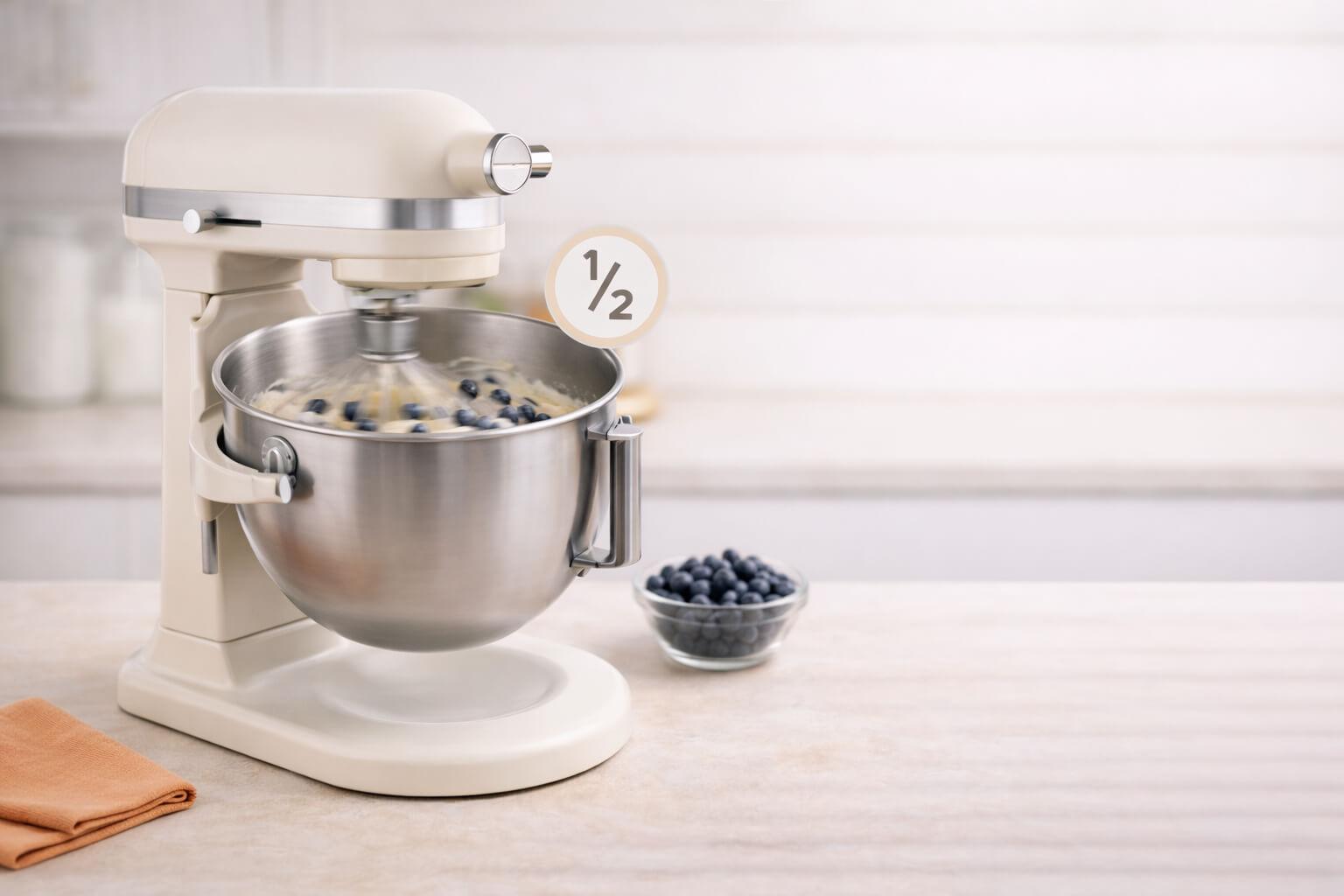
What is 1/2 speed KitchenAid for? Think “gentle fold,” not “mix.”
Use ½ speed folding for:
- Folding egg whites into batter
- Folding blueberries and other soft add-ins
- Starting with flour or powdered sugar before moving up
Skip ½ speed for dough kneading and thick cookie dough.
Best Speeds for Common Tasks
Light tasks
- Speed for creaming butter and sugar: start low, then move to medium
- Speed for whipped cream: start low, then go medium to medium-high
- Fold-ins: ½ speed or the lowest speed
Heavy tasks
- Speed for bread dough: low knead speeds only
- Thick cookie dough: low to medium; stop and scrape instead of cranking it up
Speed Control & Usability
A mixer’s speed control should feel smooth and predictable, especially on low.
- No sudden jump when starting with a loaded bowl
- Steady low speed without surging
- Easy step-ups from low to medium without overshooting
Simple habit: start low, let ingredients combine, then step up gradually.
Next up: how many batches of cookies, dough, and bread can a 7-quart bowl handle?
KitchenAid 7-quart Stand Mixer Review of Bowl Capacity & Batch Sizes
This is a big bowl stand mixer. It earns its counter space when you:
- bake for groups
- double recipes often
- want headroom for flour, cocoa, and powdered sugar without a mess
It’s not subtle: the bowl is large, the mixer is heavy, and it’s easier to leave it parked on the counter.
Batch Guide: Cookies, Bread, Frosting, Potatoes (Realistic Expectations)
KitchenAid 7-Quart Bowl-Lift — Batch Guide (Realistic Expectations)
| Task | Listing Claim | Realistic Takeaway |
|---|---|---|
| Cookies | Up to 13 dozen | Softer doughs go further. Thick dough hits the mixer harder—scale down if it strains or climbs. |
| Bread dough | Up to 8.5 lb | Stiff dough reaches the limit faster than wet dough. Stay under max for smoother kneading. |
| Frosting / buttercream | — | 7 quarts shines here: big batches, less splatter, fewer pauses. |
| Mashed potatoes | Up to 7.5 lb | Built for crowd-sized mashing in one go. Expect one quick scrape-down. |
Small-Batch Performance
Big bowls don’t love tiny jobs. Here’s what that looks like:
- Whipping small amounts: Whipping small amounts of cream can take longer because the whisk may not catch a shallow pool right away.
- 1 loaf dough: Usually fine, but small stiff dough can spin around instead of kneading cleanly.
- 1 cake: Works well, but if the beater sits high you’ll still find dry flour at the bottom and need to scrape.
If you mostly bake small batches, a smaller bowl will be more convenient. If you often ramp up for holidays or big bakes, 7 quarts gives you the extra room you’ll use.
Next up: what you get in the box—and which accessories you’ll use most.
What Comes in the Box With the KSM70?
The KSM70 accessories add real value. It covers the basics and adds a few extras that make baking easier with less scraping and less mess.
Included Tools
Here’s what’s commonly listed in the box:
- 7-qt stainless steel bowl
- Pouring shield (helps control flour and sugar when you add ingredients) — handy if you bake big batches and don’t want a mess; this is the pouring shield KitchenAid 7 quart shoppers look for
- 11-wire whip (for whipping cream, egg whites, and lighter mixtures) — the 11-wire whip is a nice upgrade for volume and aeration
- Coated dough hook (for kneading) — this coated dough hook is for bread and pizza dough at low speeds
- Coated flat beater (standard mixing for cookies, cakes, mashed potatoes)
- Double flex edge beater (scrapes the bowl while mixing, so you stop less)
If you bake often, the pouring shield + flex-edge combo is a win. It doesn’t replace scraping in every recipe, but it can cut down the stop-and-start.
Coated vs Stainless Attachments (What Users Report)
This set includes several coated attachments. Some owners report coated beater flaking over time or after rough handling/cleaning. Nobody wants those chips in food.
What to watch:
- Inspect coatings when you unbox: look for chips, rough spots, or thin edges
- Avoid harsh abrasion: metal scouring pads and aggressive scraping can damage coatings
- Follow cleaning guidance: if the listing says not dishwasher-safe,follow it.
If you prefer to avoid the coating worry, consider switching to stainless attachments KitchenAid offers (sold separately). They cost more, but hold up better long-term, especially if you bake frequently.
Next, let’s look at optional attachments, what fits, and what’s worth buying.
Attachments Compatibility: Do KitchenAid Pasta or Grinder Attachments Fit?
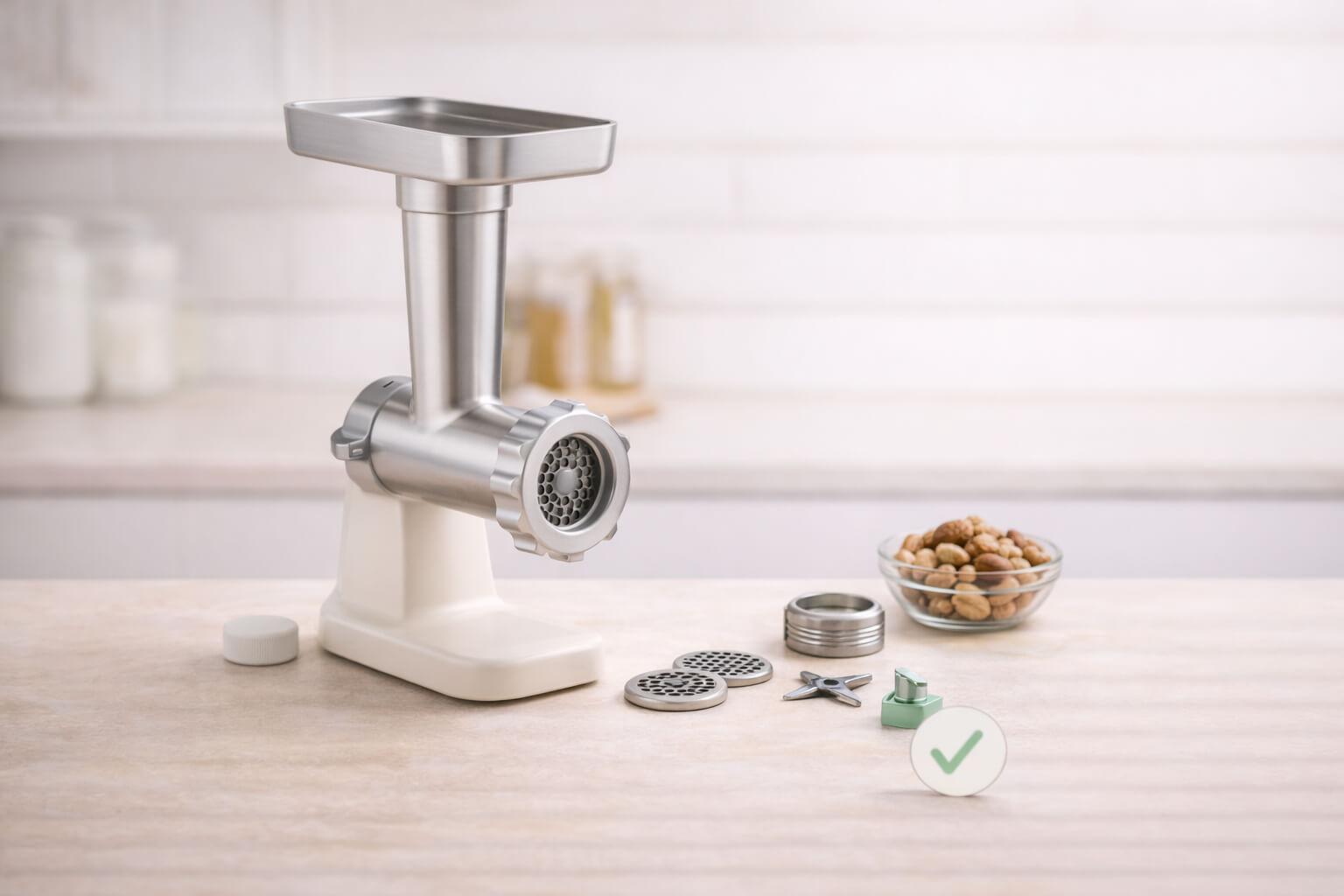
Yes, this mixer has a front KitchenAid attachment hub that drives add-ons like a pasta roller attachment and a meat grinder attachment. It turns this mixer into a multi-tasker.
If the attachment is made for the KitchenAid hub system, it will mount and run on bowl-lift models like this, but always confirm compatibility on the attachment’s product page before you buy.
If pasta is on your list, see my full guide to the KitchenAid attachments for pasta to compare the roller, cutters, and what’s worth buying first.
Or, see current prices for KitchenAid’s pasta roller or pasta press.
Attachment Hub Basics
The KitchenAid hub is the front power port. You remove the cover, insert the attachment, tighten the knob, and the mixer motor powers it.
Common stand mixer attachments people use with the hub:
- Pasta roller attachment (rolling sheets, then cutting noodles with companion cutters)
- Meat grinder attachment (grinding meat, making fillings; often used with sausage tubes)
- Slicer/shredder style attachments (for cheese and vegetables)
Compatibility Notes
Hub attachments are one thing; bowls and beaters are another.
- Bowls + beaters are model-specific. This is a 7-quart bowl-lift, and owners often point out that the whip or flex beater is larger than standard and not interchangeable with smaller models. When shopping spares or upgrades, look for compatible bowls or /beaters for KSM70 / 7-qt bowl-lift, not “KitchenAid universal.”
- Pouring shield fit depends on the bowl rim and size. Your included shield should fit the included 7-qt bowl. If you buy another bowl later (different size or material), don’t assume the same shield will fit. Verify it.
Quick buying rule:
- Pasta/grinder-style hub attachments: Check the attachment listing for “fits KitchenAid stand mixer hub” and confirm bowl-lift models are included.
- Bowls/beaters/pouring shields: Match the part to KSM70 / 7-quart bowl-lift specifically—don’t buy “universal” KitchenAid parts.
Go here for KitchenAid attachment fit guarantee (universal power hub).
Let’s move to what owners say the KitchenAid 7-quart sounds like in real kitchens, especially under load.
Is the KitchenAid 7-Quart Bowl-Lift Mixer Loud?
The KitchenAid 7-quart noise level depends on speed and what you’re mixing. Expect moderate noise at low speeds and noticeable noise at high speeds.
Sound by Speed (Low vs High) + Vibration
At low speeds (stir/low):
- Quieter, more controlled sound
- Best choice for dough and flour-heavy mixing
- Less movement on the counter
At higher speeds:
- It can get loud at high speed, especially when whipping or running near the top settings
- Noise rises fast because the motor and gears are working harder and faster
Vibration and “walking”:
- Dense dough can cause vibration when kneading if the batch is heavy or the counter surface is slick.
- Some owners mention slight “walking” at higher speeds, especially with thick mixes. If that happens:
- Knead dough at low speeds
- Make sure the bowl is locked in place
- Use a stable, grippy surface (no wobble, no lightweight cart)
A good rule: if the mixer gets louder as you increase speed, that’s normal. If you hear grinding, rattling, or sudden changes in sound, stop and check the setup and load.
Coming next: cleaning and maintenance, plus what to know about repairs and replacement parts.
Cleaning, Maintenance & Repairs: Are Parts Easy to Replace?
Keep your stand mixer running longer with these basics:
Cleaning Workflow (What’s Easy vs Annoying)
What’s easy:
- Bowl and basic accessories are easy to detach, making daily cleanup quick.
- A simple wipe-down of the body keeps it looking new.
What’s annoying (not a dealbreaker):
- Wire whip: Lots of crevices, so washing it takes more time.
- Beater shaft and bowl cradle area. Batter paste can cling here. May need a quick wipe after thick doughs or frosting.
Fast cleaning routine (2–3 minutes):
- Unplug → remove bowl and attachment.
- Wash bowl/attachments → air-dry.
- Wipe the beater shaft and any splatter spots with a damp cloth.
- Dry and you’re done.
Maintenance Care Tips for Longevity
Stand mixer maintenance is not complicated if you observe these habits:
- Don’t overload. If the motor sounds strained, reduce batch size or slow down.
- Use the right speed for dough. Low speeds for kneading equals less stress and less heat.
- Keep vents clear: Dust or flour buildup can trap heat.
- Check beater-to-bowl clearance occasionally if you notice scraping or ingredients not incorporating well.
Greasing and long-term care:
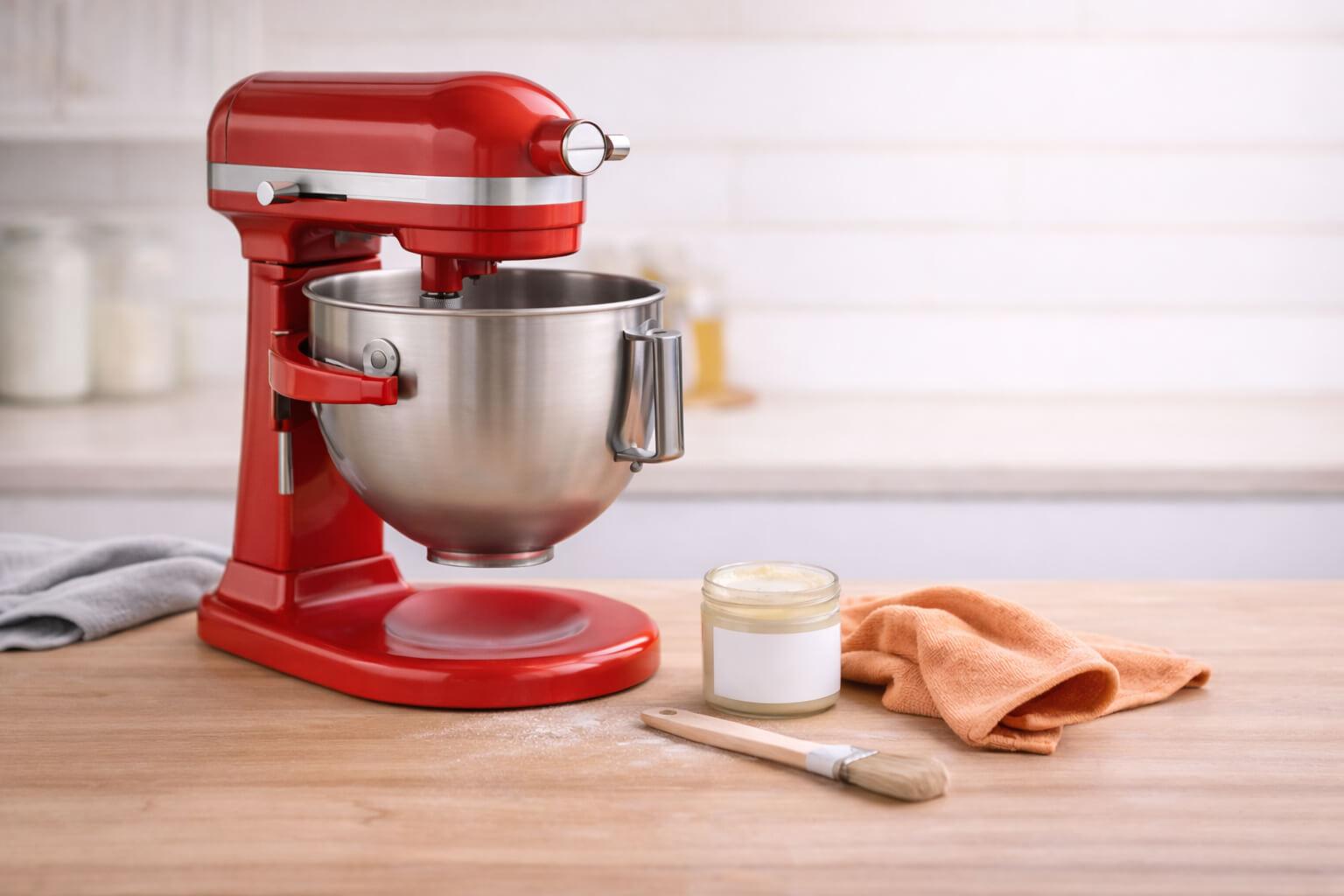
Stand mixers use internal gear grease. Over years (or after long storage), you may notice oil or grease seepage or leak. That’s usually a “service maintenance” issue, not an immediate failure.
Parts Availability and Repair Options
Easy to replace (owner-friendly):
- Bowls, beaters, whips, dough hooks, pouring shields, some exterior pieces are widely available and are typically a straightforward swap.
Not as easy (usually service-level):
- Internal gears, seals, gaskets, motor-related issues, power, and speed control faults.
Best practice before buying any part:
Double-check your model number before ordering parts.
When the symptoms are confusing, KitchenAid Mixer Troubleshooting helps you pinpoint the likely cause.
If it looks like an internal repair, use the KitchenAid Repair finder to locate the right service help.
Now that we’ve covered the practical stuff, let’s see what owners say after living with this KitchenAid mixer.
What Do Real Owners Say?
Across KitchenAid 7 quart stand mixer reviews, the same themes pop up: people love the muscle and stability, then nitpick a few recurring pain points.
Most Common Praises
Is it great for bread? Yes, owners often praise it for handling heavier doughs more reliably than smaller tilt-heads.
Does the 7-quart capacity actually matter? For big batches, absolutely. The roomy bowl is a big reason people upgrade. It tackles more dough, more batter, fewer “don’t overflow” worries.
Are the speed options useful or just marketing? Owners like having more control, especially the gentle 1/2 speed for folding and the broader spread of speeds overall.
Most Common Complaints
Shut-offs during kneading (“it stopped working”): A common complaint is the mixer shutting off when it gets hot, especially during heavier dough work. KitchenAid notes the mixer may shut off and need about 30 minutes to cool before restarting.
Beater not reaching the bottom (poor incorporation): Some owners report the beater seems too high out of the box (ingredients sticking at the bottom). KitchenAid’s fix is adjusting beater-to-bowl clearance (the bowl-lift “dime test” guidance).
Coating wear or chipping on coated beaters: Another repeat issue: coated beaters chipping or wearing over time (or, in some reports, sooner than expected). If this bothers you, many owners prefer switching to stainless steel accessories for peace of mind.
Seller/fulfillment headaches (arrived broken, missing or cracked accessory, returns): Some negative reviews are less about performance and more about arrival condition (broken on arrival, cracked guards) or buying through a marketplace seller. Quick tip: inspect immediately and keep packaging until you’re sure everything’s right.
What this means for you: If you want a sturdy, high-capacity workhorse (especially for bread), the praise is consistent, but double-check beater clearance, expect possible heat shut-offs with heavy kneading, and buy from a seller with an easy return policy.
Let’s turn the user feedback into a pros and cons checklist.
Pros & Cons
Price, Warranty & Value: Is the KitchenAid 7-Quart Stand Mixer Worth It?
Worth it usually boils down to: will you actually use the extra power and capacity, or will it sit there like a very expensive countertop statue?
Price Reality
What’s the “normal” price?
Most major retailers list the KitchenAid 7-quart bowl-lift around the mid-$600 range (commonly $649.95).
Why do prices vary so much?
- Bundle differences: some versions include more accessories (you’ll see bundles with 5 included accessories vs upgraded sets with 7 included accessories).
- Sales cycles: big markdowns tend to show up around major retail events (Prime Day-type promos and Black Friday/Cyber Monday-style promos).
- Third-party sellers: sometimes cheaper, but higher risk of arriving damaged, missing parts, or return hassle, especially with heavy appliances.
Amazon vs KitchenAid (quick reality check):
- KitchenAid direct can be great when they’re running promos, plus you may get perks like free delivery and free returns (KitchenAid has shown a 60-day free return policy on the product page).
- Amazon/marketplaces can be cheaper or faster, but your best move is to buy new, verify who it’s sold and shipped by, and keep your proof of purchase.
If you’re buying online, compare prices from reputable sellers and confirm the return and refund policy so you’re covered if anything arrives damaged or defective.
Warranty Basics and What to Do If It Stops Working
What warranty comes with it?
KitchenAid stand mixers typically include at least a 1-year limited warranty (some 7-quart variants may have longer coverage depending on the exact model/region).
Return/Refund windows (this matters in the first weeks):
If it’s brand-new and something feels “off,” returns are often faster than warranty service—but the window depends on where you bought it:
- KitchenAid.com (US countertop appliances): returns within 60 days from shipment (return shipping is free except parts/accessories).
- Amazon: most items can be returned within 30 days of delivery (can vary by item/seller).
What to do if it stops working (quick checklist):
- Unplug it and stop testing it repeatedly.
- If you’re still diagnosing symptoms, start here: KitchenAid Mixer Troubleshooting.
- If you’re inside your return window, contact the retailer/seller first (often the easiest path).
- If it’s beyond the return period or is clearly an internal issue, use the KitchenAid Repair Finder to locate authorized service.
Keep your proof of purchase handy; it’s commonly required for warranty claims
Alternatives & Comparisons
Use the table below for the quick spec to find out“who should buy what” version, especially now that the 6-qt bowl-lift is harder to find in many lineup.
KitchenAid Bowl-Lift vs Tilt-Head vs Commercial — Quick Comparison
| Feature | 7-Qt Bowl-Lift (KSM70) | 5.5-Qt Bowl-Lift (KSM55) | Artisan Tilt-Head (KSM150) | Commercial 8-Qt (KSM8990) |
|---|---|---|---|---|
| Bowl size | 7 qt | 5.5 qt | 5 qt | 8 qt |
| Motor type | AC | AC | AC | DC (high-efficiency) |
| Motor rating | 500W | 500W | 325W | 500W / 1.3 HP |
| Design | Bowl-lift (3-point lock) | Bowl-lift (3-point lock) | Tilt-head | Bowl-lift (commercial) |
| Speeds | 11 speeds incl. 1/2 speed | 11 speeds incl. 1/2 speed | 10 speeds | 10-speed commercial slide |
| Best for | Bread + big batches | Everyday big batches | Everyday baking + convenience | Max capacity + long/heavy runs |
KitchenAid 7-Qt vs 6-Qt Bowl-Lift
If you’re shopping the 6-qt, think of it as a “middle” size that’s often limited/leftover stock now.
- Choose the 7-qt if you bake bread often, do double batches, or hate feeling like the bowl is “too full.” More headroom is less stress.
- Choose the 5.5-qt bowl-lift if you want bowl-lift stability, but your batches are more “everyday big” than “feed-a-crowd.”
- If you find a 6-qt at a great price from a reputable seller, it can still be a solid buy; it just shouldn’t be the only plan.
7-Qt Bowl-Lift vs Artisan Tilt-Head
This one’s simple:
- Pick the 7-qt bowl-lift if your weekly rotation includes bread dough, thick cookie dough, or frequent big batches, and you want a mixer that’s stable during mixing.
- Pick the Artisan tilt-head if you mostly bake cakes/cookies/frosting and value convenience: quick access for scraping, adding ingredients, and swapping attachments.
When an 8-Qt Makes More Sense
An 8-qt only makes sense if you’re regularly baking at max volume or running long, heavy mixes (think: big dough loads, frequent bulk baking, small business use).
If you’re not routinely pushing capacity, the 8-qt can be too much: bigger footprint and expense for power you won’t fully use.
See this post for a complete lineup and comparison of KitchenAid stand mixers.
So, where does all that land? Let’s find out next.
Should You Buy the KitchenAid KSM70?
If you bake big, bake often, or make bread regularly, this is the kind of mixer that feels like an upgrade every single week. If you’re mostly an “everyday batch” baker, it can be more mixer (and more money) than you need.
1-Minute Decision — Should You Buy the KitchenAid KSM70?
| Step | Ask Yourself | If YES | If NO |
|---|---|---|---|
| 1 | Do you knead bread dough (or thick dough) weekly or often? | Go KSM70 (workhorse choice). | Consider Artisan tilt-head or 5.5-qt bowl-lift. |
| 2 | Do you regularly make double batches or bake for a crowd? | KSM70’s 7-qt bowl earns its keep. | A smaller bowl size will feel easier day-to-day. |
| 3 | Do you value stability over convenience access? | Bowl-lift feel = steady, planted mixing. | Tilt-head may fit your workflow better. |
| 4 | Will you leave it on the counter most of the time? | Great—its size/weight won’t annoy you. | Heavy to move; consider a lighter model. |
| 5 | Are you okay with minor “owner stuff” (clearance check, smart kneading breaks)? | You’ll likely love it long-term. | Choose a simpler “everyday” model. |
Best For / Skip If (One-Minute Decision)
Best for (buy it if you):
- Make bread dough often (or any thick, heavy dough)
- Regularly do double batches (cookies, brownies, buttercream, holiday baking)
- Want a stable bowl-lift feel that stays planted while mixing
- Plan to keep it long-term and value parts/service support
Skip if (consider something else if you):
- Mostly bake small-to-medium batches and rarely knead dough
- Want a lighter, more compact mixer you’ll move around
- Prefer tilt-head convenience for constant scraping/add-ins
- Need “quiet” (it’s normal stand-mixer loud at higher speeds)
- Don’t want any fuss, like possible beater clearance tuning or occasional overheat shut-offs on heavy kneading
For the right baker, the KSM70 is a “buy once, use for years” mixer: big capacity, steady bowl-lift mixing, and the power that makes bread and big batches feel easier.
But, if you bake mostly small-to-medium amounts and you care more about convenience and footprint than dough strength, you’ll get better value from a smaller bowl-lift or an Artisan tilt-head.
Bigger Batches, Fewer Headaches
If you came into this KitchenAid 7-quart bowl-lift stand mixer review feeling stuck because your mixer struggles through thick dough, your bowl is too cramped for double batches, or flour puffs up the moment you hit “on’, you should have a much clearer picture now.
You’ve seen where the KSM70 shines, and most importantly, you know what to do if something isn’t right, so you’re not guessing under pressure.
And here’s what’s possible with the right mixer for your baking routine: dough pulls together without that strained, unhappy sound. The mixer doesn’t “walk.”
Add-ins go in without a flour cloud and cleanup is calmer. You finish with a mixture that’s properly mixed and has no stubborn dry pockets at the bottom.
So, whenever you’re ready, here’s your next step: decide whether you’re a big-batch / bread baker or an everyday batch baker, then choose the model that fits that reality.
If it’s the KSM70, check current pricing from a seller with a solid return policy, and give yourself the gift of a smoother baking rhythm from the very next batch.
Ready to Choose?
- Reduce risk with a strong return policy + warranty support.
- Get value fast from bigger batches and steadier kneading.
- Avoid upgrade regret by buying the right size once.
If the KSM70 matches how you bake, it’s a confident buy.