
Notice: I receive compensation if you buy something through affiliate links on this post. This does not change the price you would pay. As an Amazon Associate I earn from qualifying purchases.
You shape the loaf well. It proofs well.
Then the bake starts, and that first lift tells you whether the dough still has room to expand or whether it is about to set where it is.
That early-stage change affects how the loaf opens, how high it rises, and how the crumb forms inside.
Once you understand those first minutes of baking, you can connect the loaf to what happened in the oven.
The rise, score, and shape show what played out in that early stage.
Key Takeaways
- Oven spring is the loaf’s rapid early expansion in the oven.
- It happens before the crust fully sets.
- Heat, expanding gas, surface moisture, and dough strength all shape how much spring you get.
- Good oven spring affects loaf height, score opening, and crumb structure.
- Oven spring, bloom, and ear are related, but they are not the same thing.
What Is Oven Spring in Bread Baking?
Oven spring is the bread’s early lift in the oven before the crust sets.
This is different from proofing. By the time the loaf goes into the oven, it has already risen.
Oven spring is the extra lift you get from heat during that short window before the crust firms.
Oven spring definition
Oven spring is the stage when the loaf rises more, opens at the score, and gains height before the outside turns firm.
You can think of it as the dough’s last chance to expand. Once the crust sets, that movement slows down and then stops. Whatever height and shape the loaf gains by then becomes its baked form.
What oven spring looks like in a loaf
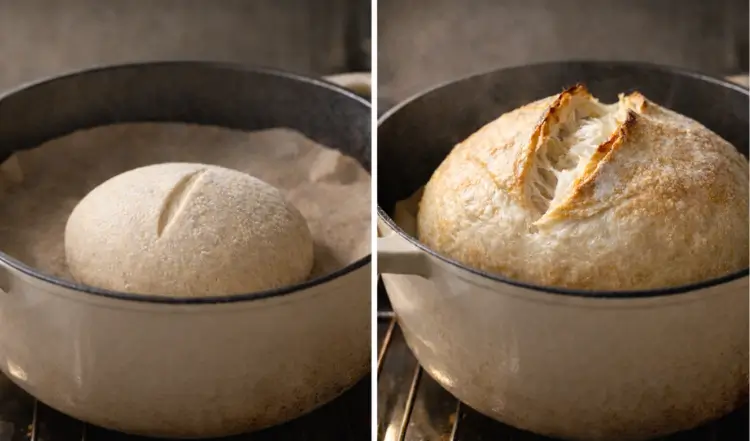
You can usually spot oven spring by how the loaf lifts and opens during the first part of baking. The bread looks fuller, taller, and more developed than it did when it first went in.
A loaf with clear oven spring often shows:
- more lift through the center
- a score that opens instead of staying narrow
- a fuller, rounder shape
- visible expansion before the crust firms
You often see it most clearly at the score line. The cut opens, the surface stretches, and the loaf rises before the crust turns firm and dry.
If your loaf did not rise, see the Bread Troubleshooting Hub to match what you saw to the right stage.
In a pan loaf, oven spring may be more evident as a higher crown and greater overall height. In a free-form loaf, you will usually notice it more in the bloom and final profile.
Why bakers pay attention to oven spring
Bakers pay attention to oven spring because it changes the finished loaf in ways you can see right away. It affects how much volume the bread gains in the oven, how the shape develops, and how much room the crumb has to open inside.
Good oven spring often contributes to:
- better loaf volume
- a fuller, taller shape
- more space for a lighter, more open crumb
- clearer opening at the score
A loaf that expands well in the oven often looks more balanced and better supported. A loaf with limited oven spring can still be good bread, but it usually bakes flatter, opens less at the score, and has less lift through the upper part of the loaf.
When Does Oven Spring Happen?
Oven spring is the brief period during baking when the loaf still has room to rise before the outer layer firms and holds its shape.
The early stage of baking, when the loaf expands fastest
The fastest expansion happens early. This is when you see the loaf lift, the score begin to open, and the shape grow fuller.
That lift does not continue at the same pace throughout the whole bake. The main rise occurs during the opening stage, when the dough is still flexible enough to expand.
Bakerpedia’s overview of the baking process maps oven spring to the first few minutes of baking and shows why that early window matters so much.
What changes as the dough moves from proofed to baked
As soon as the loaf enters the oven, the heat changes what’s inside it. The gases already in the dough expand, pressure builds, and the loaf pushes outward while the surface is still soft enough to stretch.
This is the window where the loaf can gain more height and open at the score. The dough is no longer just holding its proofed shape. It is reacting to heat and expanding into its baked form.
When oven spring stops
Oven spring stops when the crust firms and the structure sets enough to hold the loaf in place. At that point, the bread keeps baking, but the main expansion phase is over.
Your loaf may keep browning and drying at the surface, but it is no longer gaining meaningful lift. Its final shape has already been set.
If your loaf did not rise well, see Why Was My Oven Spring Weak?
How Oven Spring Happens
Oven spring happens because heat hits the loaf while it can still expand.
In that short window, gas inside the dough expands, fermentation continues briefly, the surface remains flexible a little longer, and the dough stretches before it sets.
Heat makes the gas inside the dough expand
Your dough already holds gas before it goes into the oven. Once the loaf heats up, that gas expands.
That expansion pushes outward on the dough and helps lift the loaf. Some of the rise you see in the oven comes from the gas already trapped inside, enlarging.
Fermentation activity continues briefly in the early oven stage
Yeast does not stop working the second your loaf enters the oven. For a short time, fermentation continues as the dough warms.
So, early oven rise is not only about the gas getting bigger. The dough is still producing a little more gas at the start of the bake before the heat shuts that down.
Bakerpedia notes that yeast activity continues into the early oven stage, which is why the start of baking is still so active
Steam and surface moisture delay crust setting
Steam and surface moisture help keep the loaf’s surface flexible for a little longer.
If the exterior sets too soon, expansion gets cut short. If it stays flexible for a while, the loaf has more room to lift and open at the score.
King Arthur Baking’s guide to baking with steam explains why a moist surface helps delay crust formation, allowing the loaf to keep expanding early in the bake.
Gluten has to stretch before the loaf sets
The dough needs enough structure to stretch without falling apart. That structure comes from gluten.
First, the dough stretches. Then the loaf sets.
If setting happens too soon, oven spring ends early. If the dough can stretch first, the loaf has more room to gain height and hold a fuller shape.
If you want a clearer sense of how much development your dough needs before baking, see how long to knead dough with a stand mixerfor visual signs to watch instead of relying on time alone.
Oven spring happens in a short sequence
The loaf enters a hot oven with gas already inside it. That gas expands as the dough heats. For a short time, fermentation activity also continues, which adds a little more pressure from within.
At the same time, surface moisture and steam help keep the outside flexible. That gives the dough time to stretch before the crust firms.
First, the loaf expands. Then the structure sets. That short sequence is what gives you oven spring.
Why Oven Spring Matters in Bread
Oven spring matters because it changes the loaf you pull from the oven. It affects height, shape, and how the crumb opens inside.
How oven spring affects loaf height and overall shape
Oven spring gives your loaf more lift before the crust sets. That can make it look taller, fuller, and more upright.
With less oven spring, the loaf is usually flatter and broader because it gained less height in that early stage.
How oven spring affects crumb structure
When your loaf has more room to expand in the oven, the inside has more room to open.
That does not mean every loaf should have a very open crumb. It means the bread had enough room to grow before the structure set.
With less oven spring, the crumb is often tighter.
If your loaf comes out low with a tighter crumb, this guide to dense bread walks through the signs of limited oven spring.
Why a strong oven spring is not just about making bread taller
More oven spring is not automatically better. What matters is how well that expansion is supported and directed.
A loaf can rise unevenly, tear where you did not want it to, or open poorly at the score.
What you want is not just more height. You want controlled expansion that helps the loaf bake into a balanced shape.
How Oven Spring Affects Bread Texture and Shape
Oven spring changes what you see on the outside and what you find when you slice. It affects your loaf’s final profile, how the score opens, and how much room the crumb has to expand.
What stronger oven spring often changes in the finished loaf
With a stronger oven spring, your loaf often bakes with:
- better height
- a more defined bloom
- a more open upper crumb
The loaf usually looks fuller and more upright because it had more lift before the crust set.
What limited oven spring often changes in the finished loaf
With limited oven spring, your loaf often shows the opposite pattern:
- a lower profile
- less dramatic score opening
- a denser feel through the upper loaf
That does not automatically mean the bread is bad. It means the loaf had less expansion in the early bake.
Why can the same dough bake with different oven spring
The same dough can bake with different oven spring because this stage depends on process conditions, not just the recipe.
Small changes in proofing, surface moisture, scoring, or oven heat can change how much room the loaf has to expand.
So even with the same dough, you may not get the same final height, bloom, or crumb every time. What happens in those first minutes still makes a visible difference.
What Supports Good Oven Spring?
Good oven spring starts with a loaf that still has room to rise and enough strength to hold that rise in the oven.
The goal is not just more rise. It is rising the dough can support and direct before the crust sets.
Proofing to the right level
The loaf needs to go into the oven with some room to expand. If it does, the oven stage can add height and open the score more clearly.
This is why proofing matters. You want a loaf that feels aerated and ready, but not overproofed.
If you want a clearer visual for whether a loaf still has expansion left, this guide to underproofed vs overproofed dough shows what different proofing stages look like before baking.
Dough strength and gluten development
The dough needs enough internal structure to expand without spreading too easily. That structure comes from gluten development.
If the dough has enough strength, it can stretch and still hold shape as it rises. That gives the loaf a better chance of rising rather than widening.
If your dough still feels sticky, loose, or hard to handle before baking, this sticky dough guide helps you distinguish normal stickiness from dough that lacks sufficient\
structure.
Shaping that creates support
Shaping helps organize the dough before baking. It creates support around the loaf and gives the expansion more direction.
Oven spring is not just about how much the loaf expands. It is also about where that expansion goes. Better support helps the loaf rise evenly.
Scoring that gives expansion a path
Scoring does not create oven spring.
What scoring does is give that expansion a path. It helps direct where the loaf opens, rather than forcing pressure to break out wherever it can.
King Arthur Baking’s scoring test is a good reference because it shows how scoring guides expansion instead of creating it.
Steam and oven environment
The loaf needs a short window during which the surface remains flexible. Steam helps with that by slowing how fast the crust firms.
That extra flexibility gives the dough more time to lift and open before the outside sets. Steam helps the loaf keep expanding a little longer at the start of the bake.
Oven heat and timing
Early-bake conditions matter most because oven spring occurs early.
The loaf needs enough heat to drive expansion during that short window.
That is why the start of the bake matters more than the later part. Once the structure sets, the chance for more lift is mostly over.
Oven Spring vs Bloom vs Ear
These terms are related but not the same. Describing them separately makes it easier to identify what you are seeing.
Oven spring is the loaf’s early expansion
Oven spring is the loaf’s early expansion in the oven before the crust sets. It refers to the overall lift the bread gets in the first part of baking.
Bloom is how the score opens during expansion
Bloom is how the score opens, as the loaf expands. It is a visible result of oven spring.
You see it at the cut. The score spreads and lifts as the loaf opens in the oven.
An ear is a scoring outcome
An ear is the raised flap of the crust along a score. It is a scoring result.
You can have oven spring without a strong ear. Oven spring is the larger process. The ear is one possible surface result.
If you want to go deeper on ears, King Arthur Baking’s ear guide shows how scoring angle changes how the crust lifts and peels back.
Oven spring, bloom, and ear are related, but not the same
Oven spring is the loaf’s early expansion in the oven. Bloom is how the score opens during that expansion.
An ear is the raised flap of crust that can form along the score. It is one possible scoring result, not another word for oven spring.
Why Some Breads Have More Oven Spring Than Others
Not all breads show oven spring the same way. Dough style, ingredients, shape, and baking setup all affect how that early expansion happens.
Lean hearth loaves vs enriched breads
Lean hearth loaves often show oven spring more clearly. Their final shape depends more on dough strength and early oven expansion, so you see it in the lift and in the opening of the score.
Enriched breads behave differently. Fat, sugar, eggs, and dairy change how the dough develops and bakes, so the rise often looks softer and less dramatic.
Pan loaves vs free-form loaves
Pan loaves rise with side support from the pan, so the expansion looks more contained and upward.
Free-form loaves have to hold themselves. That makes oven spring more visible in the profile, score, and bloom.
Sourdough vs commercial yeast breads
Sourdough and commercial yeast breads can both produce good oven spring, but they may not show it in the same way. Their timing and dough structure can differ, so the finished rise can look different, too.
This is not about one being better. It is about how the dough was built and fermented.
Hydration, flour strength, and dough style
Hydration and flour strength also shape the appearance of oven spring. Some doughs can stretch and still hold shape well. Others expand in a softer, less defined way.
That is why not all breads show the same kind of spring. Some rise higher and open more at the score. Others expand more quietly.
If you want to see how water level changes dough behavior, dough hydration breaks down how wetter and drier doughs behave and expand differently.
What Oven Spring Can and Cannot Tell You
Oven spring tells you something useful, but not everything.
It gives you a clear indication of how the loaf handled the first stage of baking. It does not give you the full story on its own.
What strong oven spring can suggest
A strong oven spring can suggest that the loaf still had good expansion potential when it went into the oven. It can also suggest that the dough had enough structure to lift without losing shape too early.
It may also point to a baking environment that gave the loaf time to expand before the crust firmed.
In other words, the dough had room to rise, support for that rise, and enough early flexibility to use it.
What weak oven spring does not automatically mean
Weak oven spring does not point to one single cause. A lower rise in the oven does not automatically tell you exactly what went wrong.
It only tells you that the loaf expanded less during that early stage. The reason for that can vary, so the result should not be treated as a single fixed diagnosis.
If your loaf baked low and spread outward, this post explains why bread spreads instead of rising covers the most likely reasons.
Why the whole loaf matters
Oven spring makes more sense when you judge it with the whole loaf, not by one detail. Height matters, but so do score opening, crust shape, and crumb.
A loaf may not rise dramatically, but still have a good crumb and balanced shape. Another loaf may lift more, but open unevenly or bake into a less controlled form.
You get a clearer picture when you look at the rise, the score, the crust, and the inside together.
What to Watch for Next Time You Bake
You now know what oven spring is, when it happens, and what supports it.
It helps you connect the baked loaf to what happened in the oven.
You can trace the rise, the score opening, and the crumb back to what unfolded in the first part of the baking process.
Next time you bake, watch that early stage more closely.
Look at how the loaf lifts, how the score opens, and what the crumb shows after slicing.